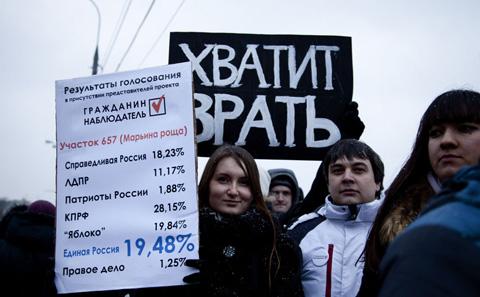
Chapter 7 Eastern Europe and Russia’s White Ribbon Movement
Central Moscow, December 10, 20111. Protesting election fraud[1]
We are born in independent Ukraine and we are used to freedom and desire of constant development. Liuba, 17, f, Ukraine
Contents: Eastern Europe, Russia
Communist countries replaced a philosophy of proletariat solidarity with materialism and nationalism led by a few patriarchs, Vladimir Putin in Russia and the Central Committee of the Chinese Communist Party. Both approaches inhibit youth activism for freedom of expression.
Eastern Europe
Srdja Popovic (age 25) led the Serbian group that evolved into CANVAS, which continues to advise young international changemakers. Otpor (“resistance”) learned revolutionary tactics from Gene Sharp’s books The Politics of Nonviolent Action (1973) and From Dictatorship to Democracy (1993) about non-violent resistance (available online along with Otpor guides).[2] Popovic was also inspired by Gandhi, Martin Luther King, Jr., Lech Walesa in Poland, and the Chilean movement against dictator Pinochet in another demonstration of global idea exchanges in action.[3] A postmodern revolution, Otpor worked to create a lifestyle, identity and brand, a feeling of being heroic and cool. Young men competed to see who could get arrested most often to become celebrity stars. To generate media coverage they used street theater and stunts that made the government look silly. Young Serbians applied images and slogans on stickers and T-shirts, banging pans from their apartments during the state radio news (a tactic used in Argentina and later in other youth-led demonstrations in Spain, Canada and Turkey). They placed women, grandparents and veterans in front of demonstrators so police would feel less threatened. Popovic explained that the essence of Sharp’s teaching was, “The pillars of the regime support it out of fear. The moment the fear factor disappears and people are fearless with the police and hugging the military, you have lost your main pillars” or resources.
Otpor was hired to apply the Serbian formula for regime change in Ukraine in 2004. An unnamed Otpor organizer explained, “We trained them in how to identify the key weaknesses in society and what people’s most pressing problems were—what might be a motivating factor for people, and above all young people, to go to the ballot box and in this way shape their own identity.” Social Movement Theory would say they identify weakness in the elite and citizen discontent as their main resources or assets, along with creating a desired identity as a cool activist.
WikiLeaks’s “Global Intelligence Files” revealed that Popovic and his wife had worked for Stratfor since 2007, a Texas global intelligence-gathering firm whose clients are large corporations and the US government.[4] Popovic said in his defense that all his briefing papers are public and that CANVAS doesn’t take money from governments.[5] CANVAS began to train opposition leaders in Venezuela in 2005: President Hugo Chávez called them the Coup D’Etat group. Popovic went to Texas to present Stratfor with a plan for how to unseat Venezuelan president Hugo Chavez in 2010 and forwarded emails he received from activists around the world to Stratfor. Otpor was assisted by the CIA funding in their work to oust Milosevic in Serbia. Otpor and other opposition groups were funded by US organizations including USAID, and NGOs that receive government funding including Freedom House, the National Endowment for Democracy and the International Republican Institute.
Popovic still leads CANVAS in Belgrade. It’s also called the Revolution Academy and stresses discipline and planning as it trains leaders from over 59 countries. Their books are available for free download.[6] CANVAS “advises groups of young people on how to take on some of the worst governments in the world–and in Georgia, Ukraine, Syria-occupied Lebanon, the Maldives, and now Egypt, those young people won.”[7] (A book describes the unemployment problem among young men in Georgia.[8]) It also trained activists in Spain, Morocco, Azerbaijan, Venezuela, Cuba, Zimbabwe, Syria, Iran, Vietnam, Tibet, and Bolivia. CANVAS prefers to work with students because they’re idealistic and energetic. Reporter Tina Rosenberg described recent CANVAS training with Burmese resistance leaders in her article cited in the previous endnote.
Within a week of the start of Occupy Wall St. in 2011, Otpor activists came to New York to assist Americans. CANVAS was also involved in the 2014 Kiev uprising when they handed out a pamphlet previously given to Egyptian activists and paid university students and unemployed Ukrainians to take the bus to Kiev to demonstrate.[9] Serbian journalist Ivana Mastilovic Jasnic accused CANVAS of being a “revolution consultancy” for the US.[10] (More on Eastern European uprisings on the book webpage.[11]) More on Serbia is found in After the Revolution: Youth, Democracy, and the Politics of Disappointment (2014) by Jessica Greenberg.
Austrian professor Florian Bieber pointed out that protests in Eastern Europe opposed the privatization of the commons such as in Gezi Park in Istanbul; Banja Luka, Bosnia; Tirana, Albania; Maribor, Slovenia, and the environmental degradation of the Roșia Montană mining project in Romania.[12] This activism contributed to the fall of the Slovenian government, the resignation of Bulgarian Prime Minister Boyko Borisov and the defeat of unpopular policies such as the Romanian health care bill. In 2013 Bosnians in Sarajevo blocked parliament over failure to act on providing citizen identification numbers and Bulgarian protests centered on high electricity prices and rejection of the appointment of a media mogul as security chief. An Open University was organized to discuss direct democracy.
A 15-year old Serbian boy, Vuk Visjnic succeeded in getting Zoja’s Law passed by parliament in 2015 to help children with rare diseases. Visjnic created an online petition and Facebook page and met with family groups. Unlike the Arab Spring, the Eastern European protests occurred in post-communist democracies with market economies. Over all, the social movements are “realigning the political space” with discussion of corruption and elite power. A film and book, Bastards of Utopia: Living Radical Politics after Socialism (2015) report on Serbian activists from the anti-globalization protests of the early 2000s to Occupy camps, along with After the Revolution.[13]
Ukraine’s Maidan or Euromaiden
Ukraine gained independence after the collapse of the USSR in 1991. Since that date, the US spent $5 billion in Ukraine to develop “a good form of government,” according to Victoria Nuland, Assistant Secretary of State.[14] George W. Bush’s administration spent $58 million to help Ukrainians foment a peaceful uprising against their dictator, although they complained his administration didn’t help sustain them.[15] Journalist Andre Vichek charged that EU spent over $1 billion to foment the Euromaidan uprising including paying demonstrators: “I’m afraid that the West is making the last push to actually destroy and overrun anything standing in its way that is semi-independent or different.”[16]
A problem is the Ukrainian GDP per capita is only about $6,000 a year, a third of Poland’s GDP. Few of the former Soviet Union states developed successful capitalist economies with the exception of Albania, Armenia, Belarus, and Estonia.[17] In the less successful economies, a “get what you can” attitude developed a culture of corruption, as in Ukraine, making it difficult for young people to get ahead. Ukraine is divided by dependence on Russia for its energy supply and nearly 30% of its trade and ties to Europe. Russian influence is strongest in the industrialized and Russian-speaking east, while the west is closer to Poland and the EU, less populated and more agrarian. The south is the only area with a majority of ethnic Russians. As in Russia, oligarchs took control of former state assets after the dissolution of the USSR and got involved in politics to protect their wealth.
Government efforts to cheat in the 2004 presidential elections led to the “Orange Revolution,” the color brand of the opposition. Tens of thousands of Ukrainians, many of them young, camped out in Independence Square for almost three weeks. They used tents and concerts similar to earlier protests in 1986, 1991, and 2000. The tent city occupied by protesters was a precursor for Tahrir Square and other occupations. About a quarter of the population engaged in protest. This movement is compared with Argentina’s protests of 2001 in MappingMass Mobilizations by Olga Onuch (2014.) The youth movement was advised by Serbia’s Otpor and Georgia’s Kmara, and young people from other former Soviet republics came to learn how to lead a “color revolution.” To head off similar movements in Russia, in 2005 the Kremlin created a youth group it controlled called Nashi. Some of the Ukrainian protesters were trained and funded by American NGOs and government agencies like USAID, as in Serbia and Georgia the previous year. Large protests and rebellion by the media against government control resulted in mediation by the EU and a new election.
The president after the revolution, Viktor Yuschenko carried out some democratic reforms but his rivalry with Prime Minister Yulia Timoshenko inhibited their ability to reverse economic problems after 2008. This led to a $16.5 billion loan from the IMF with all the usual austerity cuts. Their opponent in the Orange Revolution, Viktor Yanukovych won the 2010 presidential election, tilting Ukraine to the Russian side. He restricted media freedom and put rival politicians like Yulia Timoshenko in jail. He tried to impose unpopular neoliberal measures although public pressure prevented them from becoming law.
Large protests occurred in western Ukraine in 2013 against Putin’s pressure on the government to resist closer ties to Europe with a proposed treaty with the European Union. President Yanukovych rejected a trade deal with the EU at the last moment partly because it would end gas subsidies from Russia. Young people hoped that joining the EU would lead to revolution from abroad to end government corruption. The government was also negotiating a $15 billion loan from the IMF, with the usual strings attached in terms of austerity cuts. After learning that the president dropped the proposed EU agreement, a small group of protesters gathered on Independence Square on November 21, 2013, organized by students, journalists and other activists. November was the ninth anniversary of the Orange Revolution. As students read Facebook and Twitter posts with the hashtag #EuroMaidan, they joined the crowd that grew to 250,000 when opposition leaders coordinated a pro-EU march on November 24.
The main slogan was “Ukraine is Europe.”[18] Police assaulted the protesters camped out in the square on November 30; videos of the events went viral as usual, leading to discussion that the protests weren’t about the EU anymore, but about “saving Ukrainian democracy.” A group of protesters pulled down Kiev’s statue of Lenin and decapitated it. By December 2, more than a million Ukrainians participated in protests around the country.[19] Crowds of over 300,000 gathered in Maidan, Kiev’s central square in December 2013 in the largest protests since the 2004 Orange Revolution. As in other occupations of squares, they built shelters and provided entertainment as well as speeches and services like first aid stations, food stalls, and a church tent. They chanted “Glory to Ukraine” and “Peaceful Protest,” but the police charged them anyway, causing Secretary of State John Kerry to express his disgust. Opposition leader Vitali Klitschko told the crowd, “This is an island of freedom and we will defend it.”
An opposition leader with the nationalist Svoboda Party, Oleh Tyahnybok told the crowd, “It’s not just a simple revolution. It’s a revolution of dignity,” a familiar theme in the global uprisings. Protestors called for end of government corruption. At first police arrests incited larger crowds in multiple cities, as in all the other global uprisings, but growing violence led to reduced crowd size, with women dropping out faster than men. Organizers said in interviews that they struggled to control young male right-wing nationalist protesters who used violent tactics, walking around the square wearing hard hats, bats in hand, chanting nationalist slogans. By this time the crowd was more diverse, including people of various ages, Russian speakers and various party affiliations, according to interviews in the square documented in the previous endnote.
Inspired by the Occupy movement and its organizing methods with tents and masks, the large student movement tried to stay clear of political parties asking them not to display party symbols. As reporter Marina Lewycka said, “For the young people in the square, this whole game of political tit-for-tat is what they reject.”[20] (The endnote includes video documentaries.) These young people grew up in an independent Ukraine and see themselves as Europeans, while another group of protesters is aligned with political parties. However, they didn’t form assemblies in Independence Square as opposition parties took over organizing. An effort to form a liberal “Civic Council of Maidan” didn’t get off the ground and right-wing forces attacked some leftists who carried feminist slogans. Far-right groups joined the protests including Right Sector and Svoboda, critical of the EU for being too liberal. The Freedom Party and Right Sector organized militias that forced police from the streets of Kiev, without a unified left leadership. The EU and Western countries called for an end to violence after 82 people were killed in the protests.
A random survey of every sixth person in Midan from November 26, 2013, to January 10, 2014 (1304 people) reported that although the average protester was middle-aged, 35% were under age 24 and 18% were young professionals age 25 to 30, about half from Kiev.[21] These young people wanted democracy and freedom and blamed the older generations for allowing corruption. Men outnumbered women, 59% to 41%, and the average person had at least some university education. In-depth interviews with 50 demonstrators indicated 30% were center or left activists and 12% from radical right groups. Researcher Olga Onuch observed that smaller protests took place all over the country, but the largest were in Kiev with 800,000 demonstrators by December 1. Most of the demonstrators were motivated by joining acquaintances or family members to defend their rights from the corrupt government, the concept that framed the demonstrations. They shared ideas on “Live Journal,” the most popular blogging site. As in other uprisings, social media reached a large audience but was not as instrumental in bringing people to the streets as personal contacts, and radio and TV was the main source of information about the protests.
Denis, a member of the Autonomous Workers’ Union in Kiev, reported the protesters initially were mainly students and urban “middle classes,” and then over the three months became more “proletarian.”[22] However, the percent of workers was low and they didn’t think of themselves as a class. Denis used Marxist language to explain that the “intelligentsia and petty bourgeoisie were the main social forces supporting Ukrainian nationalism.” He said the collapse of the USSR was replaced by a mixture of nationalism and conservatism in Ukraine and other former republics like Poland, Hungary, and Romania.
Students held up banners in English stating, “Ukraine is part of Europe!” and “Back to Russia? Oh bitch, piss!” The common demand was for Yanukovych to resign, “Get out criminal! Death to the criminal!” He represented the eastern part of the country where people speak Russian, while demonstrators were more likely to speak Ukrainian and live in the western part of the country. The first three post-Soviet Ukrainian leaders wrote a press release stating that, “We express solidarity with the peaceful civil actions of hundreds of thousands of young Ukrainians.” The government sent a mass message to cell phones in use near the protests to intimidate them: “Dear subscriber, you are registered as a participant in a mass disturbance.”
I asked Max about the uprising; he’s a 28-year-old high school teacher in western Ukraine.
I support the initiatives of people in Kyiv Maydan. The vector of protests has been changed after the police violated the rights of people in Maydan. You won’t see many people there during the working days, but the number increasingly changes on weekends. It is a peaceful protest. But we have to be realistic; there are no legal backgrounds to overthrow the government now. [Parliament failed to pass a no-confidence vote to topple the government of President Yanukovych.] In my opinion these events will end up without any changes. The main problem is that the key opposition leader is imprisoned. [He suggested YouTube videos about the president’s corruption.[23]]
The videos Max recommends show many police on the streets and evidence of lavish presidential lifestyle. A more recent video shows the interior after the president fled in a helicopter to Russia in February 2014.[24] When I asked about on police presence, Max said Ukraine is a police state, not just in big cities where they have plain-clothes police, but in small towns too. The west is freer but in the east and south, “They are like North Korea, with access only to governmental TV channels as most of the independent media are blocked. The Internet helps, but propaganda is stronger coming from the authorities.” Anna, 18, one of his students, commented on corruption in her response to the book questionnaire:
I would prohibit bribes and try to decline the level of corruption in my country. I would improve the medical and educational systems by modernization and additional qualification improvement programs. I would decrease the number of unemployed people by rehabilitation of the old closed factories. I would do everything possible to make my country great and developed with European values, a healthy nation with high standards of living.
The government outlawed demonstrations in Kiev involving loudspeakers, tents, banners, and wearing helmets and masks on January 16, 2014. Protesters built barricades in the Maidan, by now a majority of young men with growing right-wing group influence. Everyone agreed that Yanukovych should resign. The crackdown only made the demonstrations more violent, which increased police violence, even kidnapping demonstrators. About 90 were killed, many of them under the age of 25, and about 600 injured in February. Protests spread to other western cities and even to eastern and southern Ukraine, and tents remained in Independence Square. Demonstrators lit firecrackers, beat rhythms on metal sheets, and burned tires as a circular barricade to keep police out. They fought with rocks, bats and firebombs. Women helped dig up paving stones and passed them down a line for fighters to throw at police, similar to Egypt’s rebels. Older women shouted at police, “Killers!” and “Shoot us, kill us, kill us, you bastards.” In negotiations with opposition leaders, Yanukovych promised to reshuffle his cabinet and release some jailed demonstrators. However, the crowd booed opposition leader Vitali Klitschko when he discussed compromising with the president, yelling “Shame!” and “Revolution!” They wanted the president out.
Two weeks later the president agreed to rescind anti-protest laws that outlawed masks, as demonstrators wore masks in defiance. But the government wouldn’t offer amnesty for jailed protesters unless demonstrators stopped their protests against Yanukovych. Protesters also wanted action to prevent election fraud. Thousands of anti-demonstrators tired of the protests rushed a Kiev barricade but retreated after meeting resistance.
Former President Leonid Kravchuk warned that Ukraine was gripped by revolution and on the verge of civil war. On February 18 Vladimir Putin criticized Western countries for backing the Arab Spring to advance their own economic interests, which he said resulting in the rise of religious extremism and backing a fascist coup in Ukraine.[25] Putin offered the Ukraine $2 billion in aid by purchasing Ukrainian bonds and the conflict escalated. Deaths and thousands of injuries escalated as snipers picked off protesters, killing100 people as fires lit up the night sky in Kiev, and a policeman was shot in the head. A protester explained that the difference between protests in 2004 and 2014 was the military didn’t support the current protests. President Obama warned the government not to step over the line and bring in the army while President Putin accused the protesters of being brown shirts, a reference to Nazi troops, and fascist bandits. He blamed the US for fomenting a coup in Ukraine and other critics viewed the struggle as “an energy pipeline squabble” between the US and Russia.[26]
When Yanukovych’s military protectors left him, as they did Ben Ali in Tunisia and Mubarak in Egypt, he boarded a helicopter for Russia on February 23. An activist reported as news spread that Yanukovych had left Kiev, “I have never seen so many people smiling. Everyone is overflowing with delight.” Ukrainians lined up to see his palace with its zoo, tennis court, swimming pool, car collection, and a huge mansion with gold bathroom fixtures. Parliament turned it into a public museum. In a speech given in Russian from Russia, Yanukovych said he was still the elected president and condemned the “bandit coup” that replaced him with a new head of parliament, Oleksandr Turchynov. He is a close ally of Timoshenko and her Fatherland Party, accused of appalling corruption.
The new Prime Minister, Arseniy Yatsenyuk said “welcome to hell’ because Ukraine was bankrupt, “on the brink of a disaster” after $70 billion left the country during Yanukovych’s presidency. Yatsenyuk was 39, a fluent English speaker and member of the Fatherland Party, and one of the new breed of young leaders in Italy, Greece and Spain. Nominees for the new cabinet were introduced to 50,000 people in the square and former Prime Minister Yulia Timoshenko, just released from prison, addressed them. She told the crowd, “You are heroes, you are the best thing in Ukraine! I was dreaming to feel the power that changed everything.” Rumors were that she wanted to be president.
Russia sent troops into Crimea with uniforms with no insignia but Russian license plates on their vehicles. They took over the airport and military bases and public buildings because it has a majority of ethnic Russians and a large Russian naval base. A young Russian woman told me that she didn’t know if Russian troops were in Ukraine because the news didn’t cover it. Russia’s Prime Minister Dmitry Medvedev condemned the new Ukrainian government as “Kalashnikov-touting people in black masks,” terrorists backed by the US. Russians also blamed the US for the 2004 Orange Revolution in Ukraine.
Putin got the highest public approval rating since he returned to the presidency in 2012, but said he would step down no later than 2024 in order to follow the constitution. He labeled the revolutionaries in Kiev fascist Nazis backed by the CIA and the EU and said any critics who tried to weaken Russia were like bacteria who sit inside you who would be crushed. Russian parliament member Nikolai Ryzhkov also blamed the West, saying, “They tore apart Yugoslavia, routed Egypt, Libya, Iraq and so on, and all this under the false guise of peaceful demonstrations. So we must be ready in case they will unleash the dogs on us.”[27] Another member of parliament said President Obama insulted the Russian people. This rhetoric led to discussion of a new cold war, complicated by the fact that about 40% of Europe’s natural gas is supplied by Russia, mostly through Ukraine. Despite a cease-fire in 2015 and economic sanctions against Russia, fighting between Ukrainian and separatists supported by Russia continued.
When asked if the revolution made a difference in his life, Max said:
The revolution gave a big push to the volunteer movement in Ukraine. On one side it taught people to be united in the times of trouble. It has taught me to be proud to be Ukrainian more than ever before. As for the other side, it is always the long-terms effects of each revolution that brought us nothing but a collapse of our economy. Prices have increased while my salary is worth less. Everything is organized in a way to destroy the middle class; now we only have poor and really poor, rich and really rich. The government decided to overcome this crisis on the people’s backs and all our oligarchs remained sacred.
And in three years after revolution we kept on asking for aid from the USA, EU and IMF. That’s disappointing. So, I have mixed feeling of being proud to being disappointed. Still I hope that someday “all our enemies will fall as the dew on the Sun” [from the national anthem] and we will have a strong country with content, rich people and happy children.
As for Russians, these people are unpredictable. They say they won’t go farther at noon, but during the night their troops come up closer and closer. I don’t trust Russians and never did.
Russian speakers in the east who want to break away from Kiev seized a dozen cities’ government buildings, formed two “people’s republics,” and held a referendum for autonomy similar to the vote in Crimea that led to Russian annexation. Some workers formed vigilante groups to oppose them and took over positions in several locations. Max reported on the conflict with Russia in September 3, 2014, when I asked him about news reports of a civil war in Ukraine:
Russians were in the East from the very beginning. During my vacation in Carpathians I met a woman from Donetska region. She was very irate with uninvited Russians. They have destroyed her home and she moved to the Western part of Ukraine. There is no civil war in Ukraine. We have people from Luhanska region in my site. The attitude to those people is pretty much the same as to anyone else. Nobody violates their rights and no one cares about their language, which is Russian. So, it is open Russian aggression towards Ukraine. That woman I met in Carpathians told me that there were many people from her region involved in that conflict as so called “rebels,” are drug and alcohol addicted. She also said that 5 people out of 10 will be pro-Ukrainian, 3 neutral and 2 pro-Russian. And answering the question about the presence of Russian troops, not a single person can deny their presence.
Presidential elections were held on May 25, 2014, with few votes for the neo-fascist parties Right Sector and Svoboda much derided by Russian leaders. Petro Poroshenko was elected as a pro-western president, called the “chocolate king” because of his ownership of chocolate factories, one of Ukraine’s richest men. In second place was another wealthy oligarch, former Prime Minister Yulia Tymoshenko. Six months after the encampment began in Kiev, several hundred protesters remained in the camp, suspicious of the government. They planned to stay until reforms were implemented.[28] Although a cease-fire was signed by separatists and the government in September 2014, almost 2,600 people died in ongoing fighting from mid-April to August with about 36 people killed each day, over 10,000 were wounded, and over 190,000 people fled their homes, according to a UN report.[29] The underfunded and corrupt Ukrainian army is crowdfunded on a Facebook campaign called Help the Army of Ukraine led by Anna Sandalova.[30] When she delivers supplies she also kisses unmarried soldiers. The most reliable news is found on the Facebook site “Information Resistance.”
When I was in Moscow when it was part of the USSR I became friends with Andrei, who later married a Swedish reporter and moved to Stockholm. I asked him to critique this section.
I´ve got a feeling that you manage to collect everything which is critical to Russia and Putin. I start with Crimea: I have a friend who before the event in Crimea wanted to buy a summer house there, he went to Crimea, came back and told me that he was amazed that the government in Kiev did absolutely nothing in Crimea during 20 years of independence!! Most, most of the people living there including Tatars preferred to be a part of Russia, they speak Russian, only Russian mass media was popular there and which is more important they think Russian, after 20 years!!!
Gayle, you know very well that I am not Stalinist, not conservative and not against West, but I want to ask one thing: Why it is forbidden to watch Russian TV in the free Ukraine, but you can watch Ukrainian TV in not very free Russia? You should not think that I approve of everything, but it was disgusting to watch high-level apparatchik from the Department of State in downtown Kiev distributing rolls to demonstrators. That does not mean that I support the former president, but if the new leaders are so good they should face the reality. Western mass media is very much one- sided. It is high time to understand that Russia has its own interests.
I asked Max for an update on Ukraine in 2015 when he commented on increase in prices but not salaries, explaining, “Our currency is undervalued for more than 60% due to the mediocre work of the national bank. Everything has been organized in a way to destroy the middle class in the society, now we only have poor and really poor, rich and really rich. Women may feel especially burdened as seen in the joke that kids are raised by a same-sex couple, their mothers and grandmothers.
President Poroshenko admitted in 2015 that a new $17.5 billion loan from the IMF would not help ordinary people, just pay foreign creditors and fund the military to fight the civil war.[31] IMF austerity demands included raising the price of gas in a time when the economy is shrinking, corruption is widespread, and the population is aging, similar to Russia but much worse. Many people expected corrupt officials would siphon off much of the IMF loan. The author of Killing the Host: How Financial Parasites and Debt Bondage Destroy the Global Economy (2015), economist Michael Hudsonargues that selling off public properties to repay IMF debts devastates the people and makes the situation worse—“finance is war.”
Ukraine is another example of how uprisings fought in the name of democracy can lead to destabilization and suffering: After 16 months of fighting, over 6,000 people were killed in the civil war.[32] Corruption continued, along with fighting that killed more than 9,000 people in the eastern industrial area, and a shattered economy, although President Poroshenko declared a crackdown on the oligarchs.[33] Separatists formed the Donetsk People’s Republic that continued to fight Ukrainian soldiers who charge that Russians continued to send military equipment such as tanks.[34] These problems led Prime Minister Arseniy Yatsenyuk to resign in April 2016. Olena Litvishko of the Ukrainian Initiative for Peaceful Protest reported the revolution inspired people with the energy for change but they lack the instruments for change, such as representative political parties.[35] I talked with a Russian-speaking Ukrainian in June 2016 who said nothing has changed since the uprising, that the old guard still dominates parliament. He said communism isn’t relevant to youth; his 16-year-old son doesn’t know who Lenin is and his 21-year-old daughter has visited Europe many times, rather than Russia.
Russia
I visited Russia before the fall of communism when Moscow was drab and dour. People on the streets didn’t smile and when I visited my Russian friend Andrei he told me not to speak English so his neighbors wouldn’t report him to the secret police. After I returned home, the police told him not to correspond with me and jeans I mailed to him didn’t make it to him, as I found out years later after he moved to Sweden and found me on Facebook. Apartments were small and crowded. Women spent a lot of time waiting in line to buy food. To buy something in a drug store, I waited in one line to order, in another line to pay, and another line to pick it up. Clerks used an abacus to add up sales, as some still do today. However, modernization means fewer jobs with one person doing the job that four used to do. Consumer goods were in short supply, including birth control, so abortion was the main form of family planning. Soldiers checked under our train seats and used mirrors to look under the train when I left for Berlin, looking for people who might try to escape from Russia, so much has changed in terms of freedom to travels.
The Dissolution of the USSR
After the USSR dissolved in 1991, Russia went through a decade of turmoil. The documentary Red Army about the Soviet hockey team and the fictional Leviathan show the transition from the USSR to Russia (both 2014).[36]Leviathan won prizes in the West for best foreign film, but its portrayal of corruption and vodka consumption in a small town was seen in Russia as another attempt to attack Russia and the Orthodox Church. The film tells the story of a mechanic whose home is taken over by a bishop and drunken mayor who has a portrait of Putin above his desk.
President Boris Yeltsin privatized many industries in the early 1990s, leading to the rise of nouveau riche businessmen called the oligarchs, as portrayed in Generation P.The popular independent Russian film is based on a bestselling novel, released in 2011 with 40,000 followers on its Facebook page. It takes place in the 1990s when Yeltsin was president. With few women characters, Generation P refers to the “Big Boys,” the oligarchs who control Russia behind the scenes with Mafia-like shootings. A character says, “Communism is out. The only idea left is money.” Another man reveals the resentment towards the US, which he feels hates Russians. He complains about the fact Russians watch US films, ride in their cars, use English words, smoke their cigarettes, and even eat their food (Pepsi and McDonalds), as they continue to do. Saying Russia is a great country, the character wants to reclaim “the Russian spirit” and national pride, just what Putin offered later as he expanded his control of Russia in the name of national pride, spending $50 billion on the 2014 Winter Olympics in Sochi and taking over Crimea, with troops on the Ukraine’s eastern border.
Generation P’s hero is Babylen Tatarsky, who works in advertising. He gets involved in rigged elections and advertising so false he helps create a virtual politician shown on mass media who looks like Putin and gets elected president. Tatarsky feels lost; illustrating hybrid global culture, he turns to a Ouija board for guidance where he channels Che Guevara, uses a mantra given to him by a Buddhist friend, tries cocaine and LSD, drinks vodka, and prays to God. In the end of the film, virtual duplicates of the fake politician increased his presence and power. Writer and director Victor Ginzburg explained, “I was interested in seeing the border between real and virtual in Babylen’s world gradually disappear, ultimately bringing the viewer to a place I hope they will recognize as the world we all live in today” (similar to the US Matrix films about virtual reality). Putin portrays Russia under his leadership standing up to American-led bullying and injustice from the corrupt West in what a Russian journalist calls “an imaginary, media-concocted universe. My countrymen have gone passive.”[37]
The economy collapsed in 1998, but increases in oil and natural gas revenues strengthened the economy and government, enabling Vladimir Putin to be in charge since 2000. The GDP grew and unemployment was only 2.8% in Moscow in 2011, and the state controls 55% of the economy. Putin elevated his friends to be billionaires in crony capitalism, replacing the oligarchs who acquired fortunes under Boris Yeltsin in the 1990s and taking over control of media. Putin said the Internet is a “CIA project.” He also said the fall of the USSR was the major political disaster of the century and a poll by the Levada Center, only 28% felt positive about the breakup of the USSR.[38] The poll was conducted in 2016 when Russians were spending more than half their incomes on food. Nobel Prize winner Svetlana Alexievich reported on how Russians feel after the breakup of the USSR in Secondhand Time: The Last of the Soviets (2016).
Maria, 31, a Russian woman who started school after the breakup of the USSR, describes generational differences in an email from Moscow:
I can say some words about three generations–my parents, me and my nieces and nephews. The education in the Soviet Union was very important; it was the only way to become a successful person. The discipline was strict but the knowledge you got at school was great. For example, my mum speaks German well even now after 50 years later. There were a lot of different workshops at school (art, science and sport). My grandparents had a high status at work, therefore had a lot of benefits – the best clinics, sanatoriums, they even bought food without queues in special shops. It is important to note that they were not in the party (which sounds strange even for Russians, but they just worked hard).
My generation is the most unlucky. I was at school just after the Soviet Union fell. Those were the worst years for my family and for thousands of families in Russia. Money instantly depreciated. My dad (with two higher education degrees) worked in a furniture factory in the nights after his day job, my mom worked as a cleaner after working all day in the publishing house. One winter she fell and broke 10 eggs and it was almost a tragedy. A lot of people got rich those years but not my honest and principled parents. We got humanitarian aid from other countries and we were offended by this. So you see, maybe the fall of the Soviet Union was a long-awaited holiday for some people but not for ordinary families such as mine.
In the 90s all the school workshops were closed. And we saw that education is not the way to become somebody. In those years, the most popular profession was to be a bandit. They were the heroes! But the level of education was still rather high because of inertia.
And now times have changed. My nieces and nephews study in a different cities (Moscow, Voronezh, Nizhniy Novgorod) and I see how different it is. They have a lot of very interesting programs, different workshops, and they go to sport and art academies. In general, the situation has changed. Moscow is the same as other European capitals, i.e. Paris or Berlin. But in the provinces the life is still difficult. My mother-in-law still lives in a house with wood heating (in the country, 1000 km from Moscow). But after living 20 years in the North she can get a flat in any city she wants so we are waiting!
A Russian urban youth trend that emerged at the end of the 1990s is desire to be glamorous in reaction to Soviet drabness and post-Soviet bleakness: “Russian glamour has become the cultural equivalent of unchallenged globalized capitalism.”[39] A Russian scholar wrote that interest in “mass glamour signals the desire for social change, but this longing has been redirected into the sphere of consumption.”[40] Urban women read books and go to workshops to learn how to be fashionable and use their sexuality to marry a rich man, in “the fine art of manipulating men.”[41] Some middle class people spend much of their income to buy imitation fashion brands worn by wealthy celebrities. They read magazines and novels found in bookstores under the category “Glamorous Paperbacks.” Women’s magazines like Gloss provide this type of instruction, as do Russian editions of Glamour and Cosmopolitan, which are mostly advertisements like the English editions. (More on this topic in Brave Chapter 11.)
The Current Situation
The transition from communism to capitalism was difficult with the loss of government services and social security for many. A Pew Research Center survey found that two decades after the dissolution of the Soviet Union in 1991, Russians, Ukrainians and Lithuanians were unhappy with the outcome, disillusioned with democracy and capitalism, believing that the wealthy prosper while the average person suffers.[42] A 2013 Credit Suisse report revealed that 35% of Russian household wealth is owned by only 110 people, although only 32% of Russians prefer a democracy to a strong leader and only 42% favor free market capitalism.[43] Young people and well-educated urban adults are more likely to support the multiparty system and free market, while older Russians are nostalgic for the USSR.
Sveta, 34, describes the current situation in Moscow in an email, compared to life in the USSR:
Currently we are living in a different country. On the one hand, the service level (shops, transport, tourism and so on) has become better. We practically don’t have queues in the shops. Besides that Russian people can buy anything and travel anywhere if they have enough money for that. We have more possibilities to choose our own way of life – where to live, study, rest and what book to read and what film to watch and so on. On the other hand, the level of education and economy on the whole has fallen. Most people are too poor and disabled to have an adequate style of life. Only those that make a good salary in the major cities live comfortably.
Most villagers are poor. The retirees and other unprotected sectors of society (large families, persons living alone, disabled persons) present a sizeable part of the poor population in our country. Russia is a country for young, healthy and ambitious people. In the Soviet Union there were much better social programs to protect different social groups. For example, in the USSR an unmarried mother could bring up her child by getting child benefits until the child was 18-years-old. These benefits were enough to buy good food, clothes and get medical care. Now it is impossible for single women to bring up the child using only government assistance. Women are required to get additional money from their boyfriend or relatives. Besides that, currently single mothers don’t have any government-sponsored privileges such as time off work and paid vacation time.
Sveta makes an important distinction between urban areas like Moscow and St. Petersburg and rural areas stuck in the past where roads aren’t passable in winter, wooden cottages are heated with a wood stove or expensive diesel fuel, vegetables come from the garden, clothes are washed in a river, and structures built during the Soviet are crumbling. A truck driver told a US reporter that the people at the top “have their own world. They don’t know what is going on here…in a stagnant swamp. Nothing is changing.”[44] Many children don’t go to school, renewing the tradition of child marriage. Young people with ambition leave villages to go the big cities, but the economic downturn in 2014 made jobs more difficult to find. Even in cities, a report by the Russian Union of Engineers found that 20% of dwellings lack hot water and 10% have no indoor plumbing. Soviet policies such as free higher education and health care are no longer affordable, resulting in budget cuts for teachers and other state employees and closures of health centers in rural areas.[45] However, Putin’s base of support is in rural areas where voters don’t see a viable alternative to his leadership and feel he restored national pride.
As well as an active Internet, big cities display luxury department stores, fashionable cafes, McDonald’s, and pay-as-you-go cell phones. Urban youth have access to smart phones and the Russian counterpart of Facebook that provides free access to most films, TV shows and songs. A young American tourist in Moscow, Hank Leukart discussed TV shows like Glee and House with his Russian friends. He blogs about his travels around the world, including Russia.[46]
Leukart met Pavel, a DJ who grew up in the early 1990s when the first McDonalds opened in Moscow resulting in long lines to try a big Mac. Pavel said they all listened to Michael Jackson and kids watched Sesame Street, but there wasn’t much food to eat. Misha, his wife, added, “every day was like a war” in the 1990s. People formed gangs and some became powerful, one of the reasons Russia is so corrupt. Bribes are part of university admission for some students and a bribe is a common way to get a drivers’ license without taking a test. Leukart commented to his friends about the lack of men at parties and was told by a woman named Vera, “They never come. Russian men are lazy and irresponsible.”
Despite the excellent and majestic marble subways, Moscow is home to four million cars. I wondered if things had changed since I visited the USSR and observed dour expressions on the street and much Vodka drinking. Many Russians scowl constantly Leukart reported and the kind women who befriended him consumed a lot of Vodka—twice as much alcohol as consumed in the US. A young woman named Olga told him, “Our country may have corruption problems, but you can’t buy friendship in Russia.” Maria, who lives in Moscow and studies English, emailed, “We never smile without a reason.” I paid attention today in the subway – nobody smiles, and, yes it looks unpleasant. But if you try to speak with someone, the situation changes at once. I think you can see that Russians are very smiley. Like me.”
Anne Garrels, who reported on Russia for decades and speaks Russian, told National Public Radio, “The issue is corruption, lack of trust in the authorities, lack of trust in the police, and that has to be dealt with because it is utterly corrosive.” A former Russian deputy prime minister, opposition leader Boris Nemtsov estimated that between $20 billion and $30 billion was spent on “embezzlement and kickbacks” in preparation for the 2014 Olympics. The most expensive Olympics, the government spent more than $50 billion but reporters complained about hotel rooms with undrinkable water and flushable toilets.[47] When asked why Putin allowed corruption, Nemtsov said, “Putin is part of a mafia; they do not turn in their own.” Just before he was assassinated in 2015 Nemtsov reported, “Three years ago we were an opposition. Now we are no more than dissidents. The task is to organize a real opposition again.”[48] He referred to Putin’s Ukraine policy as insane.
Soviet leader Nikita Khrushchev’s granddaughter, Nina Krushcheva, explained that Putin’s message is the West is out to get Russia with the NATO expansion. She observed, “Gorbachev collapsed the Soviet Union, and Putin is painstakingly putting it back together to have a greater country.”[49] She said that Russia is wrapped up in the past; “We almost don’t have a present.” Putin said in annual speech to the nation in December 2014 that although the West has pursued a policy of trying to restrain Russia for decades, if not centuries, he didn’t want to restore the Iron Curtain. He also said that the collapse of the USSR was a tragedy. I asked my Russian friend Andrei what motivates Putin, egoic love of power or nationalism. He said, “I honestly think that he is mainly motivated by love of Russia. Russia is not only Moscow, St. Petersburg and a few very big cities, but the countryside as well. Russians have become tired of constant humiliation. The only thing that I really do not like with Putin is that he is at the top for the very long time,” alternating between being Prime Minister or President.
CSUC Russian History Professor Kate Transchel’s driver asked her how much it cost in the US to keep a police officer from writing a traffic ticket, to get a business license, or ship something illegal abroad. She said bribery isn’t accepted in the US (although one can look at lobbyist gifts and campaign financing as bribes to legislators). The driver commented, “The US must be very inefficient.” A Russian democracy activist told BBC reporter Paul Mason, “There is no freedom to own property, to do business. There is so much corruption; people don’t work with any real professionalism or sincerity. There is a culture of learned helplessness. There’s is very little trust in society; people are naturally suspicious of each other’s motives.”
Fyodor Dostoyevsky said in the 19th century, “The most basic, most rudimentary spiritual need of the Russian people is the need for suffering, every-present and unquenchable, everywhere and in everything.” If you ask a Russian how are you, they’re likely to tell you’re their troubles, while an American will say “fine,” according to a Russian who lives in the US.[50] The rate of teenage suicides is three times the world average (an average of 1,500 a year) and failed attempts may result in being committed to a psychiatric hospital (only Kazakhstan and Belarus have higher suicide rates).[51] Girls are more likely to commit suicide than boys and suicides are likely to occur during exams and holidays. The major cause of suicide is family problems but few support centers exist.
Russia has a high rate of alcohol consumption and resulting health problems, including adolescent alcoholism. Andrei told me this joke, “75% of the Russian population are happy, 25% do not drink alcoholic beverages!” About half of all deaths of Russians ages 15 to 54 between 1990 and 2001 were caused in some way by alcohol.[52] Transchel told me that social gatherings often end with many of the guests passed out or vomiting: The tradition is to drink until you can’t drink anymore. She said it’s problematic if a guest doesn’t drink, including celebrations at work of an occasion like the boss’s birthday. A Russian language professor at CSUC, Julia Kobrina-Coolidge, modified Transchel’s observations; “I wouldn’t call it a tradition. Sometimes people, especially men, drink excessively. However, it doesn’t happen at every social gathering.” Recognizing this problem, in 2012 the government banned late-night alcohol sales, drinking in public places, alcohol advertisements, and added new taxes on alcohol.
Government Youth Organizations
In the Bolshevik era, youth were an important symbol of a vanguard for revolutionary change. Youth surfaced again in the last years of the USSR to express their dissatisfaction with the youth organization, the Komsomol. Its earliest form was in 1918 but the organization for Russians age 14 and older became uninspiring and staid. Gorbachev again used youth as a symbol for change in perestroika, but conservative authorities criticized youth for listening to western music or using computers, leading to generational tension. After the fall of the USSR, the criticism of the old system was multi-generational so that youth were no longer seen as the vanguard. The shift to a market economy saw reduced government spending on education and public welfare that made life difficult for many young people.
Around 15 years after the dissolution of the USSR youth led the Color Revolution in Eastern Europe that frightened Putin who became president of Russia in 2000. He also feared the influence of NGOs that received western funding. Therefore, pro-Putin youth organizations like Nashi (2005) or Young Guards (youth wing of Putin’s United Russia party) were organized to use “the energy of youth” to oppose western influence and protect Putin from enemies. In 2011 a new leader took over Nashi; Vvacheslav Volodin wanted to build a less divisive and more inclusive youth organization that provided youth with new skills. Around the same time, a youth opposition group called My! organized sarcastic protests with slogans like “Give us censorship” and “Putin our leader.” The most radical group was Vanguard of Red Youth. They put up a banner stating, “Putin, it’s time to leave” and invaded Nashi rallies with anti-Nashi banners. On the right, youth skinhead groups opposed immigrants.
Concerned about the youth-led “color revolutions” in Serbia (2000), Georgia (2003), and Ukraine (2004), Russia proactively created Nashi (Ours), youth organization in 2005, recruiting in the provinces. These nationalistic youth admired Putin for restoring Russian power. A young man living in Moscow, Ash emailed in 2016, “Our government takes the youth policy very seriously, so there is no room for any young organization that would be opposite to the officials.”
Vasily Yakemenko led Nashi, which mobilized more than 50,000 youth in a pro-Putin demonstration in Moscow on May 12, 2005. The Kremlin thought that the US was behind the color revolutions, telling Nashi youth that the Americans wanted to foment revolution. Nashi targeted liberals and fascists. Members were promised special favors in their career path, just as Komsomol did for youth who used it as a bridge to succeed in the Communist Party. Critics in the Solidarity opposition movement accused Nashi of being sexist and authoritarian, and called it “Putinjugend” after Hitler youth. Activist Ilya Yashin explained that if a young person wants a career, they have to be pro-Putin.[53] Yashin’s outspokenness resulted in thugs vandalizing his car, harassing him in public speeches and online, and attempting to trap him into having sex and using cocaine with a woman name Katya who would have videotaped the incident. Pro-Putin youth groups physically attacked anti-Putin journalists, breaking their fingers, and practiced breaking up tent occupations like those used in the color revolution occupations. Although the government controlled Nashi, Maya Atwal argued that some leaders became more autonomous.[54]
Former President Dmitri Medvedev distanced himself from Nashi due to scandals about its “dirty tricks” against opponents. At a rally they stomped on photos of human rights activists and opposition leaders. At their annual summer camp, they posted photo collages of decapitated opposition leaders or their heads superimposed on photos of prostitutes stuffing money in their underwear.[55] They learned to shoot guns and received other military training and were encouraged to have sex and have babies. In 2013 Nashi was renamed the All Russia Youth Forum and redirected to nonpolitical social projects such as fitness, consumer rights, and ending traffic violations. Putin’s United Russia party has its own youth wing.
A 2007 poll reported that 89% of young people didn’t want an Orange Revolution in Russia, as they approved of Putin’s efforts to return Russia to its former power. Macho photos showed Putin hunting shirtless, doing judo with a black belt, shooting a gun and scuba diving, although a young Russian woman told me she had never seen such photos.[56] In a 2007 meeting with German Chancellor Angela Mekel, knowing she is afraid of dogs, he called his black Lab into the room, enjoying her fear. A Russian speaker, she later told reporters, “I understand why he has to do this—to prove he’s a man. He’s afraid of his own weakness. Russia has nothing, no successful politics or economy. All they have is this.”[57] She understands Putin believes the West is decadent in its acceptance of homosexuality and women with beards—a reference to an Austrian drag queen who won the 2014 Eurovision singing contest. In 2016 posturing, Russian jets harassed US jets, such flying a barrel roll over a US jet over the Baltic Sea and passed over a destroyer in the Baltic.
A 28-year-old human rights activist explained that Putin is popular because his generation is “more conservative, more nationalistic, more Stalinist that the generation before it.”[58] Another activist, age 27, said people don’t trust or understand the human rights movement. However, young people demonstrated in Moscow and St. Petersburg when Duma legislators wanted to shut down a cartoon TV station called 2×2 because a religious group was offended by episodes of American TV shows South Park, The Simpsons and Family Guy. Protesters carried signs such as “Putin Kills Kenny,” a character in South Park. The young people won when the station was saved. Like their urban peers in the West, they love their smartphones and surf the Net daily where they can get uncensored news.
A recent survey of young people in 26 cities by sociologist Olga Kryshtanovskaya found “a complete collapse of norms and values” due to the dissolution of the social fabric after the fall of the Soviet system.[59] She reported, “Today’s youth believes that Russia has a glorious past and a bright future, but its present is miserable.” Because of prevailing corruption, they don’t anticipate being able to succeed by working honestly and they blame corrupt bureaucrats for this problem. Many would like to move away from their present area. They tend to look to Putin to solve the problem, not to opposition leaders, because he’s a strong “dragon.” A Carnegie report found that about one-fifth of young people view Stalin favorably. More than 90% don’t trust a political party to represent their interests and many would support “the complete destruction of the system.”
Only 25% of the young people surveyed by Kryshtanovskaya in December 2012 and February 2013 considered themselves liberals or democrats, while many would like to see a “nationalist, monarchist or anarchist party” in power. They younger ones were more likely to believe that Russia is a great power. Only one-fourth were interested in politics or understood government, and 90% don’t know a political party that expresses their interests. Young Russians are critical of both corrupt bureaucrats and the opposition leaders—40% think the opposition is weak, not following Alexei Navalny or others like him.[60] They are increasingly interested in volunteering, “becoming heroes themselves.” An American author of a parenting book who spoke with journalism students at a top Russian university reported that most of them wanted to work abroad. They told Pamela Druckerman that Russian mothers sacrifice for their children so they will care for them when they’re old, to prevent being put in an old-age home.[61]
The head of the Center for Youth Studies in Moscow, Elena Omelchenko observed that a large percent of the youth who support the government do so in hopes of getting a secure job and that there is no clear youth opposition movement. However, she reports, “Since November 2011 Russia has been living in a different climate. City squares, on the Internet, and on Twitter, have become real sites of battle between those showing solidarity for the system and those showing solidarity outside of the system.” She reported, “Young people’s brains are in a mess. Nationalist views coexist with liberal ideas, and homophobia is mixed with aspiration to freedom for all.” Omelchenko and two co-authors described the impact of western culture in Looking West? Cultural Globalization and Russian Youth Culture (2003).
On a positive note, Omelchenko reports youth are increasingly active in charity work, volunteering and environmentalism—similar to their global peers. An associated trend is “an extremely correct way of life, rejecting drugs, alcohol, and sexual promiscuity,” in favor of health measures like exercise. An odd mixture, some neo-Nazi youth follow these “straight edge” beliefs that originated with US punk musicians in the 1980s. Anne Garrels reported in Putin Country (2016) that teens aren’t activists for reasons familiar globally: their priority is doing well on their college entrance exams, chatting with their friends on VKontaite and blogs, playing online games like “Defense of the Ancients” and listening to Western and Russian music.[62]
Putin said that young Russians suffer from a moral vacuum left by the collapse of the Soviet Union in 1991 and they need better cultural education, meaning “they need to be raised with good artistic taste and the ability to understand and value the theatrical, dramatic and musical arts.”[63] This was in reaction to a school shooter in Moscow in February 2014, while a member of the Duma blamed violent American media. The “model student” 10th grade killer called his mother from the classroom after he shot the teacher and his father came to talk him into surrendering.
A horrifying documentary titled Hunted shows young Russians in groups like Occupy Pedophilia tracking down and beating up gay men and posting the violent videos, watched by tens of thousands.[64] This prejudice was heightened by 2013 legislation that prohibited discussing “non-traditional sexual relations” with minors, punished with fines. Attacks on GLBT people are a common method to restrict civil society, not confined to Russia. The nation as a whole struggles to shape a post-Soviet national identity with nationalism and a resurgent Russian Orthodox Church. Putin aimed to be the champion of traditional values, supporting the Orthodox Church, telling women to have three children, opposing homosexuality, censoring Internet use, even signing a law in 2014 mandating heavy fines for using profanity in the arts.
Pavel Durov (born in 1984), was called Russia’s Mark Zuckerberg and a cult figure because he founded the social media giant VKontakte (called VK) in 2006, inspired by Facebook. VK is the largest social network, followed by Odnoklassniki (“classmates”). When an 11-year-old boy named Stepan Saveliev was teased by schoolmates for being a loser for not having “likes” on his Vkontakte page, his mother asked people on Facebook to like Stephan’s page and thousands responded. He also appeared on various TV shows.
When Durov was in charge of his company, the government demanded that he delete the pages of opposition politicians in 2011, to which he responded by tweeting a picture of a dog wearing a hoodie with its tongue out. “I like to make fun of serious matters,” he said. Durov said the authorities also pressured him to remove content critical of Ukrainian policy.
Putin’s allies took control of the company and fired him as CEO, so Durov went into exile with a group of his engineers and his brilliant older brother in 2014, saying, “I consider myself a legal citizen of the world” without property anywhere.” He became what one writer called a global nomad and stays centered with yoga and meditation. He said he was looking for a place to settle that matched their values: “We like freedoms, strong judicial systems, small governments, free markets, neutrality and civil rights.” What he doesn’t like is “bureaucracy, police states, big governments, wars, socialism and excessive regulation.“[65] He said in a 2016 interview, “I believe in small governments or no governments. I think the majority of people want to have big government, a big brother taking care of them.”[66]
Urban youth rely on the Internet for information (i.e., www.slon.ru) rather than state-controlled TV propaganda. They grew up watching American cartoons like The Simpsons, and dream of democracy and a free press, according to German reporter Benjamin Bidder.[67] He quotes a 20-year-old law student who told him, “We no longer live under the heel of the Soviet Union, which imposed its positions on every citizen. Today, we have a free choice.” However, most Russians get their news from state-controlled TV.
Russian-speaker Gary Shteyngart watched the three main channels non-stop for a week in 2014, reporting they’re “indistinguishable in their love of homeland and Putin and their disdain for what they see as the floundering, morally corrupt and increasingly lady-bearded West.”[68] This is a reference to the Eurovision talent show won by a bearded drag queen named Conchita. Criticism continued with a Ukrainian song critical of Russia; a Tartar, Jamala won the Eurovision contest in 2016. Putin stated in his 2014 New Year’s address that “Love of homeland is one of the most powerful, elevating feelings,” but his TV speech was followed by American movies including Avatar and The Chronicles of Narnia. Shteyngart also reported a media trend similar to China’s of portraying unhappy unmarried women in a move to increase the birth rate.
Young Russians get their news from the Internet, scorning state TV as propaganda, but don’t protest if their favorite news sites are closed down. When asked about their heroes none listed an opposition leader, many didn’t have one, and others listed Joseph Stalin, Steve Jobs, Bill Gates and Gandhi—the only political reformer. When a foreign teacher asked them to discuss issues evoked in TED Talks, they said, “The government, which is wiser than us, will decide.” Students told her that although elections are rigged and the government controls mainstream media, Putin provides stability for their country. One issue young men do care about is avoiding the military draft, bribing doctors or draft board members to get out.
Education is problematic now because students are expected to pay fees and give “donations.” Garrels said in Putin Country, “Money is now the key to everything.” Schools only provide basics for free and don’t offer sports programs, after-school programs are fee based. With the ruble dropping in value, teacher pay averaged about $250 a month, requiring a second job such as many hours of tutoring. Good teachers are especially hard to find in villages where parents can’t pay for school fees. Universities used to be free but now departments have various quota systems for paid and scholarship students. Administrators may take bribes and pressure faculty to tolerate students who pay even if they fail or cheat. Faculty salaries are even lower than in secondary schools and even students graduating in fields like business aren’t getting jobs.
In the Russian Winter youth and adults protested together, as they did in the few demonstrations against Russian involvement in the Ukraine in 2011, and against election fraud in 2011 and 2012. Groups like My! dissolved as their members were no longer youths and new youth leaders didn’t come forth. Academic Felix Krawatzek concluded in his chapter on youth activism that with political stability under Putin, “youth mobilization disappeared again, from headlines and streets and rebels silenced.”[69]
Putin organized a new youth group called Network (Set); it’s website launched in April 2016. Unlike Nashi that appealed to working-class rural youth, Network is aimed at the urban middle-class who protested the rigged elections, although some of its leaders are former leaders of Nashi. The head of the St. Petersburg branch explained, “Network offers them an alternative agenda so that draft projects make it onto Putin’s desk.”[70] The group favors Orthodox Christian values, opposes homosexuality, and aims to protect Russian language from foreign influences. A Vice News video includes interviews with some of the members.[71]
Large Anti-Putin Demonstrations
Putin dismantled democratic elections and independent media that emerged under Soviet leader Mikhail Gorbachev’s glasnost (openness). Putin’s government intimidated critics and journalists and was suspected of ordering that some of them be killed or jailed. He perpetuated systemic corruption and bribes in business transactions. In the largest demonstrations since the fall of the Soviet Union, tens of thousands of protesters led by the usual young urban middle-class people took to the streets in 2011 after charges of ballot stuffing in the December 4 legislative elections. Activists posted many online videos of ballot rigging. They demanded annulment of the recent elections because of fraud by Putin’s United Russia party. In Moscow older secondary school students were required to stay in school until 6 PM to keep them off the street during demonstrations on December 3, and authorities instituted a mandatory Russian exam on December 9 during the time of the planned protest. On December 10 tens of thousands demonstrated in Bolotnaia Square. Putin’s press secretary called for protesters’ livers to be “smeared on the asphalt.”[72] Prior to 2011, protests were local and about narrower issues such as the environment or pension cuts, so the large “Snow Revolution” demonstrations took academics by surprise, similar to the Arab Spring uprisings.[73] Most of the organizers had previous experience with protests.[74]
Another large protest took place on December 24. A poll conducted by the Levada Center on that day found that one-quarter of the protesters were ages 18 to 24, 55% were between the ages of 18 and 39 and 81% had completed some university education.[75] Most (89%) learned of the demonstration from the Internet, mostly from blogs. There were furious about blatant cheating in the December election documented on YouTube. They chanted, “We are not cattle! We are the Russian people!” The regime posted a video on YouTube portraying the protesters as monster orcs from TheLord of the Rings movie trilogy, chanting “Russia without Putin” as they storm into a castle. Again we see the prevalence of western media applied as a global symbol system. Protesters also use YouTube to post satirical humor and music that generates millions of hits. The last Soviet leader, Mikhail Gorbachev commented on radio, “I’m happy that I have lived to see the people waking up. This raises big hopes.” But after Putin’s third presidential election, as predicted, parliament passed repressive bills meant to stifle opposition, along with arrests and searches of activists’ homes.
Led by middle-class protesters, they blamed President Putin’s corrupt United Russia party. Demonstrators chanted “We exist!” and “We are the Power!” Some students demonstrated with tape on their mouths to signify their votes being silenced. Others wore stickers reading “For fair elections” with a picture of Putin crossed out, just as Otpor used a similar image in the Serbian revolution overthrowing Slobodan Milosevic’s regime in 2000. Putin told a summer youth camp that political progress would be slow and evolutionary, not revolutionary. He blamed Secretary of State Hillary Clinton for “setting the tone for some opposition activists.”[76]
President Dmitry Medvedev responded on Facebook that he had ordered an investigation into election fraud, but within hours his post elicited thousands of mostly negative and skeptical comments such as “shame!” and “you’re pathetic.”[77] A doctor wrote, “Leave now, and don’t wait for the Tahrir Spring. It is going to happen, I promise you.” In his final address to parliament at the end of December, Medvedev told them, “We should learn to respect public opinion and not force our decisions on the public.”
The demonstrations took place in around 90 cities, as shown in photos, despite efforts to silence organizing on Twitter.[78] Putin responded sarcastically that the white ribbons worn by demonstrators to demonstrate for fair elections were condoms and that they were paid agents of the West, but as large demonstrations continued he offered reforms to enable more political competition in elections and protesters added condoms to their ribbons. “Mother Mary, drive Putin away” and “Virgin Mary, Mother of God, become a feminist.” Russian Pussy Riot punk band song during 20-second flash takeover of a Moscow cathedral in 2012, punished by two years in a labor camp.
Protests occurred again on February 4 and May 6, 2012. On the eve of Putin’s third inauguration as president, tens of thousands protested in a second Million Man March, carrying banners advocating “Start the Pussy Riot” (a reference to the fearless punk feminist band) and chanting “Russia without Putin.” Ironically, the 12,000 police who monitored the march wore their ceremonial white uniforms, the color symbolizing the protest. A student, 22, was arrested for throwing “an unidentified yellow object of spherical shape” at riot police. He said it was a lemon. Hundreds demonstrated outside the court, including the two freed members of Pussy Riot and famous blogger and opposition leader Alexei Navalny. Police arrested about 50 of the protesters plus dozens more who demonstrated near the Kremlin. Seven of the accused were convicted of rioting on May 6, 2012. The eighth defendant, a 20-year-old woman, got a suspended sentence.
Shortly before presidential elections in March 2012, the anti-Kremlin protesters formed a human chain along the Big White Circle, Moscow’s ring highway. People waved unfurled rolls of paper towels and wore white to identify their brand. Demonstrators were handed joke “tickets” to get on police buses set aside for arrested demonstrators. Other large demonstrations continued in the fall of 2014, with the Pussy Riot punk band’s symbol of colorful balaclavas painted on large balloons carried in the marches. A government film titled The Anatomy of Protest claimed that protesters were given “money and cookies” to get them on the streets. That’s the first time protesters were accused of turning out for cookies, although Libya’s Gaddafi said youth must have had “hallucinogenic pills in their coffee with milk, like Nescafe.”
At the June 2012 protests environmental activist Evgenia Chirikova read aloud the movement’s manifesto, calling for more scrutiny of parliamentary elections, limiting the president’s years in office, direct election of governors (Putin banned direct elections for provincial governors in 2004), and a better standard of living for the poor. Protesters turned out on the streets despite new laws setting fines as high as $9,000 and years in jail for participating in an unauthorized protest, more than the fine for building dangerous radioactive nuclear energy facilities. Mila Basenko, 25, commented, “It’s typical, this kind of crackdown. We won’t be afraid.” She carried a sign telling Putin to “shoo.” (For more on female activists including Pussy Riot, see the chapter on socialist countries in Brave: The Global Girl Revolution.) The Duma passed a law feared to be the first step towards Internet censorship, presented as a law to protect children from harmful websites.
Putin was supported by youth organizations Nashi and Young Guard and won a majority of votes everywhere but Moscow. (A national survey conducted in 1992 found that people with higher incomes were less likely to vote but more likely to participate in sustained activism.[79]) In June 2012 the government enacted heavy penalties for unauthorized assemblies and participation in the Opposition Coordination Council. Political analyst Masha Lipman observed that young professionals have “effectively gotten rid of habitual paternalism — the attitude of ‘nothing depends on us’ or ‘what can we do’? Of reliance on the state even as you resist the state. They are relying on themselves.”[80] The most online votes for the council went to Alexei Navalny (born 1976).
He mobilized thousands of young people in a movement called Generation Navalny who read his blogs and campaigned for him in a uniquely free council election. He reported two million people read his blog each month and he was featured in a documentary titled The Term (2014). Navalny was arrested for demonstrating, along with Pussy Riot’s Maria Alyokhina. Pussy Riot is a fearless women’s punk band that criticize Putin and the Russian Orthodox Church and advocate feminism and GLBT right. Two of the band members were jailed for singing a short song in the part of a cathedral where women are prohibited. In December 2014 pro-Kremlin activists distributed condoms with pictures of opposition leaders like Navalny who they blamed for collapse of the ruble. Navalny organized anti-Maidan protests against Kremlin intervention in Ukraine and formed a new political party called Party of Progress. It merged with the party founded by murdered opposition leader Boris Nemtsov in April 2015 to prepare for parliamentary elections in 2016. The “Open Russia” movement organized by Mikhail Khodorkovsky backed 18 candidates for the Duma in 2016 but opposition forces weren’t able to unite and they had no TV time. Democratic political parties included Parnas and Yabloko. The head of Parnas, former Prime Minister Mikhail Kasyanov, was targeted in 2016 with a hidden camera revealing his extramarital affair with a staffer. Other opposition figures were murdered, usually poisoned like Alexander Litvienko, or shot like Boris Nemtsov.[81] Putin’s supporters won control of the Duma again, with low voter turnout.
Andrei commented on this section:
All the facts that you mentioned are correct, but Alexey Navalny is known much better in the West then in Russia (I am writing not only about Moscow and St. Petersburg but about the whole of Russia). Same story with the Pussy Riot, they can criticize Putin but they cannot do it in the Church, when they defile the Temple, they insulted me and millions of believers. And please do not call their “performance” as art, I would call them for cheap clowns. The Nashi movement has practically disappeared.
Putin is a very popular leader, but not among the middle class, but this middle class in Russia is not very big and not really active politically. Those big demonstrations in Moscow led to nowhere. I attended one of them in September 2013, about 40,000 came and shouted “Putin – thief!” I went away, not because of my big love to Putin, but it was not really serious. My friend, who is one of the opposition leaders, Vladimir Ryzkov, told me that I was right: to shout Putin thief is simply not clever.
You may ask me if I miss Soviet Union? The answer in no, I do not miss Soviet, but I miss Union! You wrote about 50 billions for the Olympic Games, but you know that most of the Russians were proud of the ABSOLUTELY the BEST WINTER GAMES EVER!
Alexei Navalny said he would run for President if reforms were enacted but didn’t achieve his goal. He is called Putin’s fiercest critic, along with Boris Nemtsov who was murdered in 2015, just before revealing his research on Russian involvement in the Ukraine. Navalny became a Moscow mayoral candidate, charging rigged elections, but came in second to Putin’s candidate. An anti-corruption lawyer, he called Putin’s United Russia “the party of crooks and thieves.”[82] He blogged that Russian inertia, “The main enemy—Mister Nothing Can Ever Change—is not dead, but he has suffered a stroke.” He explained, “They can laugh and call us microbloggers. They can call us the hamsters of the Internet. Fine. I am an Internet hamster. But I know they are afraid of us.” From jail, he wrote, “It’s impossible to beat and arrest hundreds of thousands, millions. We are not cattle or slaves. We have voices and votes, and we have the power to uphold them.” (However, he has been associated with anti-immigrant groups and policies.) A Facebook page called “Putin Must Leave” attracted thousands of “hamsters.”
After the mayoral election, Navalny was charged with theft from a state timber company and threatened with a 10-year prison sentence. In July 2013, he was sentenced to five years in prison, and then sentenced to house arrest with no access to the Internet or a phone in February 2014. He was supported by around ten thousand of his middle-class urban demonstrators who chanted “Freedom!” and “Putin is a thief!” Author Masha Gessen reported that this was the largest unauthorized protest in recent history. Demonstrators with no criminal records were jailed for years, including eight middle-class young Muscovites who participated in the May 6, 2012 demonstrations. One of them was a woman. These arrests are seen as a warning to educated professionals to stay away from street demonstrations, but they kept showing up. In February 2014, eight activists were sentenced to two to four years in prison camp for their participation in a 2012 anti-Putin rally. The day they were convicted, the police, mostly young men, detained over two hundred demonstrators and most were released. The same month Pussy Riot released a video about human rights violations.[83]
Opposition leaders formed the People’s Freedom Party in 2010, including Vladimir Milov, who became deputy energy minister when he was 38. Now he’s part of the Democratic Choice movement. In a BBC interview in 2016, Milov acknowledged the common criticism that opposition leaders fight among themselves and didn’t succeed in forming the umbrella organization they attempted in 2015.[84] He reported they are worn out from constant government surveillance, have few media outlets to get their message of democracy and voting rights to the people and most of them are banned from running for office. Some of their leaders have been killed so it’s not safe to live in Russia but he intends to stay to fight for democracy. They were hurt by the release of a sex tape including two of the leaders that added to what Milov referred to as an “image problem.”
The largest demonstrations in two years occurred in Moscow, March 15, 2014, against Putin’s takeover of the Crimean region of Ukraine and the anti-American media coverage of the fighting in eastern Ukraine. Some reports counted over 100,000 people on the streets in a “March of Truth.” A woman wearing the traditional Ukrainian wreath on her hair held up a photo of Putin with the caption “Stop lying.” A protester interviewed by BBC said Putin was playing a “dirty game.” Activists, including Pussy Riot members, chanted “Putin, go away,” and “Say no to war!” They were branded as fascists by the state media. However, Putin’s popularity ratings went up with nationalistic Russians. He said the worst catastrophe of the 20th century was the breakup of the USSR, so he’s trying to extend Russia’s empire and defy the Western powers he fears are threatening Russia with expansion of NATO to Ukraine. A Russian think tank reported that young people born in the 1980s are “increasingly suspicious” about the US global ambitions, but newspaper editor Maxim Trudolyubov noted the brightest young people want to leave Russia.[85]
A Russian commentator, Vladimir Frolov believes Putin used the struggle against “the US-sponsored fascist coup” in Ukraine to shift the political discussion away from democratic alternatives to Putin’s government and an economic system where 110 families control 39% of the wealth.[86] Putin justified his takeover of Crimea in 2014 as a correction to the humiliation suffered after the collapse of the Soviet Union. The missile destruction of a passenger airline flying over eastern Ukraine in July that killed 298 on board increased Western anger and economic sanctions of Russia. The missile was thought to shot down by a Buk M1 missile fired by a Russian Anti-Aircraft Missile Brigade in the area.[87] Despite urban protests, Putin’s popularity increased. A Gallup poll published in July 2014 reported he had an 83% approval rating, a record high for him and that 76% of the respondents believed state media is reliable.[88] A 2016 poll revealed similar high favorable ratings.
However, Western sanctions hurt the Russian economy with growing inflation, decreasing value of the ruble, and large corporate debt owed to Western banks. Food prices rose and GDP fell, leading former Finance Minister Alexei Kudrin to warn parliament that the economy in 2015 entered a “full-fledged crisis.”[89] More than 23 million Russians lived below the poverty line, an increase of three million from 2014, but the government reduced social services like health clinics and schools. Putin advocated using the economic problems to become more self-sufficient economically and resist Western attempts to harm Russia. He jointed in the Chinese-led New Development Bank (it has 57 members and started loans in June 2016) and Asian Infrastructure Investment Bank set up to rival the World Bank and IMF.
About 3,000 protesters gathered in Manezh Square outside the Kremlin on December 31, 2014, chanting: “We are the power!,” “Russia without Putin!,” and slogans of support for Ukraine. Pro-Putin counter-demonstrators chanted, “Those who don’t like Russia should go to the United States!” Riot police pushed most of the crowd into subway passages, leaving a few hundred who spent the night in the cold square before being arrested. Many rebels were jailed, went into exile to escape arrest, or dropped out. Putin critic Kseniya Bochak became editor of a fashion magazine but continued hosting a critical TV talk show, causing her to be put on a contract hit list in 2015. Navalny explained, “People are afraid. Totally destroyed,” with 45 criminal cases against 20 members of the coordinating council that organized the 2012 protests.[90] Also, he said the Russian soldiers killed in Ukraine conflicts made the discussion of corruption and democratic elections “look kind of silly.”
The Kremlin went after the White Ribbon movement. In December 2014 Alexei Navalny and his brother Oleg were convicted of cheating a French cosmetics company; despite lack of evidence, both were given a three-year sentence, but only Navalny’s was suspended so as not to make him a martyr. A huge protest was organized on Facebook for January 15, 2015, so the sentence against Navalny was announced earlier.[91] Pussy Riot released a YouTube video urging people to come to the streets to protest. Dressed like glamorous 1920s flappers in high heels with Harry Potter-style brooms they sweep the square of symbolic corruption and then fly off on their broomsticks repeating “clean” and “fair.”[92] A Facebook page calling for demonstrations on December 30 also generated thousands of views.
Dimitry Gudkov, an independent member of the Duma, confirmed in December 2014 that Putin succeeded in suppressing the protests of 2011 and 2012 led by the urban middle class. But he predicted that economic problems would lead to more protests, even though government control of the media prevents leaders from gathering supporters. Future novelists like Vladimir Sorokin obliquely criticize government repression in popular books like his Day of the Oprichnik. Sorokin’s novel is about a Tzar in the Kremlin in 2028. A law critics call the Big Brother law passed in 2016 increased jail terms for “extremism,” used against critics of the regime, increased prison terms from four to eight years. Inciting people to participate in “mass disturbances” became a crime punished by five to 10 years in prison. I talked with a Russian young woman who said Putin is popular because he provides stability. A Levada poll in 2016 reported that 82% of Russians would vote for Putin because they think he can rescue them from economic difficulties.[93] Many youth activists support Putin’s “sovereign democracy” for fear of returning to the chaos of the 1990s and fear of Western values, concluded professor Felix Krawatzek. He said, “Young Russians, unlike during perestroika, no longer desire democracy or individual freedom but are increasingly attracted by Putin’s nationalist ideas and visions of stable order.”[94] However, German reporter Benjamin Bidder views young urban Russians as transforming the country; he titled his 12 article “Putin’s Unruly Children: A New Generation Aims to Revitalize Russia.” He refers to youth like Vera Kichanova, 20, write for the Novaya Gazeta, a newspaper that criticizes Putin, although other critical journalists have been shot, like Anastasia Baburova and Anna Politkovskaya.[95] Vera is an activist who participates in protests in Moscow where she gets interrogated by police and works for the unregistered Libertarian Party. She lives with her parents whose generation “have been worn down by crises and wars,” so they associate stability associated with Putin. Another example is hip-hop star known as Noize MC whose fans protested when the government tried to muzzle him and other popular musicians. He said he has 75 times more VK fans than Network, the pro-Putin youth group. Most of Noize MC’s shows were cancelled after he accepted a Ukrainian flag from a fan during a music festival in Ukraine. Alexei Kornev, 19, said, “Nobody and nothing should stand in the way of music.
Demonstrations kicked up again in 2016 because of economic problems and increasing budget deficit caused by falling oil prices, rising inflation, and shrinking value of the ruble.[96] Corruption scandals revolving close Putin friends surfaced, publicized by blogger Alexei Navalny who calls Putin a Mafia boss and gets millions of viewers on YouTube and by Pussy Riot music videos. A truck driver said about Putin, “He’s sticking his nose into everything—Syria, Turkey—so good, so powerful, but in his own country, he can’t even talk to the people.”
Young people who experienced the fall of the USSR went on to lead the “color revolutions” early in this new century in Serbia, Georgia, and Ukraine that in turn inspired recent revolts from 2010 to the present. Fear of these uprisings spreading to Russia led President Vladimir Putin’s forces to repress opposition voices with jail terms (e.g., Pussy Riot band members and Alexei Navalny), poison (like Vladimir Kara-Murza who survived two attempts on his life), or gunshots (like Boris Nemtsov). Putin cracked down on protesters in the wave that occurred in 2011 to 2012 against election irregularities when Putin ran for a third term and he continued the heavy hand against anti-corruption protests in May and June of 2017 to commemorate the fifth year anniversary of protests against corruption in the presidential election. Demonstrators waved Russian flags united in their goal for “Russia Without Putin.” More than 1,700 demonstrations were arrested in dozens of cities.
Authorities in cities across Russia responded by harassing students and their parents, including the over 60,000 people who demonstrated in 82 locations on March 26, 2017. When the group Open Russia was banned in 2017, its response was “see you on April 29” when demonstrations were held in about 30 cities. (The group was founded by billionaire Mikhail Khodorkovsky who lives in exile.) This was more national in scope than the anti-corruption protests of 2011 and 2012, which were mostly in Moscow and St. Petersburg. Some university students were threatened with expulsion and some high schools required students to watch films critical of the most prominent opposition leader Alexei Navalny, age 40. His video about Prime Minister Dmitri Medvedev’s “corruption empire” was viewed over 14 million times at a time when income was falling and food prices rising due to the fall in oil prices and the impact of Western economic sanctions. Some parents of young protesters were charged with “failure to execute child-rearing responsibilities” or told that authorities could remove their children.[97] The speaker of the upper house of parliament, Valentina Matvienko suggested that children should be banned from unapproved demonstrations although the UN Convention on the Rights of the Child guarantees children’s freedom of speech.
These threats didn’t stop teenagers in the “youth revolution” from demonstrating at rallies called for by Navalny in 80 cities, such as more protests against corruption on Putin’s birthday in October of 2017. The young activists have only known Putin as the head of Russia, so they don’t yearn for or appreciate stability like their elders who suffered the poverty and chaos of the Yeltsin Presidency (discussed in Masha Gessen’s The Future is History: How Totalitarianism Reclaimed Russia, 2017). Educated young people have other ways of getting information than censored government TV news, and in general are “braver, less likely to compromise and less susceptible to cynicism,” according to journalist Roman Dobrokhotov.[98] Journalist Yevgenia Albats explained that youth get their information from Facebook, Twitter, Vkontakte (similar to Facebook), and YouTube and what bothers them the most is the lack of opportunity to advance economically unless your family belongs to “the clan that developed out of the KGB.”[99]
Many young Russians fear they have no economic future. A demonstrator, age 16, Andrei said, “For a country that is so rich in natural resources, we are too poor.” On YouTube, Navalny praised the courage of the “tens of thousands of brave young people in the country who are not afraid of any threats and ready to go out to the streets to ask the authorities some relevant questions….I want to puke when I hear the hypocritical government officials say that the youth should stay out of politics.”[100] Putin’s spokespersons said the youth were paid to demonstrate.
Despite these problems, a Levada poll in 2016 showed that 82% would vote for Putin—the next elections were in 2018. A media-savvy Russian woman, fashionable journalist Ksenia Sobchak who is called the Russian Paris Hilton, 35, announced on YouTube that she would run against Putin for the presidency to give a voice to the opposition. She has over five million Twitter followers. Opposition leader Alexi Navalny opposed her decision as divisive for the opposition. Also complicating her campaign, over half the Russians polled were opposed to a woman president. Her savvy campaign manager had worked on the Bernie campaign in 2016 but Putin won by over 75% of the vote.[101] Putin won by a landslide after preventing Navalny from running against him.
Sanctions have hurt Russia’s economy, along with falling oil prices, resulting in a recession and austerity cuts to the budget. Putin retains his popularity by keeping Russia on center stage as a global power, giving Russians pride rather than prosperity, as well as controlling the media. His influence spread to anti-democracy leaders in Turkey, Hungary, Italy, and the US. Putin described the West as in moral decline, “Infertile and genderless.”[102] Garry Kasparov, the chess champion, said, “I do think these other leaders look at Putin and see not so much an inspiration but a type of permission. . . the real Putin model of government is nonideological kleptocracy.” Like Putin, they tried to control the media and stifle descent, inflaming nationalism.
We’ve seen that former communist countries replaced service to the masses with individual consumption. Russia’s Putin retained popular support due to his appeals to national pride, control of media and improvement of the economy. China is a country with a large youth population fairly quiet since the violence in Tiananmen Square in 1989, due to government censorship of the media, invasive security forces, low unemployment and increasing prosperity. The next chapter moves across the world to Latin America, the home of many organizing models referred to frequently in global uprisings.
Discussion Questions and Activities
What’s a postmodern revolution? Is Ukraine better off after ousting President Yanukovych?
Why has President Vladimir Putin retained his power and popularity in Russia since 2000?
“Young people’s brains are in a mess,” observed Russian Elena Omelchenko. Comment.
Films
1. See the Russian film Generation Pi (2011). How does it help you understand Russian politics today? The same questions for Kolya, about a five-year-old Russian boy cared for by a Czech bachelor during the Russian occupation in the 1980s. 1996
4 months, 3 weeks and 2 days takes place in Romania in the late 1980s before the fall of communism when abortion was illegal. Two university students try to arrange for an abortion when one of them gets pregnant. 2007
[52] According to the UN Food and Agriculture Organization, Russia had the third-highest per capita alcohol consumption, after Moldova and Reunion. If unrecorded alcohol produced for home consumption or illegal trade on the black market is included, Russia comes second. http://www.forbes.com/2009/07/27/russia-alcohol-health-business-oxford-analytica.html
[53] William Dobson. The Dictator’s Learning Curve: Inside the Global Battle for Democracy. Doubleday, 2012, p. 167.
[68] Gary Shteyngart, “Out of My Mouth Comes Unimpeachable Manly Truth,” New York Times, February 18, 2015.
[69] Felix Krawatzek, “Fallen Vanguards and Vanished Rebels?” chapter in Eastern European Youth Cultures in a Global Context, edited by Matthias Schwartz and Heike Winkel. Palgrave Macmillan, 2016.
[70] Tom Balmforth, “Network, Son of Nashi,” Radio Free Europe, August 9, 2016.
[72] Graeme Robertson, “Protesting Putinism: The Election Protests of 2011-2012 in Broader Perspective,” Problems of Post Communism, Vol. 60, No. 2, March, 2013, p. 11.
[76] Brian Browdie, “Russia Prime Minister Putin Blames U.S. Secretary of State Hillary Clinton for Encouraging Violence,” New York Daily News, December 8, 2011.
[79] Donna Bahry and Lucan Way, “Citizen Activism in the Russian Transition,” Journal of Economic Literature, /vi. 10, No. 4, May 15, 2013, pp. 330-366.
DOI: 10.1080/1060586X.1994.10641389
[80] Tom Balmforth, “Generation N,” Radio Free Europe, August 6, 2015.
Greek uprising in Syntagma Square, with hanging empty tear gas canisters, 2011. Photo by Aggelos Androulidakis
Without a house, without work, without a pension, without fear.
Spanish slogan of “Youth Without a Future”
All foreigners have to get out.
Jake, 15, m, Netherlands
Not everyone in the protests is 19 (although it is great that so many are!)
Lawrence Cox, professor and activist in Ireland
Let us be inspired and motivated by the youth of the Global South. Let us open our eyes to a different vision that refuses to accept the economics of austerity and the politics of elitism.
Contents:Uprisings in 2011; Iceland; United Kingdom; Spain; Portugal; Greece
Pertinent photos are noted by ** and found on the Global Youth Facebook page.[2]
******************************************
Inequality and high youth unemployment fueled global youth-led uprisings. They spread in 2011 from public squares in Tunisia, to Egypt, and on to Spain where the “People’s Assemblies of the Outraged” began on May 15, referred to as the 15M movement. Spanish Indignados initiated an international Day of Rage on October 15, 2011, which spread to over 80 countries and 1,000 cities, shown in photographs from around the world.[3] Banners proclaimed #WorldRevolution and “This system treats human beings as numbers and not as persons. Together we can change it.” Occupy Together estimated that 1,400 occupations occurred in one of the largest international protests in history, followed by a second Global Day of Action on May 12, 2012.[4] Believing themselves to be part of a global movement for real democracy, demonstrators carried banners stating they were “United for Global Change.”
The Spanish Real Democracy website emphasized the new identity of being part of the 99%, “We are ordinary people, we are like you. Without us none of this would exist, because we move the world… I am outraged. I think I could change it.” Trade unions also got involved in the protests and people of all ages followed the youth into the streets to challenge the control of the 1%. The movements used popular assemblies with consensus decision-making and tried to avoid having leaders as bosses.
Unlike Millennials in the US who are a larger percentage of the population, in the European Union (EU) more people are over 50 than are young.[5] Millennials are about one-quarter of the EU population. Millennials in both regions suffered from the recession of 2008, but Europeans faced bleaker economic prospects leading to dissatisfaction with the direction of their countries, especially in Southern Europe with its high youth unemployment and brain drain. German Chancellor Angela Merkel said in 2013 that youth unemployment is “Europe’s most pressing problem,” as almost eight million youth were NEETs. One-third of Germans between 18 and 30 say they’re in “precarious” unstable employment.[6] A survey of 1,000 Germans between ages 18 to 30 found that these precarious youth are twice as likely as peers in secure employment to be more uninvolved politically, less likely to vote or be undecided. Up to 40% don’t believe they can change anything with their vote, compared to only 16% of the youth in secure jobs. If they do vote, they’re likely to select center-right parties.
Only 26% of Europeans aged 15 to 25 have good jobs with over 30 hours of work a week. Unlike their US peers, a majority of Europeans of various generations don’t feel they can impact the world around them, believing their future is determined by forces they don’t control.[7] Brits were the exception, as only 37% held this pessimistic view (compared to 43% of young Americans), but young adults were more satisfied with their lives than older Europeans. EU Millennials also viewed a good education and working hard as less necessary for success than US Millennials.
However, similar to the US, European Millennials are often optimistic, with the young Germans the most satisfied with their lives and the Greeks the least happy. Over a million migrants entered Europe in 2015 with hope for a better future than in their countries of origin (like Syria and Afghanistan), with the exodus speeded up by Russian and US bombings in Syria—where half the population has been displaced. An estimated 184,887 migrants and refugees entered Europe by sea by in August of 2016, arriving in Italy, Greece, Cyprus and Spain, although over 3,000 died on the journey.[8] Thousands of unaccompanied minors from Africa made the journey, while most children from the Middle East had adult supervision on the journey to Greece. Along the way, children are forced into hard work and prostitution in countries like Libya.
In France, Millennials are called the “700 generation” because they only earn 700 euros a month and struggle to find affordable housing. Large student strikes shut down universities and over 700 high schools in 2010 to protest President Nicolas Sarkozy’s proposal to raise the retirement age by two years. That year, the largest student protests in a generation occurred in Dublin, London and Rome to protest cuts in education budgets.
Protests by traditional interest groups like public sector unions were joined by crowds of young people who camped out in Madrid and Athens, much like the Arab Spring demonstrations, making the Mediterranean region the hotbed of protests. Protests like 15M in Spain were unique in the huge numbers of diverse demonstrators, many of whom were inexperienced activists and not afraid to risk police violence. On the other side of the political spectrum, anti-immigrant nationalist groups gained popularity in many countries, like Britain’s UKIP and France’s National Front. [9]
The economic crisis of 2008 led to the ouster of governments in Ireland, Portugal, Greece, Italy, Spain, Finland, and Romania. A Gen Y Dutch activist and Ph.D. student in Greece, Jerome Roos points out that the recession brings class issues to the forefront as housing and social programs are no longer secure, wages stagnate, and food prices rise along with extreme weather change. He blames the global financial crisis for causing a “global revolutionary wave” in a “resonance of resistance.” The movement aims for the death of the “cultural hegemony of neoliberalism” and its propaganda that the free market and representative democracy will liberate everyone. As the Spanish Indignados said, “No es una crisis: es el sistema” in which the politicians “don’t represent us.” European socialist and social democrat politicians are faulted for their support of neoliberal policies. They controlled a majority of the 28 EU member governments between 1997 and 2002 but didn’t take adequate steps to encourage employment.[10] Protesters faulted the EU for serving the elite and aimed to return power to the people. Roos provides European updates in his ROARMagazine and produced a documentary about activism in Greece when he was a Ph.D. student there.[11]
The best-selling author and French economist Thomas Piketty reported that the wealthiest 10% of Europeans own 60% of the wealth, while in the US it’s even more unbalanced at 70%. The EU is dysfunctional, he said, joining with others in calling for a European manifesto for financial reform, including pooling national debts, sharing corporate income taxes, and adding a chamber to the European Parliament.[12] Growing inequality pushed ordinary people to become revolutionaries, leading to the rise of a new Left in what’s called the Real Democracy Movement.
I interviewed Demi, age 25, to talk about youth unemployment issues when we were in Greece, as seen on video.[13] A global citizen born in Israel, he moved to Greece when he was seven, where he went to French-language schools, and then attended university in Italy. His fifth language is English. He reported about his unpaid internship and not yet finding a job.
Things have changed; we’re the victims of the economic situation worldwide. We can adapt to new jobs but the problem is employers take advantage of us with unpaid internships. Many of my friends have continued their graduate studies to be able to have their dream work, because they can’t get a job without graduate degrees. In Italy employers don’t start paying their workers until they’re around 30 years old, using the excuse you don’t have experience. To survive, they live with parents, or have a second job as something like a waitress, along with an unpaid internship. In Greece, young people with a dream leave the country to find work. I would like to believe that in my 50s or 60s I could come back to Greece to bring my experience and something new.
I asked Demi if governments are helping his generation get paid jobs. Despite claims that his generation is apolitical, he said, “I’m very political; I’d like to work in cultural politics sector, because I’d like to improve things.” He’s thinking about moving to Belgium to work for the EU. A centrist in his political views, he’s on the right about the economy and on the left about social policies. He’s very accepting of diversity and equality for women and LGBT people.
The politicians are always the same, they’re corrupt, and do things in their own interest. Young people really are not understood by adults, but we’re much more mature because of the economic problems. We’re well-informed because social networks help provide information on everything. There is no ignorance anymore, although politicians think young people are ignorant. I want to believe my generation will change things a lot.
In Europe, almost a quarter of youth are unemployed. The European Union set aside around $8 billion in 2013 to invest over a period of seven years on work programs for youth under age 25 to provide a job or training, called the Youth Guarantee. Finland is a trendsetter, as 83% of unemployed youth who registered with the program in 2011 had a job within three months (it also experimented with a $600 basic income in 2016). To be more specific about terminology, the European Union includes 28 countries that elect members to the European Parliament, which elects a Commission President. The Council of Europe has 47 member states, founded in 1949, governed by a parliamentary Assembly that can only advise. The Council includes committees on equality and non-discrimination. The EU’s Youth Forum provides youth input into various EU programs.
The main European organizations that represent young people are the European Youth Forum (YFJ) platform of youth organizations and the Council of Youth Foundation, which represents 52 states as opposed to the Forum’s 27 EU states.[14] The YFJ president Johanna Nyman said in 2014, “We need to become stronger…in times of crisis,” both economic and political, to defend young people’s rights and fight unemployment.[15] She stated that youth organizations are the best way to represent young people, but she also wanted to empower the League of Young Voters to encourage voting. To represent European youth in government, The Young European Council meets annually “to make the voices of the European youth heard!” Discussion themes in 2014 were “education to employment, digital revolution and exponential technologies, sustainable development and growth.” Their 2016 conference included how to reduce the gender pay gap, a Solidarity Corps to provide youth with volunteer or job opportunities, collecting data on LGBT and other marginalized groups’ issues, and managing the influx of refugees.[16] The European Students’ Union (ESU) represents 45 national student unions from 38 countries including over 15 million students. The ESU aims to influence the Council of Europe, European Youth Forum, and UNESCO. The European Commission established a €21 billion annual program to ensure that people younger than 25 who graduate or who lose a job are offered work,, training, or other continuing education within four months. Finland implemented a successful program emulating this model.
To learn more about youth attitudes towards government, a UNICEF survey of European and Central Asian youth found that their heroes are entertainers and athletes, but only 2% admire political leaders.[17] They are much more likely to trust military and religious leaders. They would like national governments to address educational problems (43%), leisure time activities (42%), social issues (33%), and to improve living conditions (23%). They worry about crime and violence (43%), the economy, peace, and government’s inability to solve problems. Less than half (40%) think voting in elections is an effective way to improve their countries. Only about half of the youth from Southern and Eastern Europe want to live in their own country as adults. In Poland, for example, despite a 30% unemployment rate for educated young adults leading to over half of them living with their parents, the country hasn’t experienced unrest because many of them leave to work in other European Union countries.
The Global Revolutionary Wave of 2011 “tumbled in a whole new range of alternative futures.” It’s revolutionary to believe that another world is possible. Jerome Roos added that what’s “most incredible is that we’re watching all of it happen right in front of our very eyes,” in huge demonstrations with hundreds of thousands of people in Madrid, Frankfort, and other European cities. Roos believes the occupations in city squares are “a globally interconnected web of tiny little Utopias” without parties or leaders, where decisions affecting the community are taken collectively and on the basis of consensus.”[18] Similar to a Marxist perspective, he aims for a society without wage slavery or unemployment, where people choose their own type of work and are rewarded on the basis of need, not greed.
Awareness grows about the 1% “bankocracy” that was an unspoken reality for the last 30 years. As Rosa Luxemburg wrote, “the most revolutionary thing one can do is always to proclaim loudly what is happening.” Greek blogger Alex Andreou warned the 1%, “You have run out of ideas.” Professor Cristina Flesher Fominaya from Scotland reported that young people were often in the vanguard of the most progressive social movements in Europe in the past decades, including feminist, squatter, peace, environmental, and student movements.[19] She views precariousness as the key concept motivating European youth activism over the last decade: the uncertainty around their economic future and increasing costs of higher education. This common problem unites them in a shared identity similar to Spain’s group Youth without Futures.
Flesher Fominaya pointed out that the difference between the Arab uprisings and those in Europe is that the latter’s call for “real democracy now” aims to deepen existing democratic institutions. Similarities are political parties and unions do not lead protests. Activists occupy public spaces, as they learned to do in squats they turned into social centers run by an assembly (described in Squatting in Europe, 2013, written by a collective), and oppose the privatization of the public commons. Occupation of public spaces makes youth politics visible and public.
Precursors and Roots
The global youth revolts of the early 20th century, of the late 1960s (university students in Berkeley, Rangoon, Mexico City, Bangkok, Rio de Janeiro, and European cities were joined by high school students), and in the current post-crisis neoliberal era have three characteristics in common, according to Mayssoun Sukarieh and Stuart Tannock in Youth Uprising?[20] The authors believe the recent movements share exaggerated claims of youth power as the vanguard of revolution and public surprise over youth activism after a period in which they were accused of being apathetic. These claims of youth leadership ignore the roles of adults and adult-led organizations for youth and the focus on uprisings as a generational issue obscures the foundational economic problems. Sukarieh and Tannock suggest that neoliberal interests manipulate this interest in youth to deflect from systemic problems of inequality. They point out the difference in the geography of the demonstrations from organized and formal youth movements of the early 20th century, to university demonstrations in the 1960s, and recently to occupations of public squares with the rejection of nationalism and organized political parties. Tactics changed to direct action and civil disobedience as learned from Gandhi and the US Civil Rights movement, and the action shifted to the global south. Sukarieh and Tannock suggest that all these youth movements had limited results due to youth’s lack of power.[21]
The revolutionary uprisings of 1848 that began in Paris are compared to the university student movements of the 1960s, which started off with the Berkeley Free Speech Movement and spread globally. Previously, the Young Europe movement of the early 20th century aimed for nationalist independence led by groups called Youth Germany and Young Italy, with similar groups in Africa and Asia like Young Egypt, Young Turks, and Young Java. More recent precedents were the Solidarity movement in Poland in the 1980s, the Global Justice Movement of 1999 to 2002, the Serbian Revolution in 2000, protests against European participation in the Iraq war of 2003, and the tent city set up during the Ukrainian Orange Revolution of 2004.
In 2005 and 2006, youthful immigrants living in French ghettos rose up in violent protests against their lack of opportunity, leading to thousands of arrests. (A French documentary features immigrants who are learning French in a middle-school class; School of Babel, 2014.) Soon after the immigrant riots, French university students protested changes in laws about employing youth under age 26 and were joined by millions of protesters. Student protests against budget cuts and tuition increases occurred in many European countries in 2005 and 2006, and in the UK in 2010. Iceland’s anti-bank protests in 2008 toppled the government and banking systems, and there was also the Green Revolution in Iran in 2009.
Protests against neoliberal reforms of higher education sparked student movements throughout Europe, occupying universities in reaction to the Bologna Process of 1999 and the tuition hikes that followed. The Bologna Process aimed to unify academic standards throughout Europe by setting common standards for obtaining degrees. Students joined the International Student Movement (ISM), described on their Facebook page, to work for free education. In their demonstrations students utilized global youth strategies with music, art, dance, flashmobs, graffiti, consensus decision-making, and horizontalism. ISM’s first major event organized protests in over 25 countries in 2008 for an “International Day of Action Against the Commercialization of Education.” Massive demonstrations followed to advocate more student input into education policies, with especially large crowds in Spain, Germany, Croatia, and the US. Students rallied against tuition increases in Italy, Spain, France, and the UK (also in Chile, the US, and Quebec, Canada). The new student precariat lost their previous elite status as they acquired large debts to pay for increasing tuition fees.
Uprisings against the recession and concurrent austerity programs occurred in Athens in 2008 led by students and by less educated urban youth, followed by Madrid and other European capitals in 2009. Uprisings followed the economic recession, beginning in Greece, spreading to Spain and then on to the Arab world. The countries most harmed by the crisis had the largest protests: Iceland was followed by Spain and Greece. Millions of people went to the streets in France to protest President Nicolas Sarkozy’s 2010 austerity “reforms.” Students went on strike in about 400 French high schools, and built barricades to prevent other students from going to class in October. Further budget cuts sparked student protests in 2011, beginning in Austria in November, and spreading to German universities.
Large anti-austerity demonstrations broke out in England in August 2011, in France in 2012, in Sweden in May 2013, and in Turkey (as well as in Brazil) in June 2013. The criticism of German-led EU austerity programs increased in 2014 when the French leader of the European Confederation of Trade Unions, Bernadette Ségol said, “Europe’s disastrous response to the crisis—austerity—has led Europe to a social crisis and to within sight of a political crisis. Europe does not need more austerity; it needs new policies.”[22] About 100,000 students, teachers, union members, and other supporters demonstrated in Brussels against government austerity programs in November 2014 in the largest labor demonstrations since World War II. Young Canadian activist Andrew Gavin Marshall described the European protests as the “Age of Rage” in response to a devastating global economic system.[23]
A team of scholars surveyed more than 16,000 people in nine European countries between 2009 and 2012 during 90 protest demonstrations, [24] or what Charles Tilly called “contentious performances.” Often informal and temporary, older issues of economic inequality joined with new ones about lifestyle such as gender, LGBT, and anti-war issues. Students were only 12% of the demonstrators; men were 52% and they tended to be leftist in their politics (only 6% were right-wing). Youth’s top issues were centered around LGBT rights and discrimination, anti-austerity measures, and anti-racism. They were most likely to sign a petition and demonstrate with friends, while less than a third were members of the organization that led the demonstration. The study found youth under age 25 were less likely to vote or be involved in conventional politics, although men are were more likely to be active than women. Women were more likely to donate money to a cause and base purchases on ethical issues such as the impact on the environment. Youth were more likely to take political risks than older people. They were more likely to participate if feeling close to their peer group and if the issue was local rather than national. Many respondents felt adults didn’t respect them and that politicians didn’t pay attention to their issues.
As well as provoking youth-led uprisings, economic problems led to the growth of nationalist right-wing, anti-immigrant groups in France, Austria, Germany, Britain, Bulgaria, the Czech Republic, Hungary, Denmark, Sweden, the Netherlands, and Russia. Attacks on mosques increased in countries like Sweden and Germany. The nationalist Sweden Democrats party increased to 13% of the parliamentary vote in 2014, after young people rioted for six nights in several Stockholm immigrant suburbs in May of 2013, similar to earlier riots in London and Paris.[25] Nearly half of the Swedish immigrant students have grades that are too low to allow them to enter high school. A Danish Social Democrat explained, “History reminds us that high unemployment and wrong policies like austerity are an extremely poisonous cocktail.” The nationalist autocrats promise stability, order, and morality as opposed to western chaos and decadence.
Hungarian leader Viktor Orban said that liberal democracy has been in decline since the recession of 2008, and praised authoritarian “illiberal democracies” in Turkey, China, Singapore, and Russia.[26] German editor Jochen Bittner calls this rejection of democracy “orderism,” and it is also problematic in Poland and the Philippines.[27] Bittner includes Donald Trump’s campaign for toughness and America First in “orderism.” Former Greek Finance Minister Yanis Varoufakis suggests that the only escape from this political trap is if majorities around the world support “progressive internationalism” like that of Bernie Sanders or Jeremy Corbyn and his DiEM25 movement discussed below.[28]
During the refugee crisis of the summer of 2015, about 850,000 people migrated to Europe, including over 95,000 unaccompanied minors, and around a million refugees migrated the following year. Europol (The EU’s police) estimated that almost a third of the over one million refugees are children, and about 10,000 of them are missing.[29] Some may be with family members and some may be exploited by sex traffickers. Jerome Roos warned that “tens, if not hundreds of millions are likely to follow as a result of climate change in future decades.”[30] The EU’s solution was to deport “irregular” refugees to camps in Turkey that house about three million refugees, while around 62,000 refugees are stuck in Greek camps.[31] From January to April 2017, 31,993 refugees entered Europe by sea: Italy was the most popular entry point (80%), followed by Spain and Greece.[32] Syrians, Afghans, and Nigerians were the most numerous. This was a reduction from the 172,774 refugees during the same time period in the previous year. Across Europe, welcoming groups counter the nationalist groups: Roos states that migrant labor is needed in an aging region, “injecting a healthy infusion of bottom-up social change into the lifeblood of a moribund European community.”
Another form of backlash is anti-feminism, as found in Poland, where many universities have Gender Studies programs. Some Polish Catholic bishops campaigned against gender mainstreaming in schools as required by the European Union that sought to promote “policies, regulatory measures and spending programmes, with a view to promoting equality between women and men, and combating discrimination,” according to the European Institute for Gender Equality.[33] A well-known Catholic bishop said in 2013, “the ideology of gender presents a threat worse than Nazism and Communism combined.”[34] Another priest said that gender studies “is associated with radical feminism, which advocates for abortion, the employment of women and the detention of children in preschools.“ A Polish parliamentary group aimed to “Stop Gender Ideology.”
Despite these problems with immigrants, nationalism, and high youth unemployment, and anti-feminism, Steven Hill argues in Europe’s Promise: Why the European Way is the Best Hope in an Insecure Age (2010) that Europeans have a better social model than the US does. Europeans are healthier and less stressed than Americans are; they use bike paths and walking trails plus universal health care, organic and “slow food,” worker input into management, free or inexpensive education, paid sick and parental leave, subsidized childcare, and mass transit. Americans think of Europeans as paying high taxes, without realizing all the free services those taxes bring. In a report on the cities with the best quality of life, seven of the top ten are in Europe and none are in the US.[35]
Eric Schneider, the German editor of Youth-Leader online magazine, believes that despite the austerity programs, the US has more severe problems than Europeans and Canadians. He pointed out that Germans have four weeks of paid holidays, there are no ghettos in Western Europe except in a few urban areas in France, and racism is not an issue, except in the UK. (Turkish immigrants in his country might not agree.) In the US he observes millionaires dominate politics, while university costs and student debt plague US students and many lack good health care. He concluded that Europeans are less fearful and there’s more feeling of commonality, though not for many of the recent immigrants, while the US has “big tensions” and unhappiness. Tensions increased under Trump as families were torn apart by deportations, people worried about losing health care coverage and other benefits, and worries that the erratic president would escalate another war. Many people “unfriended” each other on Facebook due to political disagreements in one of the most polarized political environments since the 1960s.
Former Secretary of Labor, Robert Reich backed up Schneider’s argument that the US lags behind Europe and Canada, stating in 2014 that US disposable income after taxes is lower it is in than Europe or Canada, although Americans work longer hours—28% more hours than a German worker does. They don’t live as long and the rate of infant mortality and maternal death is higher due to a lack of health care. To add to these problems, Americans ages 16 to 24 rank near the bottom among wealthy countries in literacy.[36]
Michael Moore’s documentary Where to Invade Next (2015) reports on humanitarian models in European countries and in Tunisia. Moore agrees that free health care and education require higher taxes, but people in the US end up paying more than those in other countries do for basics like education and health care. He adds that over half of the discretionary budget goes to the military and its failed wars. Columnist Jon Schwarz commented on the film, “The entire movie is about how other countries have dismantled the prisons in which Americans live: prison-like schools and workplaces, debtor’s prisons in order to pay for college, prisons of social roles for women and the mental prison of refusing to face our own history.” [37]
Where to Invade Next, oddly, was rated R, meaning people under 18 have to be accompanied by a parent, although many PG-13 movies are very violent and this film is not. Moore’s film shows useful models, such as free university education in Slovenia, in contrast to the billions of dollars in US student loan debt. Worker rights are shown in Italy and Germany. Equal rights for women are featured in Iceland and Tunisia. Police and prison reform are shown in Norway and Portugal. The film includes interviews with Italian workers who have eight weeks of paid vacation, double pay in December, two-hour lunch breaks so they can eat a good meal at home, and get an additional 15 days leave after marriage. French school children sit down to gourmet lunches, are horrified at photos of school lunches in the US, and are not interested in Moore’s giving them a canned soft drink. German workers have a 36-hour workweek but are paid for 40 hours. Stressed German workers can get a doctor’s prescription to attend a spa to relax for three weeks. The film shows a few seconds of Germans getting into a spa without their clothes, a factor cited in the R rating. About half of the Europe and Tunisia’s large corporate boards include workers. More details from the film are described on my model solutions blog.[38] Moore announced the creation of the “Hammer & Chisel Awards” to individuals who make a difference for poor people, including the working poor in the US.
Social movements created leftist anti-austerity parties to counter the swing to the right in the previous decade. Leftist parties in Ireland include Sinn Fein and a new party called TD, which was formed in 2015 combining two anti-austerity groups. Other leftist parties include the Greens in UK and Germany, Die Linke in Germany, Parti de Gauche in France, and the Kurdish Workers’ Party in Turkey. Young people supported socialist Jeremy Corbyn (age 67) who was selected to head the Labor Party in 2015. He believes that we face a “crisis of imagination,” t which requires us to envision a radically different and better world. US mainstream news media ran stories calling him a “divisive far-leftist” and “Karl Marx admirer” at a time when socialist Bernie Sanders (age 74) was catching up with Hillary Clinton in the polls for presidential candidates.[39] He captured the imagination of young people who disavow neoliberal inequality, but they didn’t vote in large enough numbers for him to be nominated. Around the same time, the Liberal party in Australia replaced sexist climate-change denier and anti-immigrant Tony Abbott (who ordered national banks to stop financing solar and wind projects) with Malcolm Turnbull. He supported a carbon tax as Minister of the Environment.
In their book on Understanding European Movements (2014), editors Flesher Fominaya and Laurence Cox fault American social movement theoreticians for reducing European New Social Movement Theory to “an industry of myth reproduction” without understanding its clear intellectual history.[40] They maintain it’s erroneous to state that the European theory is post-Marxist or post-labor because it incorporates new influences: post-structural, psychoanalytical, radical feminist, anarchist, green, and anti-authoritarian. The editors point out that Marxist and socialist feminism is still widely taught in British universities, along with cultural studies and history from below (also called social, people’s, or folk history, which is taught from the point of view of common people rather than elites).
Iceland
Long ago, in 930 AD, Iceland’s chieftains founded the world’s first parliament in what some think is the world’s oldest democracy. Today, about 80% of Icelandic voters show up in general elections. Although not given media attention in the US, and not a youth-led uprising, Iceland’s revolt of October 2008 to January 2009 is the first of the recent global uprisings against neoliberal failures. Youth and radical youth groups played a role in key actions, turning out at demonstrations where masked Black Bloc youth also showed up regularly. The 320,000 Icelanders won the peaceful “pots and pans revolution” or “saucepan revolution,” which some oligarchs might want to be kept silent (there are charges of a cover-up by US media). The rebellion was preceded by two decades of activism by environmentalists (like the Left-Greens), feminists, LGBT rights groups, communists, and anarchists, along with the punk movement with its focus on DYI independent cultural creations.
After the banks borrowed and invested money equal to eight times the country’s GDP in a Ponzi-like scheme, the country went bankrupt in 2008, two weeks after the fall of the Lehman Brothers financial empire in the US. The problem was that the banks made large loans to their shareholders and a to a cabal of about 30 people who manipulated the economy, as revealed in WikiLeaks documentation in August 2009, which the elite tried to repress. In October of 2008, all three of the country’s largest banks, the currency, and the stock market collapsed. About one-sixth of Icelanders lost their savings and most businesses went bankrupt. As one consequence, the largest of the new banks, Landsbankinn, is required to have at least 40% women in top management. During the financial crisis, the voters forced the government to resign and refused to bail out the banks.
Citizens showed their displeasure with corrupt bankers by peacefully banging pots and pans in street demonstrations in October 2008. First hundreds, then tens of thousands of people of all ages protested the banks’ misdeeds every Saturday in the main square in Reykjavik. A documentary entitled Pots, Pans and Other Solutions is available online, along with a 2015 video titled Reykjavik Rising.[41] It tells the story of the revolution, emphasizing that people around the globe are realizing that they are not the slaves of government, that it’s up to grassroots movements to fix problems and that it’s dangerous to trust political parties. We see a global pattern of the people demanding change and getting it for a while until the entrenched powers surface again with offers of stability. The crisis was compared to Greece, although Iceland has only 320,000 people and its own currency. Iceland’s rebellion encouraged the later Tunisian, Spanish, and Greek anti-austerity and anti-neoliberal protests.[42] Spanish activists acknowledged the influence of Iceland’s example: slogans included “Spain rise up—be the second Iceland” and “Our role model—Iceland.”
In one of the world’s oldest democracies, protestors held the first demonstration that continuously occupied a central public place, rather than just a week of demonstrations like the famous anti-WTO Battle for Seattle in 1999. Starting on October 11, 2008, demonstrations were held every Saturday at 3:00 PM and for the next five months, demanding that the government and the heads of the Central Bank resign. Anarchists organized pre-rally meetings attended by young people. Other citizens’ meetings were held every Monday to interview leaders who were held responsible for the financial crisis. A heterogeneous crowd of protesters included many middle-aged women.
New elections were won by the Greens and Social Democrats in 2009 (who advocated democratic socialism and a welfare state) but still, parliament passed a law to pay back 3,500 million euros to the UK and the Netherlands. The government let the banks fail, resulting in $85 billion in defaults but saving local deposits by moving them to new banks. It didn’t cut social services or enact austerity programs but instead raised taxes. It didn’t bail out the banks and it did prevent making investments abroad. Iceland ‘s Supreme Court upheld convictions of the top bankers. Only 25% of EU national parliaments and senior ministers are female, but Iceland’s feminist Prime Minister Johanna Sigurdardottir (the first openly lesbian head of government) appointed a majority of women to her cabinet in 2009. Iceland had elected the world’s first female president in 1980, college professor Vigdis Finnbogadottir. In 2017 the second female prime minister was elected, Katrín Jakobsdóttir (41), leader of the Left Green Alliance.
A group of artists, singers, and comedians, the stars of the punk wave of the 80s, formed The Best Party as a joke with a platform to cancel all the country’s debts. A comedian representing the party in 2010, Jon Gnarr, won the mayor’s office in the capital city, where almost half of Icelanders live. One of their tactics was posting photos of influential bankers in public toilets, and Gnarr sang Tina Turner’s song “The Best.” The people demanded a referendum to deny payment to Europe and to draft a new constitution.
Two of the protesters were voted into parliament. Gen X Birgitta Jónsdóttir, referred to as the MP for the Movement, was a founder of the Icelandic Pirate Party for direct democracy. It was founded first in Sweden in 2006 and spread to around 60 other countries, among them Austria, the US, the UK, Belgium, and Germany, but the Pirate Party is most successful in Iceland. It supported WikiLeaks, whistleblowers, and direct democracy. WikiLeaks founder Julian Assange came to Iceland in 2010 to urge them to make information free and in response, the Icelandic Modern Media Initiative (IMMI) was passed in June 2010; it was formulated by hackers including Jónsdóttir. She became the leader of the Pirate Party in 2013 along with other “geeks.” However, only parts of the IMMI have been implemented.
Jónsdóttir said that many forces worked behind the scenes to undermine the referendum against debt repayment, fearful that they would set the example for countries like Greece. Jónsdóttir explained that each Icelandic citizen would have been responsible for paying the equivalent of buying a house in order to pay the debt, which was unacceptable. She stated that the world is in economic warfare and Iceland was the first country to face it, calling for “rEvolution” with direct democracy. An excerpt from Jónsdóttir’s poem “Generations” is on her blog (joyb.blogspot.com):
willingness to start a revolution
in our own hearts
Taste the bittersweet
brutal honesty
The collective knowledge
of the transparency generation
spreading through the nerves of cyberspace
The government selected a Constitutional Assembly to write a new constitution in 2010, with members chosen at random, but the Supreme Court declared the Assembly illegal the next year; it was accused of being a pawn of the 14 ruling families, called “The Octopus.” Parliament responded by appointing the 25 elected representatives to the Assembly. A random selection of 1,000 citizens brainstormed ideas and sent the results to the Assembly of 25 people who prepared a report. The only requirement to run for the Assembly was to be an adult who had the backing of 30 people. The committee began its work in February 2011, receiving suggestions from local assemblies and social media outlets in what was the first crowdsourced constitution. Each week the council posted its latest draft and read the hundreds of comments received the previous week. The policies with the most “likes” moved up on the priority list. In August the constitution was given to parliament, which ignored it for a year. Late in 2012, parliament called for a referendum asking if the new constitution should be approved and 67% of voters said yes. However, in 2013 parliament was led by two Center-Right parties that privatized the banks and voted down the new constitution.[43] The constitution is still on hold.
In spite of these maneuvers, over 200 corrupt bank executives and others held responsible for the financial disaster were charged with crimes. Lawyer Eva Joly advised on how to use a special court, the Landsdomur, to prosecute former Prime Minister Geir Haarde in 2012 for not holding emergency cabinet meetings to prevent the financial crisis. In December 2013 four former Kaupthing bank executives were sentenced to prison terms. In 2015, the number increased to seven executives, and a year later 26 bankers were sentenced to prison.
Iceland bounced back from economic collapse, with a balanced budget and the unemployment rate down to 4%, but no new constitution. President Olafur Ragnar Grimmson said Iceland recovered from the financial disaster by letting the banks fail, helping the poor, and not implementing austerity measures. “Four years ago, we had hope. Four years later, our hope was lost. And our Utopia, it was lost too,” said Smári McCarthy in 2014, who called himself an information activist.[44] He blamed the 14 ruling families that control Iceland: “Iceland is not a country of bribery, it is a country of nepotism.” Jonsdottir explained that the Mafia-style financial rulers are called The Octopus. It’s also a country with no army, a vast middle class, free healthcare, and free education. It uses mostly geothermal energy and has friendly police, as seen in photos.[45] By 2015, unemployment was only 4%, the economy was growing, and tourism was booming.
In the summer of 2015, the Pirate Party grew from three members of Parliament with hacker backgrounds, including Jonsdottir and 25-year old Asta Helgadottir, to being the leader in national polls and was predicted to lead the next government. Jonsdottir explained, “I definitely approach this job from the perspective of the hacker…. It’s better to pretend you don’t know the limitations, so you can break them.”[46] She explained, “People should not allow themselves to believe that we are going to save them. They are going to save themselves, and we’ll give them the tools to do it. We want to look for the wisdom of the masses…through collective effort.” She added, “Young people in particular find it unacceptable that they can only wield influence once every four years.” She is proud that many young Icelanders are actively engaged in politics. Helgadottir worked for a tech collective and describes herself as a “boring Harry Potter fan” whose hero is the British Suffragettes. She said the party is successful because “we have actually proven ourselves to be human. We are not trying to be politicians.” In contrast, the leftist parties didn’t pass reforms during their time in office. The third Pirate member, Helgi Gunnarsson, age 35, said his hero is hacker Edward Snowden. Party members can submit proposals for a vote by all members.
Pirate Core Policy advocates for increased direct democracy through e-democracy and referendums, the right to privacy and freedom of information (they passed the Icelandic Modern Media Initiative which attracted young people like Helgadottir to the party), installing the new constitution, and stabilizing the currency.[47] Their website states, “Pirates believe that centralization needs to be reduced in all areas and democracy needs to be promoted in all the forms that are available.” The website, http://www.Piratar.is, encourages people to vote on the current political issues. Their office displays posters for the film V for Vendetta and “Free Chelsea Manning.” Prime Minister Sigmundur Davíð Gunnlaugsson resigned in April 2016 after large demonstrations erupted when the Panama Papers revealed his personal use of offshore financing, which is illegal in Iceland. This increased the popularity of the Pirates, who were most popular with younger voters but not enough of them turned out to vote, and Pirates came in third. (Out of 63 members of parliament, 30 are women and none are far-right party members.)
Italy
Italy’s two decades-long protests against the Turin High-Speed Rail Project became a symbol for grassroots protest. Italian students began anti-austerity protests against education budget cuts in the “Anomalous Wave” of 2008 and in 2010. They protested against university reform and the dim future faced by their “precarious generation.” They occupied monuments and blockaded streets and railways. Although students had protested against austerity cuts for the previous three years, they didn’t have a movement like the Spanish Indignados. In October 2011 the students’ union called a national student strike, putting up tents in a square in Bologna. Like Spanish protesters, they were referred to as Indignados. They weren’t able to camp in Rome’s Piazza San Giovanni on October 15, the global day of rage when 100,000 protesters gathered in Rome for a national march, because several hundred Black Bloc protesters initiated a violent riot there. The police weren’t able to protect the demonstrators.
The largest “General Uprising” occurred in Italy on October 19, 2013, to protest austerity cuts.[48] About 100,000 people marched behind a banner reading “Only One Big Project: Income and Houses for Everyone.” Student groups, unions, and other groups, but notably not major unions or political parties, helped organize protests against evictions and the fact that one-quarter of the population is living in poverty. The goal is “universal benefits independent of wage earnings, with neoliberal capitalism as the common enemy.” Large demonstrations joined together students, workers, soccer fans, and other activists in Livorno in November 2014 to protest unemployment. (More on Italian youth activism is on the book website).[49]
Difficult to categorize, an Italian response to current troubles and austerity measures is the Five Stars Movement (M5S) in Italy, supported by anti-establishment young people who were ignored by the Democratic Party and are called the unemployed “lost generation.”[50] The five stars represent public water, ecological transportation, development, connectivity, environmentalism, along with anti-austerity and anti-corruption. The M5S mayor of Parma, age 39, rides a bicycle to work and the official car runs on natural gas. The young M5S Parliamentary legislators came to work by public transport; one wanted childcare in the Parliament building for her toddler, and they refused the plastic water bottles available to legislators as environmentally damaging. They advocated direct democracy, posted government debates on the Internet, and attacked corruption. They sought a national minimum monthly income of one thousand euros to be funded by reducing pensions and government salaries.
M5S founder Beppe Grillo’s blog is the most widely read in Italy, where he comments on his mistrust of the political system and shakes up both the old right-wing and left-wing factions. One critic, a high school teacher from Florence who doesn’t approve of M5S emailed, “You can’t rule by protesting only. They will hammer down what is left of Italy.” However, young women M5S candidates (ages 35 and 31) were elected as mayors of Rome and Turin in June 2016, which was considered a setback for centre-left Prime Minister Matteo Renzi. They campaigned on ending corruption.
Italians also protested the government’s “Fertility Day” in 2016, which encouraged procreation in a country with one of the lowest birth rates without the kind of social supports provided to French families. The government used slogans like “Don’t let your sperm go up in smoke” with a photo of a man holding a cigarette. A young Italian woman named Francesca, age 22, reported on the continuation of old sexist attitudes on the feminist book club Our Shared Shelf in Goodreads in 2016:
Women are still not supposed to sleep around, or smoke, or drink beer, or swear, or stay out too late. My best friends are all men and l am judged for hanging out with them without the presence of another woman. I still am judged for not being taken and I am just 22! Once I got the highest grade in an exam and a guy told me that was because I am pretty and the professor was a man. Do you know Samantha Cristoforetti? The first Italian woman in space? A brilliant pilot and engineer, who holds the record for the longest uninterrupted spaceflight of a European astronaut? Would you believe me if I told you that all Italy could say about her was that a woman should never stay that long (199 days and 16 hours) away from her man and her (supposed) children? How can I not be a feminist?
In 2016, Italian Prime Minister Matteo Renzi said, “Stressing austerity means destroying Europe. Which is the only country which receives an advantage from this strategy? The one which exports the most: Germany.”[51] Finance minister Pier Carlo Padoan added, “Austerity is out of the discussion in a way. We need to bring more growth and more jobs in Europe.” The Brexit vote in the UK also signaled the need for more government spending in Italy to deal with the economic consequences of Britain leaving the EU.
United Kingdom
The UK had financial problems similar to Iceland and the US, leading to bank bailouts and the largest deficit since World War II. In the most significant student protests for a generation, British student protests broke out at the end of 2010.[52] David Cameron’s Conservative government proposed a 300% increase in university fees, reducing public spending on education and eliminating the Education Maintenance Allowance grants given to low-income students ages 16 to 19. On November 10, more than 50,000 students marched in protests through London streets. They formed coalitions with unions, calling for “students and workers unite and fight.” UK Uncut was organized to oppose the cuts and end tax loopholes for the wealthy. Anarchists and Marxists were present at demonstrations and previously apolitical students got involved. Thousands of students stormed the Tory party headquarters, occupying the roof and smashing windows.
By the end of November, students, including teenagers, occupied about 50 universities in “days of action,” in cities including London, Edinburgh, Leeds, Newcastle, and Manchester. Some lasted hours and others for weeks, all linked by social media. A student named Christine told Professor Robert Hollands, “I’ve been struck by the immense power the Internet gave this student movement, as protesting groups around the country could communicate easily and learn from each other.”[53] When parliament approved tripling tuition fees in December (tuition was raised from $4,700 to $14,000 a year), thousands of students protested, who Prime Minister Cameron called a “feral mob,” although the police fired tear gas and beat youth with batons. Early in 2011, students united with other anti-austerity protesters, occupying several banks and a school in Leeds. Over 3,000 protesters were arrested and more than 2,000 charged by November 2011, according to Metropolitan Police. Sentences were more severe than for ordinary crimes.
The National Union of Students trains activist leaders on UK campuses. Their webpage features campaigns such as allowing 16-year-olds to vote as they do in Scotland and ending student poverty, along with protecting student rights and the environment.[54] Their “I am the Change” site asks readers what changes they want at her or his university. The most popular category is in education, followed by community. They opposed the budget cuts to higher education and the tripling of university tuition.
The occupations encouraged discussion of goals and democratic decision-making. A student named Sam, 17, touched on the global theme of creating a new world in local assemblies in a discussion with professor Hollands:
We built our own world from scratch on our terms, where we had the power and freedom to do as we wished through direct democracy, giving us experience of how modern life can be outside the hierarchical capitalist system; build a better collective world based on co-operation and voluntary association rather than competition, the heart of the modern world.
A final march in London with 30,000 demonstrators on December 9 didn’t succeed in preventing tuition increases from being narrowly approved by parliament.
Why do some young people demonstrate and protest and others stay away? A case study of 22 universities in 2010 found that 22% of students took part in student protests against the UK government’s plan to triple university tuition fees, although two-thirds of the non-participants supported the protests.[55] About 10% of students participated in demonstrations and 4% in occupations. Personal connections were the main influences: first, growing up with parents who often discussed politics and, second, having activist friends. The majority (62%) of activists had previous experience and were politically active before attending university. Students were more likely to visit occupations at their university if they had friends there, and social science and humanities students had more activist friends than students in technical fields of study. Men were more involved than women, who were less likely to discuss politics or to feel informed about politics. Researcher Alexander Hensby traced the legacy of the student protests as inspiring UK Uncut, the global Occupy Movement of 2011, and the Quebec student movement of 2012.
In August 2011, thousands of rioters clashed with police in London and other English cities for four nights; it was called the BlackBerry riots because of the use of social media to organize. Government cutbacks result in fewer programs to keep teens busy, which contributed to the youth riots in big cities in the summer of 2011. The catalyst was the death of Mark Duggan, an unarmed young black man (age 29) who was shot in the back by police in North London on August 4. Youth were alienated and jobless in a time of austerity cuts such as ending the Education Maintenance Allowance for poor English students ages 16 to 18, so they acted out their frustration in the largest urban riots for decades. I asked a young man who attends university in London about this: “The riots were crazy, for four days I felt like I was not in Britain, burning down buildings and cars, looting shops. I think it mostly opportunistic, but there is a lot of anger towards the government and police. Cuts of benefits combined with increased living costs just makes life a lot harder” (Kalwane, 20, m).
A protester who identified herself as a communist, Carol Brickley, said, “We are expected to pay the price of solving the public sector debt crisis—the capitalist crisis—without fighting back. Fighting back is our answer to the ruling class who would like us all to quietly rot.”[56] Another protester told a reporter that rioting was the only way to be heard. Psychiatrist Anthony Daniels blamed the riots on the “sense of entitlement” common among Britain’s youth, which he said results in British youth being among “the most unpleasant and violent in the world.”[57] To counter the charge that youth are to blame, Ed Howker and Shiv Malik wrote Jilted Generation: How Britain has Bankrupted Its Youth (2010). Howker and Malik point out that youth unemployment is high, similar to other European countries, and that austerity budgets cut back social services—so living in poverty can hardly be seen as leading to spoiled kids. Some of the protesters referred to the money spent on Prince William’s $34 million wedding while youth faced unemployment, racism, and welfare cuts by the Conservative government. Matthew, 18, reported, “At the moment kids are sleepwalking through school and blindly going to university to rack up a debt of eighty grand and then not being able to find a job…. It’s going to be survival of the fittest, sink or swim, more than ever. Kids need to get ruthless if they want to survive the coming world. Trust me.”[58]
Writing in 2013, Professor Steve Hall blamed consumer culture for “almost entirely displacing class and politics as the principal determinant of young people’s identity.”[59] He said they would rather smash shops than change the system and blamed the Occupy movement for reliance on “negative politics,” against capitalism without providing alternatives. He viewed most of the population as lethargic, despite austerity cuts, and controlled by the “surveillance state.”
Reporting from South London in 2014, Jack (age 15) said there’s nothing to do in his neighborhood and the only park is for dogs. The youth club is for kids ages seven to 15, but that’s it. Aida (18) explained that other youth clubs got shut down after the conservative government took over. Although fewer jobs with decent wages are available, media often portrays the unemployed as lacking in a work ethic, their fault, as explained by Adam Perkins in The Welfare Trait (2015). British TV features a series of reality shows called “poverty porn,” portraying people living in poverty as in the show, Benefits Street. Blogs about living in poverty spread widely; a famous one is “A Girl Called Jack” by a single mother named Jack Monroe. Her blog described turning off the heat and hot water and selling her iPhone and TV to feed herself and her son. In 2013 the government cut 12 billion pounds from the welfare budget, and a four-year freeze on welfare benefits for working age people continued in 2017, along with the child benefit limited to two children and plans to remove housing benefits from some people ages 18 to 21.
Inspired by Occupy Wall Street and the Spanish Indignados, Occupy London began on October 15, 2011, and became of the longest lasting camps until it was evicted in February 2012. Heeding the Facebook call to “Occupy the London Stock Exchange,” around 3,000 protesters settled in front of St. Paul’s Cathedral next to Paternoster Square, the home of the London Stock Exchange. Occupy London called for “Education for the 99%” and turning Trafalgar Square into Tahrir Square, in solidarity with the Egyptians and the Occupy Wall Street protests. A street sign proclaiming “Tahrir Square” stood in front of the cathedral. The occupation was supported by Spanish Indignados living in London and by UK Uncut, the grassroots group against austerity cuts. Prevented from setting up a camp outside the London Stock Exchange in October, they set up a camp at St. Paul’s Cathedral instead.
Julian Assange, the Australian founder of WikiLeaks, spoke to the crowd, as did Reverend Jesse Jackson from the US. He said that Jesus, Gandhi, and Martin Luther King, Jr. were all Occupiers and that “Occupy is a global spirit” for justice. Over 200 tents were set up around the cathedral. Familiar slogans included “We are the 99%” and “Another world is possible.” On October 26, the movement published its “Initial Statement,” explaining that they sought global equality and alternatives to the unsustainable system, rejected austerity cuts, and refused to bailout the banks.
After five weeks, occupiers had two camps (the other in Finsbury Square), kitchens, a newspaper called Occupied Times (which continues weekly publication[60]), a weekend kindergarten, welfare counseling, and General Assemblies twice a day. Five occupation sites existed by December. Similar to other occupations, participant Sam Halvorsen reported problems with sexism and “hierarchies based on experience, skills, and confidence,” plus acts of violence and abuse.[61] He noted that Internet networks are important, but so is being “grounded in place” such as at a public square. Occupiers were evicted from St. Paul’s in February, leaving Finsbury Square as the last site until it was cleared by the city in June. Occupiers continued to organize dozens of working groups and to squat buildings, including an unused bank and primary school. They published A Little Book of Ideas to explain the inequitable financial system on the first anniversary of the occupation.[62]
Student demonstrations continued, as when students protested University of London policies in November and December 2013 with support from the National Campaign Against Fees and Cuts. The main issues were the closure of the student union and reduction of benefits for university staff. The same year, members of the Occupy movement tried to shut down the London gun show, protesting government subsidies of the arms export industry in an era of austerity cuts for social services. Some demonstrators were covered with “blood money,” fake bills colored red. The UN criticized the UK government for violence against peaceful protest groups and infiltrating them with spies. Despite public opposition, colorful Conservative London Mayor Boris Johnson advocated police use of water cannons.
The Sussex Against Privatization campaign began in May 2012, adopting the Quebec student movement’s red square as a logo. In December 2013, the Occupy Sussex group took over their university convention space to protest the privatization of campus services and tuition increases. They chanted, “Education is a right.” This protest sparked other student movements against austerity. The students wanted to occupy a site that would impact university revenue and link student and worker issues. The Sussex Five students were suspended and banned from the university for their participation in the occupation. Alia, a student demonstrator in the convention center who spoke at the Global Uprisings conference, stated, “The education system sucks and needs to be re-imagined” with more student input into management decisions. She noted that young people are realizing they’re not going to get pensions in their old age due to the failure of the neoliberal system. Austerity is a choice, as is bailing out banks, so voters can choose to vote against the politicians who are responsible for the cuts.
Chloe Combi interviewed Generation Z teens in England and summarized what they told her in her 2015 book of the same name. Many were pessimistic about their own generation and the future: John, 18, listed problems that started with 9/11, continuing with Ebola, ISIS, immigration, WikiLeaks, and CCTV (video surveillance). “We’re all being watched and controlled every second of every day…You’ll probably die from government-planted disease or be assassinated in a phony government war.”[63] Mary, age 15, said, “I think things are going to get worse for the next generation. The world is becoming a much more depressing place. Much more.”
On January 29, 2014, the student movement held a national rally in Birmingham, occupying the clock tower called Bill Joe. Police arrested 13 students and set harsh bail conditions: They were not allowed to gather in groups of 10 or more or enter any educational building. A petition started on the website 38 Degrees (the degree at which an avalanche starts), which claims to be a coalition of the UK’s “biggest campaigning communities,” called on the government to stop its harsh clampdown on demonstrators.[64] It included an unsuccessful drive by 38 Degrees to defeat what’s called the Gagging Law, which limits political spending by NGOs, charities, campaign groups, and unions, but not by corporate lobbyists. [65] As one of the signers of the 38 Degrees petition wrote, “The rich get richer and the poor get poorer. Civil disobedience will be inevitable and the government will only have themselves to blame.”[66] Some young people take a more reformist approach by participating in the British Youth Council and Youth Parliament to try to increase youth political participation.
Citizens of various ages continued marches and other protests against Conservative government’s plan to cut public spending by $46 billion from 2015 to 2020. Members of U.K. Uncut and other groups carried signs saying “Cut War not Welfare,” “Austerity Kills,” ”Austerity is a Lie,” and “No Cuts Fight for Every Job.”[67] However, Conservatives won again in 2015. More than 60,000 people marched to protest austerity cuts during the Tory’s annual meeting in Manchester in October 2015. Police snipers tracked their movement on rooftops.
Youth protested budget cuts that ended housing benefits for people under 21, made workers under 25 exempt from the higher minimum wage of $9.83, and limited the child tax credit to the first two children in a family.[68] These cuts were on top of previous measures that ended education maintenance, increased tuition fees, shrunk child benefits, and cut youth services. Owen Winter, age 16, demonstrated in London because “I feel that the cuts are particularly harsh for young people…and I think that I’m going to grow up dealing with the repercussions. Generally, I think young people get a raw deal out of politics.”[69] Morgan Centini, another marcher age 16, told The Guardian, “I’ve grown up in an environment where I’ve watched the public sector in my hometown destroyed. Watching the cuts rip apart a community…It’s disgusting.” Many youth turned to Labor’s Jeremy Corbyn to put a halt to austerity. Singer Charlotte Church, age 29, supported Corbyn to “save ourselves from decades of yuppie rule” and unfair and unnecessary austerity.
They occupied university buildings and organized alternatives to traditional instruction, including the free university movement, taught by unpaid volunteers such as Free University Brighton and London’s Tent City University. University occupations continued in Britain in 2010 (Newcastle University) and in 2015 (London School of Economics). To protest additional austerity cuts by the UK’s Conservative government, hundreds of thousands marched In London and Glasgow in 2015, organized by the People’s Assembly. Spokesman Sam Fairbairn said in June, “It will be the start of a campaign of protest, strikes, direct action and civil disobedience in the country. We will not rest until austerity is history, our services are back in public hands and the needs of the majority are put first.”[70]
Ireland had smaller protests, including an occupation in front of the Irish Central Bank and a horse-drawn hearse with the words “Austerity Kills.” Threats of new university fees evoked student and teacher demonstrations in 2008 and the largest protest in 2010 organized by the Union of Students in Ireland. The recession drew 100,000 demonstrators to Dublin in 2009. Occupy camps were set up in October 2011 in various cities and continued into the next year. Dublin Occupy lasted longer than many others. In November 2011, students and their families marched to protest fee increases. Student leaders occupied a government office with a banner on the roof stating their goal of “Free Education Nothing Less.” Anti-austerity protests continued despite the lack of a large leftist electorate and “Irish respectability, normality, and avoidance of conflict built on mechanisms of repression…” [71] Lawrence Cox observed that Irish protesters don’t like to stand out in a crowd.
Evidence of a generational divide, a Millennial young woman speaking on a BBC panel about the Brexit in June 2016 complained that young people are patronized and interrupted, as an older man on the panel did while she spoke. Three-quarters of young people ages 18 to 24 voted to remain in the EU while older white people voted to exit and won the vote. Only a third of young people aged 18 to 24 voted, despite efforts to reach them on youth sites like Tinder and TheLADbible. The older working class voters rejected globalization and embraced nationalism, while young voters were comfortable with globalization and diversity. Some participated in Erasmus+, the EU university exchange program, raveled to the continent on budget airlines like EasyJet, or used the European health insurance card. British universities received about 16% of their research money from the EU.
A young Briton tweeted, “Truly gutted that our grandparents have effectively decided that they hate foreigners more than they love us and our futures.”[72] Another young Brit blamed the older generation for relying on newspapers rather than doing their own research, unlike her own generation. Prime Minister David Cameron resigned, replaced by Conservative Home Secretary Theresa May, only the second woman to hold the office. Some predict that future political battles will revolve around nationalists, internationalists, nativists, and globalists.[73] The Brexit vote is part of a European upwelling of anti-immigrant and anti-austerity populism, with the recognition that governments need to create more jobs and growth. A campaign slogan for Brexit was “Vote Leave, Take Control.”
A postgraduate student and activist in the National Campaign Against Fees and Cuts, Callum Cant reported in 2016 that the student movement, including the National Union of Students, hasn’t caught up with the “deterioration of student life.”[74] He describes himself as a libertarian communist. Now students are working more, are more in debt, and more are mentally ill.Earlier student tactics of demonstrations and occupations aren’t working on the national level, as “defeat has followed defeat” and “the power of grassroots networks based on local campaign groups has collapsed.” Cant reported “a combination of work, housing, debt, a mental health epidemic and the consumer-mindset introduced by tuition fees have collectively changed what is politically possible within the student movement.” He pointed out that 77% of students are employed in addition to their studies and that both rent and debt are increasing, along with the slow increase of tuition fees and increasingly difficult access to jobs after graduation. As a consequence, Cant said 71% of students have experienced mental health symptoms and the number of students seeking mental health counseling increased by half in the last five years. He is hopeful about going on strike as a tactic to impact university finances. University rent strikes in dormitories/halls held in 2016 starting at University College London led to a national network of 25 campuses that advocated coordinated rent strikes around the UK.
The Netherlands
Students in Amsterdam in 2011 squatted at the University of Amsterdam’s administrative building and the same space again in 2015 with support from staff and faculty.[75] These protests advocated more democracy at the universities rather than being run on a corporate model, as well as reducing tuition costs. The protesters experimented with self-governance and hung a banner calling for direct democracy. Amsterdam was also the home of one of the largest Occupy camps in the world, where the mayor visited to make suggestions about management but demonstrators weren’t organized enough to last.[76]
Portugal
Portugal’s large demonstrations against austerity cuts in 2010 inspired neighboring Spain. In an anti-capitalist rally on May 1, some banks and luxury cars and stores were smashed or set on fire by masked anarchists and others (photos available.[77]) General strikes were organized in previous years to protest the unequal distribution of wealth and against political parties and unions. Inspired by Tahrir Square, on March 12, 2011, the “desperate generation” generated the largest public demonstration since the 1974 revolution with 300,000 protesters in the streets of Lisbon and other cities. They demonstrated to express solidarity with Spanish 15M protests in 2011 and 2012 and to support general strikes with labor unions. Youth activists published a “Manifesto of a Generation in Trouble.”
After the Arab Spring of 2011, over 200,000 young Portuguese activists demonstrated against austerity measures. Protests were rooted in austerity cuts designed by the Troika of the European Commission, the European Central Bank, and the IMF. None of these groups are elected and the European Council is only indirectly elected while the Council’s president is unelected.[78] As well as cuts in government social programs, wages fell and labor union agreements were violated, resulting in increased unemployment, underemployment, and homelessness. Unlike earlier protests led by unions, political parties or university students, the protests that began in 2011 were led by youth in general who utilized ICT (information and communication technology ) to call on everyone to participate. They rejected the appointment of leaders or media spokespersons, disavowed political parties, and aimed for non-violence in their struggle for real democracy. Some leftists were in government, like sociologist Marisa Matias (born in 1976) who is a member of parliament’s Left Block and was their unsuccessful candidate for president in 2016. The Internet facilitated the creation of a horizontal platform where anyone could be heard.
The Portuguese “Desperate Generation” organized 15O to occupy Lisbon’s Rossio Square and three other large city squares, beginning on May 20, 2011.[79] Spanish young people in Lisbon started the occupation in front of the Spanish consulate and then went to Rossio Square where they read the Spanish manifesto. About 38 activist groups joined in 15O using the Spanish terms Indignadoand the slogan Real Democracy Now! They posted a call for the “Portuguese Revolution” on Facebook. The 15-day protest was the first large protest against austerity cuts organized independently of unions because civil society was traditionally weak.
A song about the precarious generation of educated young people performed by the Portuguese band Deolinda at a large concert in Lisbon in January stoked the flames of rebellion. Similar to protests in other countries, demonstrators copied slogans and organizational forms such as assemblies with the intent of influencing their national politicians. However, Portuguese scholar Britta Baumgarten doesn’t believe that a single global social movement (defined by Sydney Tarrow as “connected networks of challengers organized across national boundaries”) exists because there is no global organizing structure and protesters’ main goal was to influence their own governments. However, protesters are aware of their global wave; in Portugal, they chanted slogans like “We consider ourselves Greek!” and “Spain! Greece! Ireland! Portugal! Our struggle is international!”
Spain
Millennial Canadian writer Andrew Gavin Marshall observed that Madrid was the start of a global revolution in response to austerity measures, poverty, and repression by state, financial and corporate powers.[80] International influences were at work: Chilean students inspired the May 15, 2011, demonstration in Madrid’s central square in a global chain of support as the Spanish uprising bridged the Arab Spring and the European uprisings. Egyptian activists sent a supportive letter to Madrid activists, as they did later to Occupy Wall Street. Spanish activists also subsequently demonstrated in support of Occupy Wall Street. Activist Guillermo Zapata Romero reported, “The eruption of the 15M movement was so fierce and overwhelming, so spontaneous and liberating, that it eclipsed almost every form of political action that had preceded it.”[81] He said 15M is not utopian or alternative since it faces the world as it is and creates a new reality, “a new culture that is re-politicizing and transforming society.” Around 6.5 to 8 million Spaniards demonstrated; many of them represented the half of the “lost generation” who were unemployed or NINIS (not studying or working) and previously lacked hope.[82] The Indignados decentralized their movement by organizing neighborhood assemblies coordinated by the Madrid Assembly. As one of the assemblies tweeted, “We were sleeping, we woke up, and now we have chronic insomnia.”
Spaniards experienced long years of fascist dictatorship and conservative party rule in the 20th century, alternating with socialist governments. The socialist party that governed from 1931 to 1936 lost out to fascist General Francisco Franco who won the 1936-39 Spanish Civil War, with the help of his allies Hitler and Mussolini. Fascist youth groups supported Franco who ruled for 36 years. Under his regime, critics were jailed and strikers beat up, girls had to go to convent schools to get an education, and Catholicism was taught in all schools. The sale of contraceptives was banned until 1978. Similar to present-day Saudi Arabia, a wife couldn’t work, own property, or travel without her husband’s consent.
Democracy was restored after Franco died in 1975 and a parliamentary monarchy was established under King Juan Carlos; he turned the monarchy over to his son in 2014. Spain quickly modernized; almost one-quarter of women became employed and most Spaniards didn’t regularly attend mass. Conservatives remained in power until 1982 when the social-democratic Spanish Socialist Workers’ Party took over and governed for 22 years. The Socialists developed a welfare state and expansion of higher education like other European countries, but they struggled with corruption and scandals. Conservative Prime Minister Jose Maria Aznar, elected in 1996, moved the country back towards the right by requiring religious instruction in schools, deregulation of finance, and supporting the US “war on terror.”
Anarchist collectives formed in the 1930s continued their influence on the labor union CNT (Confederación Nacional del Trabajo) and Madrid neighborhood associations formed in the 1960s. In 1991, a utopian farm village was established in Marinaleda in the region of Andalucia.[83] “Otro Mundo es Possible” is written on a metal arch over the main street where everyone has a house and a job. Profits from the village farms go back to the village and build houses. No foreclosures occur in this town but some youth leave to find non-agricultural work.
Socialist Jose Zapatero (age 26 when he was first elected to parliament) replaced Aznar as Prime Minister in 2004, promising to tackle unemployment and make other social investments and to break with Bush and Blair’s foreign policies. But in March 2011, he disappointed youth when he acquiesced to neoliberal austerity demands to reform labor laws, cut pay for public employees, raise the retirement age, and cut funding for education and health. Zapatero was in charge during the uprisings, leaving office in December of 2011; he was replaced by conservative Prime Minister Mariano Rajoy. For this reason, activists say that when socialists get in power, they’re no different than other political parties. Neus is a Spanish graduate student in the US who emailed in 2014,
Rajoy was elected because it was time to change wings. It is a natural process. The extreme right people decided to vote and the more lefties, especially in Catalonia, voted for the more independent regional parties instead of the major left national party. What I hear about youth in Spain (besides leaving the country) is that they are becoming more entrepreneurs, finding their own way to make some money and not relying on big corporations or the government. Barter has increased as well. People trade their skills with each other, like “I cut your hair and you fix my toilet.”
More recent predecessors to 15M were the thousands who protested the war in Iraq in 2003 in Madrid’s Puerta del Sol, and the 2004 protests that opposed the government’s efforts to blame Basque nationalists for the Madrid train bombings which were carried out by radical Jihadist cell loosely linked to al-Qaida.[84] The 2004 protest attracted over 11 million demonstrators.[85] Young people joined with other European students in protesting the Bologna Process, which that aimed to unify European university standards for degrees that students feared would reduce government funding for universities. Thousands of students marched in March 2011 to protest an increase in tuition fees and precariousness. Youth Without Future‘s slogan was “homeless, jobless, pensionless, fearless.” They asked the Guinness Book of World Records to win the world biggest screaming contest but were turned down as “too weird.”
Starting in 2006, young people demonstrated in the V de Vivienda (H for Housing) protests against rising housing costs.[86] In reaction to the housing collapse of 2007, a slogan shouted by huge crowds in various plazas and posted on viral Internet videos was, “You will not have a home in your whole fucking life!” Yet corporations got government support, as in the US. Austerity cuts were severe but EU military spending remained high including in Greece and Spain—194 billion euros in 2010. Despite these economic problems, Spanish political culture was considered apolitical and apathetic, especially among young people. Laura, a young filmmaker in Madrid explained, “We are apolitical because we think nothing can be done. We don’t trust politicians…We see how our leaders all end up the same way, chasing money. My generation was raised to work hard, but there’s a crisis of values and of what life means.”[87] Due to the high unemployment rate, Spaniards had leisure time to organize. The youth unemployment rate peaked at nearly 56% in 2013, falling slightly three years later.
Housing problems generated youth activism. A movement to prevent home evictions, called Platform of People Affected by Mortgages in Spain (PAH), was formed in 2009 and was inspired by consensus decision-making models of indigenous peoples in Latin America. A documentary about PAH is called Seven Days with the PAH (2014).[88] One of its members reported in 2014 that they had stopped over 1,000 evictions and relocated the same number of displaced people in their Obra Social program. PAH uses a weekly organizing assembly that rotates tasks such as taking minutes and moderating. A large majority of organizers are women. PAH organizes alliances with similar housing groups in the UK, the US, and Brazil. Some of the activists were involved in the squatter movement and the neighborhood associations that developed in the 1960s, as well as the PAH movement against evictions. They were influenced by South American movements like the La Minga por la Vida indigenous movement in Colombia, Ecuadorians living in Spain, as well as the anarchist tradition of the 1930s. Iceland’s pots and pans revolution inspired them, as well as the Egyptian revolution: the only flags in the occupation were Spanish Republican, Greek, and Icelandic.
Regarding tactics and ideology, as well as drawing on Gene Sharp’s strategies outlined in The Politics of Nonviolent Action (1973), another inspiration for young Spanish activists was 92-year-old former French Resistance fighter, Stéphane Hessel. His 2011 pamphlet Indignez-Vous (Get Indignant) sold more than 4.5 million copies in 35 countries, urging young people to get angry and be outraged, as they were in the Resistance against the Nazis. He wrote, “Indifference is the worst of attitudes.” Thus the Spanish Occupy movement is called Los Indignados.
15M
The May 15, 2011, marches were organized by Democracia Real YA (in around 58 cities), a leaderless coalition of over 200 civil society groups. They protested the government’s handling of the financial crisis when almost half of Spain’s young people were unemployed. DRY’s coalition included Juventud Sin Futuro, No Les Votes (Don’t Vote for Them), Anonymous, and ATTAC. “Freedom technologists” and “free culture” activists in Barcelona, Madrid, and other cities contributed to the success of the actions. Scholar Mayo Fuster Morell claims that their use of social networks was “primarily inspired by Internet use in Arab countries, with a few precedents in Spain itself.”[89] News of 15M trended globally although mainstream media didn’t give much coverage; mobile Internet use rose by two-thirds by 2011. Many of the former global justice activists weren’t familiar with Twitter and Facebook, opposed by some because of their “corporate character.” This new movement changed the focus from single issue conversations, such as the environment or feminism, to a “meta-political frame confrontation” that garnered wide-spread support in Spain.
Over 50,000 people demonstrated in Madrid plus 20,000 in Barcelona, and protests expanded to other cities. Their slogans indicated their goals: “We are not products in the hands of bankers and politicians.” “If you won’t let us dream, we won’t let you sleep!” Popular Twitter hashtags were #tomalaplaza (occupy the square) and #spanishrevolution. Signs referred to the two main political parties as “The same piece of shit,” “They don’t represent us,” and “It’s not a crisis, it’s a con.” The most popular concept was el pueblo, the power of ordinary people. Demonstrators raised their arms with open palms to signal their peaceful intent.
Indignados didn’t just protest austerity cuts; they wanted a democratic revolution, creating “one of the most interesting spontaneous initiatives in participatory and deliberative democracy ever held,” according to Barcelona professor José Luis Martí.[90] He regarded the Indignados as reformist rather than revolutionary, motivated by the desire to increase democracy by opposing the corrupt political parties and their control by financiers. In their assemblies, the educated young people rotated leadership and aimed for consensus. An analysis of the key concepts or “frames,” based on 13 assemblies’ documents and interviews with participants, found the main theme was “life,” including quality of life and environmental sustainability, in sharp contrast to the harmful effects of neoliberalism.[91]
Although M15 seemed spontaneous, like other uprisings, it was based on years of activism. Among others, established groups like DRY played an important role in organizing the protest. M15 began with the formation of a Facebook group called Young People in Action (Juventud en Acción) at the end of 2010. The page grew into the main protest website joined by hundreds of groups including neighborhood associations and youth groups, creating a common identity. Their slogan was “Real Democracy Now. We are not commodities in the hands of politicians and bankers.” They set up another website to call for protests, including weekly Friday evening flash mobs in Seville that spread to 49 other cities, united by “indignation and rage” at having their futures stolen. Similar to other uprisings, they banned any signs of ideological affiliation with political or union groups. Their manifesto is available in English, stating they’re outraged and that together they can make change.[92] Outrage coupled with hope drive the new social movement for democracy.[93] Carlos Delclos’ ebook Hope is a Promise (2015)applies the concept to Spain from the Indignados to the new political party Podemos (“We Can”).
Another youth group that prepared the way for M15 was composed of university students in Juventud Sin Futuro (Youth Without a Future), organized in February 011 to coordinate student movements. In early 2011, they organized protests and a petition against proposed legislation that would lead to the “commodification of public education.” They explained they didn’t want to divide right and left, but to reach out with simple language so that a young person between the ages of 20 and 35, “who is being paid a shit wage and has no home of their own, could identify with you.” Youth Without a Future organized a protest in April based on the slogan “Without a house, without work, without a pension, without fear.” They were inspired by similar protests in Europe and the Arab world, as seen in the slogan “Tahrir de Madrid=Puertal del Sol de Madrid.” Youth Without a Future, DRY, Anonymous, No Les Votes, and other groups joined in calling for mass demonstrations on May 15 with slogans like “None of them represent us!” DRY asked citizens to propose slogans weeks before 15M. Other revealing slogans were: “The young took to the street and suddenly all the political parties got old.” “When we grow up we want to be Icelandic!” “No one expects the Spanish Revolution!” Yellow T-shirts and tweets read “Take the Street (Toma la Calle) and #IAm15M (#YoSoy15M). A journalist with El Pais newspaper described them as “young people conscious of their civil liberties who have risen to head a protest in search of a great change.”[94]
After the Madrid demonstration on May 15, about 30 to 40 protesters camped out overnight in Puerta del Sol after one of the DRY organizers suggested they should do as the Egyptians did, who made a revolution without leaders and camped out in the square. This was followed the next day by an assembly of about 200 people. Participants Leonidas Oikonomakis (Greek) and Jerome Roos (Dutch) reported that early on May 17, Madrid police made the mistake of trying to remove the protesters from the square.[95] The occupation garnered media attention after police arrested two people and injured one person early on May 17. Campers independently used social media to call others to meet in Sol that evening, drawing thousands of occupiers. Their slogan was “Take the Square” (Toma la Plaza!). They organized working groups and a communication team that coordinated with occupations in 30 other Spanish cities. Two days later 10,000 people were in Sol after videos of police forcibly removing demonstrators went viral. Young Spanish protesters tweeted that the police will let them sleep in the square to buy Justin Bieber concert tickets but not to discuss their future. By May 20, nearly 30,000 were in the square and building a city within the city. Egyptian activists sent statements of support as they did later to Occupy Wall Street organizers.
We see the global theme of police violence galvanizing turnout and commitment for protesters. About 200 of them organized an assembly that decided to occupy the square indefinitely. They sat in a large circle, holding on to each other to resist eviction. Early in the morning on the second night in the square, dozens of policemen arrived. The demonstrators moved into the center of plaza facing the police lines. They raised their open hands in peace, but the police pushed them out. Social media called for another gathering and tens of thousands came. Soon tents dotted the square and the police stayed away for a month. Right-wing politicians called the demonstrators “dirty,” and “lazy drinkers” (the Indignados banned alcohol in Puerta del Sol), similar to US politicians such as Newt Gingrich’s comments about Occupy Wall Street. Donald Trump tweeted that they should go get a job.
As in other uprisings, activists were surprised at the huge turnout, with estimates of more than 20,000 demonstrators in Madrid alone. A website coordinated information at www.tomalaplaza.net. Large marches occurred in the summer with millions of demonstrators. Inspired by the occupation of Tahrir Square, in a week 30,000 people, mostly young, set up tent camps and teach-ins. Many Icelandic flags were seen in Sol because it ousted its government, and punished its politicians and bankers held responsible for the recession of 2008.
Realizing they needed to decentralize the movement, as it’s difficult to organize and make decisions in a crowd of 1,000 people, a big poster was put up in the middle of the square with lists of over 100 neighborhood assemblies. By May 18 there were assemblies and camps in more than 50 cities, and 120 neighborhood assemblies were meeting in Madrid by the early summer of 2011. The desire to avoid hierarchies and organize by neighborhood was influenced by the Zapatistas, anarchists, and previous experience in social centers often located in squatted buildings.
Working groups and committees organized the Sol living space in the “mini-republic,” organizing a public space as the Egyptians did in Tahrir Square. In Madrid, they built kitchens and food banks, first aid stations, toilets, a cleaning service, information booths, a library with more than 1,000 books, therapists in small tents and mediators to help with conflict resolution, children’s space, a chess area, and a garden next to the fountain in the square. As happened in Egypt, supporters brought food and blankets to share. It wasn’t actually a small utopia, as fights and sexual assaults occurred. When news of the occupation reached Barcelona, about 200 people decided to occupy Placa Catalunya. Dutch activist and author Marianne Maeckelbergh was there and saw a first aid station, kitchen, legal support, media center, a women’s space, library, a stand with materials to build a living space, a drop box for sleeping bags, a community garden, and a “serenity” space for meditation and massage.
Peter, an anarchist student living in Barcelona who I interviewed at the Global Uprisings conference in 2014, was in the plaza on the first day joined by around 100 people. In less than a week the crowd swelled to 100,000 people, who couldn’t all fit in the large plaza. Although demonstrators brought a sound system to Plaça Catalunya, still, people on the fringes of the crowd couldn’t hear speakers during their allotted five minutes with the microphone. Peter reported they were fed up with the status quo, dreaming of change but not knowing what it would look like, and disenchanted with theeffectiveness of non-violent protests. Peter believes that winning means destroying a system in which everything has owners, but we’re governed by the state, therefore change will take generations.
Although it was illegal to demonstrate, thousands went to the streets the day before the general election in November with the slogan “Tomorrow we will vote you out.” However, voters turned to the conservative party to improve the economy: the Popular Party won in a landslide with Mariano Rajoy as Prime Minister. The Popular Party continued to get the most votes in a closely divided government through 2016.
Peter pointed out that real consensus isn’t possible under such crowded conditions, so “extreme bureaucratization” occurred by setting up different commissions such as kitchen, fundraising, and translation. As an anti-state anarchist, Peter calls this process “stateist paranoia about central organizing.” It took a week of eight-hour meetings sitting on the concrete in the plaza to come up with a one-page position paper, then another week more of debate with the Contents Committee. This committee suggested not trying to make decisions in a large assembly, but rather using the space to launch proposals to give people more freedom of action. Their proposal got consensus approval in the committee, and then popular support with the 50,000 people in the plaza, but Peter reported a group of 30 Trotskyites and vanguardists sabotaged the proposal to decentralize. A group of anarchists put out their own daily paper with a donation cup nearby, bypassing the large assembly.
With such a large crowd, after several weeks they started meeting in smaller neighborhood assemblies and affinity groups, some of which still function. Some feminists, tired of machismo competition to be heard in assemblies, formed their own groups The idea was to use the same committee structure, as some new assemblies did with what Peter called their “reformist social democratic pacifist rhetoric.” Others are more radical, lasted longer and are more supportive when members get arrested. Peter’s neighborhood assembly is informal, meeting in a café with a beer in hand and books for sale. Anywhere from 10 to 300 people might show up. The assemblies dwindled over time and an activist professor, Carlos Delclós, reported that some groups became dominated by political ideologues, but overall Spaniards became less passive and more involved.[96] They oppose significant austerity cuts in education, health, and women’s equality budgets and they fight for the over 400,000 families that lost their homes to foreclosure.
The Indignados quickly set up the Twitter account #spanishrevolution. Internet messages shared the anti-neoliberal platform of Real Democracy Now! as rallies spread to other European cities. One of the organizers said, “We may look like a chaotic swarm of bees to some, but we all share the same hive mind.”[97] Humor characterized the Spanish swarm. (The meme of an “anarchic swarm” was mentioned in the Canadian magazine Adbusters’ call for the occupation of Wall Street.) The template that shapes this swarm intelligence is the autonomous World Wide Web in the global theme of horizontalism. Around 100,000 protesters gathered in over 50 Spanish cities on May 15 banging pots like the Argentinian and Icelandic protesters, shouting, “People, wake up, the siesta is over.” Activists shared “how to” information with activists in other countries to “get the entire world to rise up. Everything we learn—translate it and move it,” as a member of the Madrid World Extension Team told author Eduardo Romanos.[98] As Michael Bauwens stated, the 15M movement used media to inform and work with other nationalities, “forging a new internationalist movement, as far-reaching as the workers movement of the late 19th century, but endowed with an historically unmatched set of tools and connectivity.”[99]
Occupiers formed working groups and a communication team with links to 30 other Spanish cities with occupations. A short video illustrates self-organizing.[100] An Internal Coordination Commission oversaw working groups, with the motto “We want it all; we want it now.” Graduate student José Bellver reported, “We were relating to each other on a level like never before,” with a multitude of people hungry to discuss Spain’s problems.[101] They aimed for consensus, reaching an agreement after a month on about 20 proposals from various discussion groups. Surprised by the rapid pace, a sign said, “No one expects the Spanish revolution!”
A survey of about 750 Indignados reported that slow decision-making and repeated debates were the most frequently mentioned criticisms of assemblies.[102] Regarding the issue of leadership in a movement that emphasizes democracy, José Luis Saiz, a 36-year-old salesman, was very involved with the initial protests until “I got fed up with everyone trying to do their thing. Too many claiming power but no real leadership. I don’t have a lot of time, and things at the national level didn’t really accomplish much. We decentralized as a result, and at the neighborhood level we are getting a lot more done.”[103] Some feminists in Madrid organized separately as “outraged feminists,” critical of sexism in assemblies and they organized feminist blocks and pickets.
People of different ages and backgrounds turned out, with about one million people demonstrating in various cities on June 19—a poll showed that two-thirds of Spaniards were supportive of the movement.[104] On July 23, 250,000 protesters assembled in Puerta del Sol. The Indignados movement was mainly “relatively young, college-educated precariat,” according to sociologist Carlos Delclós.[105] Retirees, union members, and others joined what started off as a youth movement inspired by the occupation of Tahrir Square. The ongoing occupations were called off in July until the first year anniversary in 2012 was celebrated with mass occupations of public places in large cities. During this time the Democracia Real Ya disavowed some of its best-known spokespersons, accused of being moderates who wanted to work with the political system.[106]
Leonidas Martin Saura is a Barcelona University professor who teaches New Media and Political Art. He refers to a “nameless force” where uprisings rise and fall without any kind of plan but in reaction to austerity cuts. Others call the force the swarm or hive mind. He observes the only characteristic that generally applies is humor, which is used to survive, and “the force” that “mixes the existential and the political.” His group, Enmedio.info, avoids any particular ideology like communism or feminism; they want to take action on practical issues like feeding people. He said the May 15 uprisings was partly a reaction to politicians’ lies about events such as the terrorist attack on a Madrid train on May 11, as well as the collapse of a huge housing bubble. For the first time protests were spontaneous, meeting times sent in text and Twitter messages from friends with the request to pass it on when @SpainRevolution announced that the revolution has begun.
In their generation’s spirit of fun, some protesters dressed as superheroes fighting evil forces and some dressed as Reflectors in silver costumes to “reflect the truth of capitalism back to itself.” A giant metallic bouncing Reflecto-Cube created by Enmedio was used in Barcelona’s plaza to reflect sunlight on police cameras and roll in front of police lines as they charged, as well as to play with in quiet times. Instructions for making the silver cube are available on the Internet, what Martin Suara called a 21st-century barricade.[107] Police said they preferred it to rocks and both sides laughed as they pushed the cube back and forth.
After banks asked for huge bailout funds, an email campaign spread to “take your savings out of that damn bank.” Activists found a woman who was closing her bank account and a crowd came in to celebrate with music, balloons, flowers, noise blowers, and silver balls, and put a crown on her head. The demonstrators hoisted her over their heads, shutting down the bank. She looked surprised in the Enmedio video of the event that got half a million hits soon after it was posted in November 2012.[108] Other bank parties were held across Spain: After all, “What better solution to fear than throwing a party?” Enmedio made posters with photographs of evicted people whose homes were being foreclosed and put them on the bank buildings and sent postcards with the evicted people’s stories to banks and politicians.
Mass mobilizations occurred again on the one-year anniversary in 2012, when thousands formed human chains surrounding the Parliament building to oppose ongoing austerity measures and advocate a new constitution. A huge general strike was organized on March 29 taking over much of the organization from unions, but relying on them to issue the call for a strike. The unions didn’t use horizontal organizing and appointed peacekeepers who Barcelona student Peter said were against “the crazy masked ones,” while he believes combativeness is necessary to make change. Police were afraid and lost control of public space. Many debates took place, with democracy being the focus. Much advance preparation occurred in the neighborhood assemblies, but masked protesters looted supermarkets, burned a Starbucks coffee shop, and burned hundreds of dumpsters while chanting, “The End of Obedience.”
The Indignados helped organize a global Occupy demonstration on October 15, 2011, held in over 950 cities in 82 countries with the slogan “United for #Global Change.” This was the five month anniversary of M15. More than a million people demonstrated in Spain. Mass mobilizations occurred again on the one-year anniversary in 2012, when thousands formed human chains surrounding the Parliament building to oppose ongoing austerity measures and advocate a new constitution. They were met by what participants described as brutal police action. Many debates took place, with democracy being the focus. Much advance preparation occurred in the neighborhood assemblies. Small unions and some anarchists organized a general strike on October 31 and two larger unions called for another strike on November 14. On that day, two protesters were blinded by police rubber bullets. Some assemblies succeeded in stopping evictions in their neighborhoods and “citizen tides” worked on various issues such as protesting against the privatization of hospitals. An activist reported that arrests of activists and restriction on freedom of speech weakened the Indignados by the end of 2013 until the rise of the new political party Podemos restored hope.[109]
A reoccurring problem is the let down after a large demonstration when “comrades ask, what now?” Vanessa, who participated in the demonstrations, bemoaned the lack of patience and long-term commitment. Another young woman, an anarchist from Barcelona, reported at the Global Uprising conference that strikers have unrealistic expectations about seeing immediate results. For her, the struggle is every day and will last her lifetime. Rather than being a “negationist” against capitalism and the state, she advocates more self-organized projects independent of the system, such as free health care clinics, but these self-organized projects don’t happen often. She bemoans the lack of dreams and visions, faulting video games and media for atrophying imagination. Capitalism isolates us, she said, without speaking to our urban neighbors. She said it’s not talked about very much, but she would like to return to the land as earlier anarchists did under Franco’s dictatorship. She asked, “We all say fuck capitalism but eat from supermarkets. What do we do after we burn down the city, die of hunger?”
Impact
After the initial occupations of the squares, as Vanessa advocated,Indignados focused on forming permanent alternatives such as consumer cooperatives to create a “new society” and continued to intervene in housing foreclosures. They said, “We need a band, not a bandleader,” and “We were the children of submission, but we won’t be the parents of conformism.” The expansion of horizontal autonomous movements followed from 15M as did increased public interest in politics. When the occupations and assemblies weren’t able to create change quickly, some people were disillusioned and “decided once again to put their faith in electoral politics, leading to intense and often bitter debates in anti-capitalist movements,” according to anarchist Peter Gelderloos.[110] He reported that activists consider the new party Podemos a “lesser of several evils” and not anti-capitalist.
“Lost generation” activists who were present in Sol said, “We succeeded in forming a new generation of activists committed to developing collective responses to problems previously considered to be the burdens of the individual, such as halting evictions.”[111] In a series of farm occupations in Andalusia in 2012 hundreds of unemployed farm workers occupied an estate owned by the Duke of Segorbe who lives in Seville. Workers stated, “We’re not anarchists looking for conflict, but our claims are similar to those of the 1930s, because the land is, unfortunately, under the control now of even fewer people that at that time.”
The leaderless 15M keeps up demonstrations, frequently blocks home evictions (about 500 evictions occur daily), offers free classes, confronts police discrimination against immigrants, creates time banks to share labor and clothing exchanges, grows vegetable gardens, forms co-ops and new media, works with trade unions in general strikes, boycotts companies that exploit workers, squats in empty buildings, and organizes neighborhood assemblies.
Youth transforming an abandoned building into a social center run by an assembly is a European tradition. Refugees from Africa squat in abandoned buildings in Spain, Germany, Greece (see my photos), the Netherlands, etc. A squat in Madrid reveals their values, such as “This is a sexism-free space.” Another squat turned an abandoned hotel with a 100 rooms in the middle of Madrid into a center for activists and assemblies and a home for evicted families.[112] Although evicted by police in December, the hotel was a school for subsequent squats that spread throughout the country, which politicized the tenants and changed squatting from a taboo to an accepted action in a “rupture of consciousness.” Activists used the term “liberated space” rather than squat.
The Movement of Mortgage Victims (PAH) is one of the strongest current movements. It was formed in 2009 but grew with new members after M15. With over four million empty houses in Spain, some evicted families squat in empty buildings and others fight foreclosures in court. PAH prevented over 800 evictions and assists migrants with expired residence permits. One of the PAH activists, Elvi Marmól explained their greatest success is empowering people to take a stand with others.[113] She believes PAH is the most important social movement after the occupations of the squares. In many areas, women are most of the activists. Other collectives emerged from 15M including food-banks and more squatted social centers.
2013 to 2017
Part of governments’ crackdowns on peaceful protests internationally, in 2013 conservative Prime Minister Rajoy proposed a new “Citizens’ Security Law” that imposed huge fines (up to 300,000 euros) on “unlawful” demonstrations, banned them near state buildings, and banned video recordings of police. It’s called the anti-15M law and could impose large fines and up to five years in prison for insulting a politician or protesting outside parliament without a permit. In response, thousands protested in front of the Congress building on December 14, but the law passed. When police tried to disperse protesters, they threw bottles and bricks and smashed police cars. In 2014, demonstrators protested against proposed new limits on abortion and healthcare cuts, as well as on corruption scandals. The proposed law would allow abortion only if the pregnancy was the result of a rape or would endanger the mother’s health, but abortion remained legal during the first trimester. Pilar Gomez, a health care center administrator, bemoaned the fact that, “After all the advances that we had made, we’re now being taken right back to the days of Franco.”
As in Greece, protest fatigue led to unions again assuming leadership in initiating protests. Blogger Oscar ten Houten quoted a 2014 report from a Spanish comrade who said there’s no unity in 15M but lots of activity, including a new site listed in the endnote:
15M is pretty dead. But certain neighbourhood assemblies remain active. What you do have now is a myriad of small, well organized groups all over the place: working groups on housing (the Asamblea de Vivienda de Madrid unites them all), the citizen waves, Yo Si Sanidad Universal (people without medical insurance, assisted by doctors who practice civil disobedience), new occupations to house people who have been evicted (30-odd buildings throughout the country), groups who organize themselves to attack the reform of the Citizen Security Law (aimed to punish people with stratospheric fines for demonstrating), feminist groups for free abortion..[114]
Professor Cristina Flesher Fominaya observed that both the main parties, the conservative Popular Party—the winner of the November 2011 elections—and the Socialist Party acted as if the people had never taken to the streets.[115] The Popular Party leaders called protesters “terrorists” and “Nazis.” Few people turned out for street demonstrations, perhaps due to “protest fatigue,” and discouragement about a lack of progress, and despite widespread awareness of corruption. Not many even met to protest the government accepting money to change the name of Puerta del Sol to Vodafone Sol. In 2014, the conservative government suppressed the Youth Council as a network for youth organizations, and the Ministry of Equality closed the 30-year-old Institute for Women, withdrew Spain from UN Women, and didn’t approve an Equality Plan mandated by the Equality Act of 2007.
Dutch professor Maeckelbergh pointed out that in countries like Spain, Greece, and the US, people survive through “networks of solidarity, providing each other with free food and services.[116] She suggested the solidarity economy is probably strongest in Greece with its 65% youth unemployment rates. Spanish neighbors share Wi-Fi, use community currencies like Seville’s PUMA, bartering, reading 15Mpedia and other free online libraries, joining classes taught on the streets (#CollegeInTheStreets), and using free legal commissions like Toma Parte. The No.Ma.Des. project finds meaningful activity for the many unemployed.[117]
Neighborhood assemblies help people to share resources and form networks. Some create squats with active social centers in unoccupied buildings. Squats were newly viewed as legitimate after 15M, according to an activist named Hugo. He explained, “I see the social centers mainly as practicing schools, as places where things that didn’t exist before are developing. Neighborhood assemblies are one of these new things.” He observed that before, people debated ideologies like Marxism or anarchism, while “Now the most important thing is to find out what are common interest is and to fight for that.”[118]
The Indignados moved from organizing on the street, neighborhood assemblies, and in activist groups like PAH to continuing direct action and forming successful political parties. The first new party to grow out of 15M was Partido X created in Barcelona in early 2013 based on hacker/free culture actions for change-making using social media, described as a “do-ocracy,” where the person who proposes an action leads it. It’s similar to Pirate Parties in Sweden and Iceland. Some of its methods were used by Podemos, founded in early 2014. Podemos adopted local assemblies, referred to as circles. A well-known professor, Pablo Iglesias, age 36, led the new leftist ”15mayistas” political party. His fame came from his leftist web/TV program “La Tuerka.” The party’s slogan is politicians should “serve the people, not the private interests.” Iglesias doesn’t want Spain to end up like Greece, and he feels himself to be part of a growing democracy movement in Europe that opposes austerity measures.
The Podemos platform includes universal basic income, affordable public housing, an end to austerity policies, and a government of the people. Some Indignados worried that their direct democracy goals would be coopted in the political party and “personalismo.” For example, a tweet read, “I wonder how long it will take for some people to stop doing things for themselves and start expecting Pablo Iglesias to do it for them.”[119]
Podemos came in fourth with a surprising five seats in the EU’s European Parliament.[120] The party came in third in national elections in 2015 in a joint campaign with Barcelona en Comú, preventing the conservative Popular Party and its 60-year-old leader from being able to control parliament and transforming the two-party system. The centrist Ciudadanos party, led by 36-year old Albert Rivera, came in fourth. It opposes Catalonian secession. Lacking a popular spokesman like Iglesias, Partido X didn’t win any seats in the European Parliament. In the June 2016 elections, Podemos united with the older United Left party to come in third. Even though they got over five million votes, they got the same number of seats in parliament as in the previous general election. The Unidos Podemos platform was to tax the rich and the financial sector, install a minimum guaranteed income, restructure Spain’s debt, reinstate collective bargaining rights for unions, impose rent controls, ban utilities from cutting off poor people, and oppose the Trans-Atlantic Trade Agreement.
Podemos mobilized the youth vote, appealed to ordinary people, used Iglesias as a popular media spokesman, and didn’t use Marxist terminology. It is compared to the Greek left-wing coalition party SYRIZA (Coalition of the Radical Left). Iglesias appeared on a stage with young SYRIZA leader Alexis Tsipras (born in 1978) a few days before the Greek elections, both singing Leonard Cohen’s song “First we Take Manhattan,” then, Berlin, about changing the system.[121] Iglesias, in jeans and a ponytail, noted that the Greek state was weaker than Spain’s government, making it easier for rebels to make political gains.
Podemos is entirely crowdfunded and its manifesto drew from public input with the slogan “When was the last time you voted with hope?” It relies on Facebook and Twitter to communicate, provides free computer courses, and asks Internet cafes to provide free access. Ideas developed for its platform on Iglesias’ public access TV debate show called La Tuerka (“The Screw”) and on social media. Over 100,000 people voted online for their Citizens’ Council that leads the party, electing a team of academics, activists, and former politicians. Iglesias wrote Politics in a Time of Crisis: Podemos and the Future of a Democratic Europe, published by Verso in 2015. The basic organizing units are hundreds of leaderless circles (circulos) or public assemblies around Spain based on location or common interests such as music. Some include hundreds of participants, leading to the use of moderators to guide discussions, but without an ongoing leader.
Podemos leaders include activists in Juventud Sin Futuro and a former adviser to Venezuelan President Hugo Chávez. Podemos is supported by a Marxist rap group that sings, “Fear is going to change sides” and “Smiles are going to change sides.” The rich right-wing is referred to as la casta (“the caste”), the ruling class. An Australian observer reported, “The movement has indeed created a new language and praxis of citizenship in Spain,” with the citizens for “real democracy” now contrasted to “the caste” of wealthy politicians and bankers.[122]
In the May 2015 local elections, progressive parties won in major cities including Madrid and Barcelona. Unidos Podemos, a coalition of Podemos, Greens, and Communists, gained 71 seats in the 350-seat parliament in summer of 2016. Much change occurred on the local level with the 2015 election of housing activist and PAH founder Ada Colau (age 41) as mayor of Barcelona. She is the first of the Indignados to win office, telling supporters, “This is the victory of David over Goliath.” Her campaign included a popular music video with her having fun singing El Run Run (the buzz). Her group Barcelona en Comú (Barcelona in Common) is affiliated with Podemos. The goal of her party Guanyem (Let’s Win) was to take back the city to serve the people. The Barcelona en Comú platform was drafted by over 5,000 people online and in assemblies. It “stands for a people-driven, ecologically sustainable, democratically determined model of urbanization, based on as high a level of neighborhood and social movement participation as possible.”[123] Neighborhood groups researched the needs of their areas and generated proposals for solutions. In response to the 2015 crisis, Colau posted on Facebook, suggesting a network of refuge-cities. Her “appeal to affection” went viral and families responded with offers to share their homes.
Activists who oppose representative democracy feared that Podemos drained off the Indignados’ will to make real change. In response, a “network of militants” formed a campaign called Apoyo Mutuo (Mutual Aid) in 2015. A spokesperson who describes herself as a militant feminist, Dilia Puerta worries about the lack of activity in the street and plazas and encourages the formation of collectives and horizontal organizing. She observes, “Great social transformations have never been given by the institutions. They were fought for and won in the streets, in the workplace, and in the neighborhoods.”[124] She doesn’t want Apoyo Mutuo to seen as an organization only for anarchists, as was stated in their national meeting in June 2015.
Hundreds of thousands of Spaniards traveled to Madrid from all over the country in a 2014 March of Dignity against austerity cuts, the continued high unemployment of 25%, and the housing evictions of nearly half a million families.[125] The legacy of 15M is that young people learned to organize and work with a diverse group of people, as they continue to do in neighborhood assemblies. Despite continued economic troubles and conservative government social policies, hope lies in creating alternative groups in the “localization movement” of assemblies, etc. “Feminisms 15M’ grew out of the uprising to make feminism visible, and join with WIDE+, a European feminist group providing alternatives to neoliberal economic policies.[126]
The progressive victories are part of the new emphasis on the city, as defined by Murray Bookchin and applied in Kurdish Rojava in Northern Syria. In reaction, the Spanish conservative government cracked down on dissidents, arresting dozens of anarchist organizers as terrorists, raided social centers, and even jailed two puppeteers in Madrid for “promoting terrorism” in February of 2016.[127] The show was about a witch who is framed by police as a terrorist. The government prosecutor sought a four-year prison sentence and was supported by the supposedly progressive Ahora Madrid party. Because of public protest, the two puppeteers were released from jail but they had to report to a court every day. Prime Minister Rajoy continued to struggle with high unemployment, government austerity cuts, and Catalonian separatists in 2017.
Greece
British journalist Paul Mason observed that widespread support for massive protests by many Greeks from different backgrounds in civil society could be called a revolution, although different from 20th-century uprisings in this newly complex and information-driven society. Greece has the highest income inequality in Europe, with children picking through garbage dumps and a wealthy elite who invested abroad before the financial crash. The impact of the 2011 uprising was it created a new generation of activists who practiced democratic processes in **lower Syntagma Square and alternative sharing economies and clinics. (**indicates my photo albums on the Facebook page Global Youth SpeakOut.)
The financial crisis of 2008 hit Greece especially hard because of high government spending and debt due to their encouraging people to take out loans for second homes and other luxuries and was aggravated by widespread tax evasion. Greece lost a quarter of its annual economic output in five years. In 2010, the government debt was downgraded to junk status, leading the EU to step in with bailouts. Large demonstrations were held in Greek cities, including the burning down of Marfin Bank in Athens,** killing three employees. By 2011, its public debt was the highest in Europe: more than 160% of GDP. The economy shrank by almost one-quarter between 2008 and 2013 when over one-quarter of Greeks were unemployed. Pensions were cut by 40% when the average pension was 600 euros a month, although about half of Greek households depended on pensions.[128]
In 2013, even the IMF admitted it made “major mistakes” in its early Greek austerity programs.[129] The health budget was cut in half because the EU and IMF lent money to Greece with severe austerity plans attached, resulting in Greeks dying from treatable diseases. The suicide rate increased by 45% during the first four years of the financial crisis, along with increases in HIV and child death rates. The 2010 default on loans resulted in an unprecedented 110 billion euro bailout by EU nations and the IMF, with a total bailout of more than $333 billion by 2014.[130] The manipulation of debt by European and US bankers is a new form of colonialism in Greece and the Ukraine, according to academic Jack Rasmus.[131] Deals made in 2015 increased Greece’s debt to more than $400 billion, causing Rasmus to warn that the EU Troika (the European Commission, the European Central Bank, and the International Monetary Fund) would control the country’s budget.
Over 60% of youth are unemployed in Greece, and it’s the highest rate in Europe. They’re called the crisis generation or sacrificed generation, resulting in a brain drain as the best educated emigrate to countries such as Germany or Australia (true of other struggling countries in southern Europe). Giannis, 19, told German visitors that his family often had nothing to eat, especially after 2010 austerity measures, which motivated him to demonstrate on the streets. A teacher named Makis reported to a German group of activists, “The general frame is a subliminal antagonism between the youth, mostly students, and the authorities.” Makis said the conflict peaked in the police murder of teenager **Alexis Grigoropoulos in 2008 and then peaked again in 2010 to protest the austerity agreements with the Troika.
A documentary filmmaker in Athens, Valerie Kontakos told me on Skype in 2014 that anyone who has the money or connections leaves Greece. People lost hope because of rising taxes and unemployment without government services like food assistance. People who worked hard all their lives are humiliated by having to go to soup kitchens that are operated by churches or city government. Fewer cars are on the streets because owners can’t pay taxes on them, property taxes have risen, and property values decreased. Kontakos said tax policies consume a large portion of news coverage. Large organizations like unions, political parties, and newspapers are in dire straits, unable to pay back their loans due to a lack of membership fees or customers.
Having to cut the number of civil servants, university staff was cut and professors went on strike to protest, shutting down some universities. Some schools were shut down because of lack of money for heating fuel until the public outcry resulted in the government paying for heating the schools. Because teacher pay is so low, teachers rely on tutoring and other second jobs that decrease their teaching excellence in the classroom. Kontakos took her two sons out of government school because of the mutual lack of respect between teachers and students, and the racist and anti-Semitic slurs her sons brought home. She explained that Greeks don’t have a tradition of working together because the country was poor for so long that survival depends on the extended family and who your connections are. The government is chaotic, reactive rather than proactive, without coherent planning for the future. She blames Greek politicians for the economic troubles.
Precursors to the May 2011 Uprising
Youth groups occupied government buildings and universities in the 1980s and 90s. Protests have continued almost without interruption since 2008. Large youth protests referred to as a “youth rebellion,” flared in 2008 after two Athens policemen shot Alexis Grigoropoulos. Alexis was killed when he was 15, visiting from his upscale neighborhood with friends in Exarcheia, the anarchist neighborhood of Greece. Outrage manifested in large demonstrations and riots, the largest since the fall of the military junta in 1974. Thousands of hooded youths fought with police and occupied universities, and took over parts of the city where police were afraid to enter. Kontakos reported that central Athens almost burned down. She had never seen such genuine outrage and passion shown by Greek youth, and she hoped they would organize politically. Solidarity demonstrations with Greek youth were held in more than 70 cities around the world and videos of clashes were posted on indymedia.org.
Protests to commemorate Alexis’ murder continued, with about 6,000 demonstrators on the street to mark the sixth anniversary of his death, including youth in black hoodies and masks. Banners read, “When the state murders, resistance is demanded.” Alexis died in the arms of his best friend **Nikos Romanos who became a cause célèbre in 2014 when he went on a hunger strike to protest not being allowed prisoners’ rights to attend university. Police tortured Romanos, 21, an anarchist, after his arrest. To show support, more than 10,000 people marched in Athens in December 2014 and SYRIZA’s youth wing called on the government to comply with Romanos or be toppled.
Youth frustration with the economic crisis, rising unemployment rates, the decline of the middle-class, and government corruption fueled the 2008 rebels, who wrote on a wall: “Merry crisis and a happy new fear!” Other graffiti read, “We are an image from the future.” The **Exarcheia neighborhood where Alexis was killed when he visited friends there is an anarchist stronghold where battles with police continueas young men throw Molotov cocktails from rooftops. The Athens anti-authoritarian communist group called “Children of the Gallery” (Ta Paidia Tis Galarias, TPTG) reported “people’s assemblies” appeared in December 2008, often connected with the occupation of public buildings.[132] However, the assemblies were fragmented between anarchists, leftists, and neighborhood members who just wanted to cope with their local issues, so that many died out.
Demonstrations and general strikes to protest austerity cuts continued since the first round in December 2009. Greece’s debt instability spread to other shaky economies in Ireland, Portugal, Slovenia, Spain, and Italy where critics fear that power is shifting from elected national governments to international financial institutions. Their enemy was the Troika of EU financial institutions that back austerity measures to pay back loans. Protests surged with the signing of the First Memorandum of Understanding with the Troika in 2010 (a ROAR video explains the Greek debt crisis[133]). Protests declined that year after three **Marfin Bank workers in their 30s (two women and a man) died from asphyxiation from the smoke in a fire thought to be started by three Black Bloc firebombs, but demonstrations surged again in December. Unprecedented police brutality escalated violent incidents around Athens while the government was collapsing. The police had long been viewed of being affiliated with right-wing politics including the Golden Dawn nationalist party.[134] In the five years following the 2010 agreement with the Troika, the economy declined by 25% and youth unemployment rose to 60%. Immigrants were blamed for the troubles and attacked by nationalists like Golden Dawn. Frequent strikes continued, but they happened so often that they weren’t taken seriously. Demonstrations swelled the next year in the Syntagma Square occupation from June to October, and again in February 2012 when almost 500,000 demonstrated against austerity programs.
Syntagma Occupation
In an anti-austerity demonstration occupied Syntagma Square on May 25, 2011, mobilizing around 2.6 million people. Inspired by the Arab Spring and Spanish Indignados, protests spread ten days later from Spain to Greece with the spontaneous Oxi (means No, a crossed out X) movement of the aganaktismenoi (Greek Indignados), as the media called them. A banner read, “We are not indignant, we are determined!” On May 25, the “movement of the squares” also simply called“the squares,” traveled to Greece and lasted until police cleared the square on July 30, as happened in other global occupations. It was started by a protest on May 20 outside the Spanish embassy in Athens, led by a group of Spaniards living in Greece, mainly students along with workers whose friends participated in the Spanish protests.[135] Greek friends and some anarchists joined them. The group set up a website called real-democracy.gr that attracted 6,000 visitors without 24 hours.[136] A false rumor, spread widely by mass media, was that that the Indignados in Spain had banners stating, “Shhhh, quiet, the Greeks are sleeping!”
About 100,000 people showed up the first day in Athens’ Syntagma Square, but as usual, the uprising was underreported internationally.[137] By the next Sunday, 500,000 were in the square creating the largest popular assembly ever held in Greece. They chanted Obama’s slogan “Yes we can,” Martin Luther King’s “Let freedom ring,” and their own “We don’t owe, we won’t sell, we won’t pay.” They also referred to struggles in Argentina and Ecuador. See my photos of the square and recent graffiti.[138] Soon over 100,000 people demonstrated in front of parliament night after night, with estimates that a total of 2.6 million demonstrated throughout the 66 days. The tents were set up on May 28.
Some say the occupation started in Athens when Spanish students organized a sit-in in front of their embassy. They drew squares on the pavement to play the Monopoly board game as bankers do with countries and held mock funerals of European countries. The occupation surprised Greeks who were used to union or political party leadership of marches, but they joined in the mobilization called by anonymous Facebook users. The first calls to protest in Syntagma Square didn’t get results, but the sit-in grew to 100 people by May 22 and moved down the road to Thiseio with tents where occupiers live-streamed their proceedings. Unknown members of a small group in Thessaloniki created a Facebook page calling for an occupation of squares to protest against the government. Invitations on Facebook, in emails, on blogs, and on Twitter led to occupations in Thessaloniki (with about 5,000 people on May 25) and Athens (around 50,000 protestors showed up) and spread in a few weeks to the main squares throughout Greece in the first “truly bottom-up mobilization” that was not called for by a union or political party.[139]
An assembly was organized the first day of the occupation. A Spanish musician who happened to be in the vicinity offered his sound system. A group from Thiseio provided the first facilitators of the assembly and the microphone. The group decided on discussion topics, people who wanted to speak got a number, and speakers with a number drawn from the lottery had access to the mic. Decisions were not made by consensus but by voting. An example of a statement was, “Our end goal is not just the fall of the current government, not even the revocation of the Memorandum.” Working groups were set up to deal with specific issues. They met every evening at 6:00 PM and sometimes continued until after midnight. They agreed to avoid confrontation with police but clashes occurred between anarchists and nationalist Golden Dawn members. Anarchists were a stronger voice than in Spain, as evidenced in the Greek rejection of “real democracy now” substituting “real direct democracy.”[140] Young people drummed on trash bins while others danced or played soccer as anti-police hip-hop music blasted through speakers. Assemblies closed with self-criticisms, a statement, and plans for the future
A participant named Fivos Papahadjis, 37, heard about the May 25 demonstrations on Facebook.[141] He doesn’t know who sent the first message but forwarded it to his network. The first Greeks to the square on May 25 had received Facebook messages from Spanish friends and anarchists in Athens.[142] Events were described in blogs such as Break the Blackout’s “Updates from the Greek Squares and People’s Assemblies” that faulted international media neglect of the uprising.[143] The blog described the international influences on the first months of the 2011 occupation where, deprived of their dignity, Greeks said, “Let’s carry forward the revolts in the Arab world.” “The Spaniards showed us the way.” “We are here to find the true Democracy.” The Egyptians “woke us up.” References were also made to Argentinean and Ecuadorian default on national debts and to the Zapatista model of direct democracy in Mexico.
Antonis Voulgarelis, age 23, also heard about the protest on Facebook. He was excited about being part of a “moment when the world was changing. An entire political system was being turned upside down,” because the system didn’t represent the people.[144] He stayed in the square for three months instead of going to his university classes. Demonstrators organized an artistic team that arranged performances, as well as a cleaning team, a catering crew, etc. After evening assembly, they listened to live music. Believing they were making history, Voulgarelis uploaded pictures from his smartphone to his Facebook page. He believes their main accomplishments were unseating the Papandreou government in November 2011 and the transformation of people like him into active citizens.
Previous Greek protests included general strikes, demonstrations, and conflicts with police, but occupying the square was new. As in other international uprisings, assemblies prohibited political symbols other than the national flag and demonstrators were asked to come as individuals rather than as a member of a political party or other group. The **upper square was associated with nationalists who chanted “Thieves!” at legislators and with The Greek Mothers who demanded jobs for their children but not for foreigners.[145] The** lower square was more inclusive and organized daily Popular Assemblies, a blog, and Twitter accounts. From early June, up to 200,000 people protested with a peak of 300,000 on some Sundays and during general strikes. The occupation of Syntagma Square lasted, from May 25 to July 30, with daily general assemblies, documented in the video Utopia on the Horizon (2012).[146] This was the longest major occupation of the global uprisings of 2011 to 2015 and mobilized more than a quarter of the population.
The assemblies demanded the cancellation of the Memorandum of Understanding to pay back the 319 billion euro debt and aimed for direct democracy free of control by financial powers. Speakers discussed Zapatista collectives and direct democracy practiced in the Greek village of Aperathou in their environmental projects.[147] An assembly declared, “We will not leave the squares until those who compelled us to come here go away: Governments, Troika, Banks, IMF Memoranda, and everyone that exploits us. Direct democracy now! Equality, Justice, Dignity.”
An activist, Papahadjis reported that thousands of people held their hands up with open palms towards parliament, a gesture meaning “I curse you” (unlike the Spanish gesture of peace). They chanted, “Thieves! Take your [austerity] measures and get out.” He ran into friends; like a festival some people were smoking a joint or drinking a beer, setting up tents and hammocks. An open mic enabled people of various ages to speak, including immigrants who were applauded. The next day he saw more Greek flags, a band played samba, and some banged pots and pans as protesters did in Argentina and Iceland. A banner proclaimed, “Quiet or we’ll wake up the French!” Over the next two months, Papahadjis said the crowds ranged from 10,000 to 40,000 people, with more on Sundays and when a general strike was called.
Theodora Oikonomides, a teacher and activist, described the form of the camp by mid-June.[148] Service teams were in the center, surrounded by left-wing and anarchist groups. Conservative and nationalist groups occupied the sidewalk across the street from parliament, but Golden Dawn wasn’t present. (Some Greeks found it easy to blame immigrants, leading to the rise of the Golden Dawn party that entered parliament in 2012, but was reigned in by the government in 2013.) Oikonomides said the protests dissipated because the assemblies couldn’t agree on specific demands.
In May 2016 I videotapedtwo Greek participants in the demonstrations, Althea (last name withheld) and Aggelos Androulidakis.[149] The following summarizes Althea’s report:
A memorandum from the Troika is what started it. The government changed the laws in a way that wasn’t 100% democratic, using a procedure to get it passed with less than 180 votes of members of parliament. They passed laws to lower pensions and cut funding to schools and universities, and other programs that we had won through the years. People started reacting to this, people who had never been to the streets—the powerful unions didn’t lead it. Everyone felt we had to react to what was happening. It was initiated by youth through Facebook and phone calls. We thought, we’ll go because no one else will. The media didn’t cover it until it became big. The first day, it was impressive with a sea of people, thousands of them in Syntagma Square. There were a lot of young people, and all ages, my mom went out, almost every part of the society. People were there 24-7 for two months, operating a kitchen, media group, organizing events, etc. At the evening General Assembly a person had two minutes to speak after signing up on a list, about equally male and female speakers. It was beautiful. The circle got bigger every night. For me, the themes were about how to change the country’s mindset and turn it into a powerful producing country, not waiting for someone else to take action, but rather be active citizens to make change. We realized we had to change ourselves; everyone had a very strong feeling in this optimistic period.
Aggellos said the upper Square by the parliament was home to more nationalist right-wing demonstrators and the larger Square home to leftists.
Lower Square had a General Assembly every night at 6:00 or 7:00 where people who didn’t have a voice expressed themselves about what needs to be done. The majority of people in the lower Square were not anarchists, but many were left-wing. Most were people who weren’t involved with politics but were frustrated with corruption and wanted to participate for the first time, not just suffer. The main demand was real democracy—the webpage was titled Real Democracy Now. Protesters were against being transformed into an authoritarian political party or any other organization.
Syntagma Park was filled with tents. Meals were prepared every day by volunteers, along with a time bank exchange of services without money, creating a sense of community. The biggest demonstrations were every Sunday—around 200,000 people at the largest one. I was there when the demonstrations were organized and participated in General Assemblies, and witnessed lots of work cleaning and preparing meals. Although it was very peaceful, at the end of June, some protests became violent, due to hooded people and the police. Occupation of the square was annoying to the government, so they exploited the violence to justify using tear gas. During a concert on the lower square, the police threw tear gas, like a chemical war. The people hung the spent canisters like trophies.** Thousands came back to the square to clean the tear gas, a very touching moment. In August, the police cleared the tents.
Did it have an outcome?
Probably not, Aggellos said. The same memorandums were signed by SYRIZA at the same time it supported the demonstrations, so they started to fade out. Since a new memorandum was signed, some felt there was no impact. The violence also contributed to the decline of demonstrations. SYRIZA was initially a radical left-wing party and people invested their hopes in that party’s anti-memorandum rhetoric, said they would tear them up, so they stayed home waiting for SYRIZA to oppose the Troika. In a referendum to say in the EU or leave, 62% said no, leave. There was a celebration in July 2015, a big celebration in the square for the no vote, but the government did the opposite action and signed the memorandum. The money the government collects goes to the banks, not the Greek people. That was the last big moment in the Square. This year (2016) people lost hope. But the legacy was local assemblies in neighborhoods that discuss the environment and need for green spaces and gardens, issues of solidarity, organizing meals for people in need like the thousands of refugees because the state was absent. Another legacy is social centers and an activist mentality shaped younger people. A few months ago we gathered stuff for the refugees, a self-organized effort. The square was filled with people, self-organized volunteers, with piles organized for food, clothes, babies, etc. I learned about it on Facebook. Such initiatives are a legacy, although they also existed before due to the economic crisis.
Althea added,
In addition to neighborhood assemblies, generally there is more solidarity, realizing working together can bring results. We’re more supportive of each other. Alternative economy happened a lot, especially with younger people creating social enterprises like farmers’ markets without a middle-person, an issue in Greece. In the political scene, nothing changed. SYRIZA got power because they seemed to be in the direction of change to get rid of the old Greece. Especially younger people thought maybe there’s something different. We all hoped, and then got a big kick, which brings you lower. We were willing to sacrifice for the next generation. Unbelievable what SYRIZA is doing now, it’s worse than what any government did. For me, they’re traitors to the nation. Three days ago they passed crazy laws, raised taxes, lowered pensions, while hospitals are in a very bad state without enough funds or doctors. Public schools very understaffed, so that a class might be missing a teacher for months. One good thing for the environment is because the gas tax will go 10%, people are giving up cars, we notice less traffic. I’ve totally lost my hope for the country, I don’t believe in the politicians at all. (She and two friends started a business called Athens Insiders for tourists.) We’re working 12 to 14 hours a day, haven’t had a vacation for two years. Although we are doing well, we have zero euros in our pocket. We decided to open the business to help the country, not do what other people do and leave; we will stay here. We really have difficult lives, especially with high taxation (without social benefits Scandinavians get for their taxes.)
A general strike was called for June 15 when the new austerity measures were scheduled for ratification. Almost 200,000 Greeks protested, people of various ages and backgrounds clapping and chanting slogans. The general strikes of June 15 and 28 brought in more demonstrators after parliament discussed additional austerity cuts and clashes with the police generated solidarity among the demonstrators. For 48 hours they attempted to blockade parliament to keep members out, resulting in some injuries, but parliament approved the austerity legislation in order to get loans.
Police first used tear gas when the protesters blocked members of parliament from entering to give their vote of confidence to Prime Minister Papandreou’s government. Small groups of anarchists, in turn, attacked the police, which gave them the excuse to attack other protesters. A reported 2,860 tear gas canisters were used on June 29 alone, the day of the austerity report. Activists sprayed Maalox and water on each other to ease the effects of the gas. The Guardian listed an hourly account of that day’s actions.[150] Papahadjis said the police chased people for hours, beating them and throwing stun grenades. He said tear gas is like breathing fire, but the protesters kept returning to the square cheered on by a stray dog they called Loukanikos, meaning **Sausage, the riot dog, who is memorialized in a large mural that says “All dogs go to heaven.” Despite all this protest, the austerity bill passed. Crowds diminished after that, but rallies were held daily throughout July and until the police cleared the square on July 30.
Debates occurred over the use of violence to repel riot police attacks, with Black Bloc youth attacking police with sticks and rocks. A banner in front of police read, “Your mum and dad are down in the demo. Throw them some more chemicals to make history.” Break the Blackout blog explained the origin of movement conflicts; “This partly reflects the difficulty of political coexistence in Syntagma of anarchists and other leftists, most of whom belong to left political parties. But there is also a split among those who don’t belong to any of these groups.” A strong influence was the Radical Left Coalition (SYRIZA) founded in 2004 by several leftist organizations, accused of packing assemblies with people who believed in their own “political line.” The more radical section of the party is referred to as the Left Platform.
Founded in 2013, SYRIZA Youth is a member of the European Network of Democratic Young Left that advocates socialism, feminism, and anti-racism with at least a one-third quota for women members in SYRIZA Youth. A member and student at the University of Athens, Aris Spourdalakis explained their goals were first and foremost to end corruption and then to find a more fair tax system, to end privatization of industries like mining, and to encourage cooperative economic ventures.[151] Like many other Greeks, they would like to remain in the EU. A spokesperson for the SYRIZA youth wing said, “Both SYRIZA and the young wing are more radical, at least in their positions, than the government is,” and they work to address problems of privatization, human rights of prisoners, immigration, and LGBT issues.[152] Many youth wanted Greece to do what Iceland did when it rejected austerity measures, defaulted on loans, and nationalized banks. Professor Juan Cole observed, “What is clear is that Greece has rejected the austerity policies of the old in favor of the risk-taking of the young” in voting no.
Other issues discussed in youth assemblies included gender, along with rural versus urban conflicts. Assemblies in the square passed proposals to organize an exchange between farmers and city dwellers and to organize feminist and LGBT events. Demonstrators talked about using boycotts to protest cuts, discussed how to connect with rural areas and how to establish food distribution systems. Women pointed out that the speakers invited to address the crowd were all male and the audience was often addressed as if they were all male. Most of the SYRIZA leaders in the news are male, but Nadia Valavani and Rena Dourou are examples of women leaders; SYRIZA has the most women members compared to other parties. The coalition has a quota for women in its central committee. The President of the Supreme Court and a member of the Independent Party, Vassiliki Thanou-Christophilou became the first woman prime minister in August 2015. She was an interim leader until the elections the following month when Greece faced a 430 billion euro debt.
Some labeled themselves as anarchists–a thread in all the global uprisings. They didn’t want formal organizations as “traditional forms of organization have failed.” They want a new form of politics in every neighborhood and workplace that includes “a life of freedom and dignity.” Delegates representing assemblies from around Greece met in Syntagma to report on their progress. Argentinean worker-controlled factories were pointed out as a model of direct democracy and anti-capitalism, so they studied Argentinean neighborhood coalitions.
As to characteristics of the protesters, researcher Markos Vogiatzoglou maintained that students were “largely absent” from the anti-austerity protests of 2010 to 2012.[153] Two participants said young precarious workers and the unemployed were most of the demonstrators, although on some Sundays the middle class was the largest group.[154] According to the communist group TPTG, members of the proletariat (including unemployed workers and university students) were the majority of demonstrators in the square. They called for real democracy free of political parties and ideologies, but “leftist politicos” tried unsuccessfully to manipulate the assembly. TPTG said direct democracy of voting on proposals wasn’t effective because it rendered individuals passive. When the police cleared the square at the end of July, the daily assembly in the square dissolved.
After the Syntagma Occupation
The legacies were a new coalition government was formed and assemblies spread around Greece. The protesters didn’t achieve material gains but they achieved unity and the confidence that they can take over a public space. A small village outside Athens rebelled against government plans to build a garbage dump. Villagers and police clashed, the latter throwing tear gas and the villagers throwing Molotov cocktails that they had made in the forest. They won, and a similar event happened in a village in Northern Greece.
Local assemblies continued around Greece with fewer participants. Many decided to organize local support for the unemployed, immigrants, and the evicted, part of an initiative started in July of 2011, called “Nobody is Alone in the Crisis.” They organized around issues like refusal to pay a new property tax collected as part of electricity bills–electricity is expensive, but if the bill isn’t paid, it’s turned off. The next phase of the anti-austerity movement, from September 2011 to May 2012, was led by workers’ organizations and civil disobedience such as refusal to pay new taxes. A large strike was held in February 2012 where the streets belonged to the people, but they didn’t know what to do with their power, according to Klara, a Greek panelist at the Global Uprising Conference. The government controls the large labor unions so they were detached from the large strikes, she said.
Successful alternative projects had specific goals such as Radiobubble news, a web radio and online information source. A “We Can” initiative transports surplus food to soup kitchens and other needy groups. Several crowdsourcing websites permit people to report corrupt practices. Tutorpool matches free tuition with families who can’t afford the common after-school private instruction. One of Tutorpool’s founders said, “Syntagma was like a fire of dry wood, it burnt high and bright and then died away. But it spread left and right—hundreds of little flames—and these are still going.”
Vio.Me self-run factory workers aim to create a new world without bosses, well known for taking over their factory after the bosses abandoned it in 2011. Demetri, one of the Vio.Me co-op factory workers who spoke at the Global Uprisings conference advocated “Workers of the World Unite,” the well-known Marxist slogan inscribed on Marx’ gravestone. They were inspired by Argentine workers who took over their Zanon factory in 2002, calling it Factory Without Bosses. Demetri said their struggle is an effort to take over the means of production “from those stealing our work and lives.” The working class is being destroyed, he said, so workers need to unite to seize abandoned factories. He advocates overthrowing the government and capitalism to create a better society where profits go to the community, classical Marxist thinking. Academics in the US who think Marxism is dead are wrong.
Demetri said the reason the workers have been successful in their factory since 2011 is because of the democracy of their general assembly where decisions are made together, without the interference of a large union. They don’t compete with each other. They formed a legal cooperative in April 2014 and brought in over 1,000 “solidarity supporters” who buy a certain amount of products a year and have an advisory vote in the worker assemblies. Vio.me workers aim to be part of an international network of factories under worker control. “Recuperated factory” workers held a meeting of the European “Economy of Workers” in France in 2014 where workers took over a Unilever tea processing plant and a Pilpa Ice Cream factory. Workers from Argentina, Mexico, and Brazil attended. In 2015, Vio.Me was threatened with eviction to auction the state-owned land and feeling abandoned by SYRIZA, as shown in a documentary Occupy, Resist, Produce – Vio.Me.[155] I interviewed a Vio.Me member in Athens in June 2016. I asked him why they didn’t have women workers and he said they were trying to recruit them.
A rare optimist, Aris Konstanidis, says the chaos is an opportunity for entrepreneurs like himself: “I think it’s an opportunity to go out of our comfort zone, shape our future and get rid of all the old negative ways of doing things. Many young people in Greece are afraid of trying new things. They do what their parents advise. We must become the leaders of Greece.” [156] Some people are leaving the city for family farms in the countryside where it’s easier to get food. My Greek friend Alexandra reported from Athens in July 2016, “The worst of the crisis and suffering is in Athens and the larger areas whose economy is business based. The islands with tourism like Santorini, Corfu, Hydra, etc. hardly have a crisis. Unfortunately, the refugee exodus and nearby terrorism [as in Turkey] caused quite a few tourist cancellations in Greece this year.”
2013 to 2014
After the 2011 uprisings, “the youth of Greece became invisible in social and economic life,” similar to other European countries.[157] Costas Lapavitsas, a journalist and SYRIZA member of parliament, and journalist Alex Politaki attribute unemployment and not being able to afford higher education for “sapping the rebellious energy of the young,” who are dependent on their parents. The communist group TPTG reported neighborhood assemblies were distracted by the “Antifa” struggle against the rise of fascist neo-Nazi Golden Dawn (GD), which was at that time the third most popular political party. A growing number of teens are drawn to Golden Dawn. Frequent riots broke out, with violent clashes between nationalist anti-immigrant groups like GD and anarchists on the left. A communist party and a coalition of leftist groups are represented in parliament, but anarchists detest parliament and political parties.
Fascist GD created its own civil society with food, legal aid, and healthcare—for ethnic Greeks, only of course (as the Muslim Brotherhood did in Egypt). After a popular young hip-hop musician named Pavlos Fyssas (34) was stabbed to death by GD thugs in September 2013 because of his anti-fascist songs, the government cracked down on GD leaders for violent acts against immigrants. Six GD members of parliament were arrested on charges of running a criminal organization. About half of police officers are suspected of working with GD and ignoring attacks on immigrants, gays, and antifascists such as Fyssas. Tens of thousands of Antifa protesters marched on the GD headquarters in Athens to protest Fyssas’ murder.
On November 10, 2013, another call was made to assemble in Syntagma Square, organized by SYRIZA. It wanted support for a confidence vote against the government that had no chance of passing, so the turnout was small. Reporter Leonidas Oikonomakis regretted the ascendancy of a political party in 2013 as the main force of resistance, without horizontal assemblies. He participated in the 2011 occupation and was co-producer of the documentary film Utopia on the Horizon.[158] He pointed to the leftist governments in Latin America where leftist parties that gained power marginalized the radical movements that brought them to the capitals in Brazil, Argentina, Bolivia, Uruguay, Nicaragua, and Ecuador. Oikonomakis worried that the same process will happen in Greece with the rise of SYRIZA.
Public sector workers went on strike against further budget cuts and layoffs when unemployment was 28% and youth unemployment rose to 60%, higher than in the US during the Great Depression. This was one of over 30 general strikes organized since the crisis began. In October 2013 students took command of over 100 high schools in support of their striking teachers to protest education cuts and layoffs. When the government shut down the public TV station ERT in Athens in June 2013, the workers occupied the building and continued news coverage until police stormed the building at 4 AM in November. One of the broadcasters told BBC he hoped to sneak back in and broadcast, “Because it’s for democracy. We feel like we are Robin Hood. We are the voice of the people.” They continued broadcasting in front of the lines of riot police who surrounded the building. Independent journalism continued online as at www.thepressproject.gr, with English translations.
Writing in December 2013, BBC reporter Mark Lowen said Greek unemployment was down slightly, tax evasion was no longer accepted, the public sector was reduced, and the government was more optimistic.[159] Despite the fact that hospitals and schools can’t afford basic equipment, and suicides rates remain high, protest movements have diminished with almost no violence. Lowen pointed to the lack of unity between communists, unionists, anarchists, and “the weary middle class.”
Rising political star Alexis Tsipras (born in 1974), the young leader of SYRIZA, was elected prime minister in 2015. Referred to ironically as the most dangerous man in Europe, he wanted to cancel the €240 billion bailout agreement with the Troika and stop cuts to social programs. He stated in 2012, “The rotten and reliant establishment is making its last stand. Their dominance is ending after they looted the country and saddled it with debt.”[160] He explained, “Our political plan is to effect alternative policies that will efficiently address the crisis and kickstart the economy by supporting the weak, creating new employment and supporting basic incomes. Greece’s reconstruction will come from a fresh developmental plan, one that is aimed at income redistribution, decent jobs and the enhancement of public goods.”[161] However, he didn’t succeed, leading Greeks I talked with in June 2016 to view him as weak. Some even joked he was incapacitated by an evil spell.
As a 16-year-old high school student, Tsipras led student protests against education reforms, appearing on TV as a spokesman. He was a student member of Communist Youth where he met his partner and mother of his sons, but after he became prime minister a leftist journalist said, “The guy with the Che Guevara T-shirt, we lost him.”[162] A photo of Che Guevara was on his office wall. Unlike many other Greek politicians, he isn’t a member of an elite family and is rarely seen wearing a tie. He campaigned to be head of the European Commission in 2014, and some leftist philosophers who usually opposed participating in meaningless elections to support him.
Italian philosophers Antonio Negri and Sandro Mezzadra explained essential issues can “only be addressed at a European level. Outside of this sphere there is no such thing as political realism.”[163] While French philosopher Alain Badiou denigrated the uprisings in Egypt and Greece as “communist invariants,” Negri believes It’s possible to create a “new political grammar” by working with European organizations. A Greek activist, Markos Vogiatzoglou, criticized Greeks and other Europeans for not establishing networks to exchange information and experience in a “set of horizontally interlinked nodes operating in a common trajectory.”[164] Former finance minister Yanis Varoufakis attempted to do this in 2016, described below.
On a Global Uprisings panel, Pablos, an activist from Athens, was not hopeful about youth uprisings: “Although the last four years has shaken the world, we are not winning.” He faulted the persistence of beliefs in John Maynard Keynes’ economic theory that government spending can create prosperity, although neither austerity cuts nor stimulus plans solve the problems created by capitalism. The situation in Greece certainly is grim, with many youth’s only hope being to leave the city or the country. Strikes and anti-austerity demonstrations occur almost daily, with 28% unemployment, and rising poverty, and diminishing services. When I arrived in Athens, the metro and bus drivers were all on strike, something people were used to experiencing.
Bailout loans continued in 2014, but Alexandra reported from Athens in September, “The tourist industry has really increased this year leading to expansion in all areas of commerce. Plus, there are more enterprises springing up, though not much looks very different yet. They extended the metro lines, a very good thing, and the sentiment is more hopeful. I think the worst has passed.” In 2016 she was less optimistic, concerned about the paucity of Greeks “networking or cooperating with their peers for the most part—strange and sad and time for a change!” Increasingly citizen groups turn to the courts to challenge government programs such as firing public workers to pay back loans and the new property tax imposed in 2011. Some are winning their cases, similar tocourt cases in Portugal.
Large student demonstrations broke out again in November and December 2014. Students occupied hundreds of schools and university students joined the protest against the shortage of teachers and the 60% youth unemployment rate. When hundreds of riot police turned out in large numbers to block the planned occupation of the Athens Law School, as usual, the police violence galvanized more protesters to turn out. Thousands of students demonstrated that evening. A Greek friend told me, “Don’t take it too seriously. This happens frequently and it looks worse on video than in reality. Yes, schools closed, but sadly, that’s nothing unusual these days.”
Greece needed another bailout, in addition to the $325 billion granted by the Troika since 2010.[165] An avenue to express despair about the 27% unemployment rate and a blighted future is graffiti seen in a slide show.[166] In 2016 Alexandra reported from Athens, “The refugee crisis is unbelievable and economy at a near standstill. Somehow, most Greeks continue to be very gracious. I saw Big Short; it tells the story of Greece and the banking system so well. Banks are amping up again offering loans now. So, so wrong! Because they lend to ignorant people.” She said the situation is very bad and that Tsipras, a weak leader, caved to the Troika.
2015
By 2015 the government reduced public jobs and social programs, and also raised taxes, but public debt remained high. One in four Greeks live below the poverty line, over a quarter are unemployed, three million are without health insurance, infant mortality rates and adult suicides are rising, over 60% of youth are unemployed, and a brain drain continues as educated people seek jobs elsewhere. SYRIZA won on an anti-austerity platform when Tsipras promised to end five years of humiliation and pain. “Hope has made history,” he said. The Financial Times compared him to President Chavez in Venezuela and President Lula in Brazil. Finance Minister Yanis Varoufakis said SYRIZA encourages self-help groups rather than relying on representative democracy. He resigned after only five months in office because he couldn’t convince Tsipras to reject the deal with the Troika. Varoufakis said that Tsipras “folded” in July 2015, even though by the previous year almost half of Greek families had no employed adult. Politicians butted heads with German leaders who insisted that loans depended on continued austerity measures. The conflict led to fears that Greece would default on their loans and drop out of the Eurozone and EU. Varoufakis compared the Troika austerity cuts to “fiscal waterboarding,” but said in 2016 that although the EU crushed the Athens Spring, it raised awareness of the formerly silent majority about Europe’s “crumbling power structures.”[167]
In July Tsipras signed a new bailout plan that included the austerity measures he spent months fighting. He said, “Our European partners and Germany were very, very tough” and that the EU is “the kingdom of bureaucracy.”[168] He resigned the next month, but was re-elected in September. Finance minister Varoufakis resigned permanently in July 2015 after the referendum and spoke against “troika-friendly” media attacks on the “Athens Springs” anti-austerity actions. He opposed austerity cuts in favor of going after the “oligarchy” and reforming public administration. In 2016 he pointed out the “endless suffering” of small businesses crushed by the 24% tax, frequent home foreclosures, and hospitals that ran out of basic supplies, while universities couldn’t afford toilet paper.[169] Varoufakis said in Athens, “only the soup kitchens are flourishing.” He blamed Berlin for escalating austerity programs when the IMF pointed out the impossibility of the cuts for Europe’s most depressed economy.
Varoufakis went on to lead a grassroots European campaign for democracy launched in February 2016 called Democracy in Europe Movement 2025 (DiEM25) with branches throughout Europe.[170] This “utopian undertaking” aims to connect progressives to take back political power from the ruling elite that he described as the “shadowy world of bureaucrats, bankers, and unelected officialdom.” The online manifesto called for transparency in government by live-streaming all meetings and forming a European Parliament that shares power with national parliaments. His book about this movement was published in 2016, And the Weak Must Suffer What They Must? Europe’s Crisis and America’s Economic Future. Varoufakis said, “It’s a utopian project, but the only alternative is a dystopia.” DiEM25 reached out to British progressives after the Brexit vote to leave the EU, to join in the European democracy movement.
Varoufakis’ call for a European movement garnered some criticism. Journalist John Malamatinas published an open letter,“Dear Yanis,” pointing out earlier European protests. He implied that Varoufakis wasn’t including existing movements such as Blockupy and suggesting that he talk directly with activists. Malamatinas pointed to the activism of the Greek student protests of 2007 and 2008 against neoliberal university policies and Greek general strikes; and progressive members of leftist parties, which have contributed to a movement from the bottom; the Spanish Indignados; Greek occupation of Syntagma Square; the Blockupy protests against austerity and the opening of the new headquarters of the European Central Bank in March 2015; the 2015 #ThisIsACoup campaign against austerity measures in Greece. [171] Malamatinas listed examples of anti-austerity European-wide forums: Blockupy International[172] and Beyond Europe launched in 2013. Malamatinas asked Varoufakis to meet with Blockupy, which described its tactics as “transnational, targeting, confrontational, hybrid.” In 2016, Blockupy launched a “Europeanization of the OXI” [Greek for no] as the spirit of both refusal of austerity and dignity for all—as a campaign taken up everywhere and by everyone.”
The new government wanted to freeze privatization of national resources, reinstitute a monthly 751-euro minimum wage, cancel public employee layoffs, and provide immigrant children citizenship. Among the new government’s first acts was to take down police barriers in front of parliament and remove riot police from Exarchia, the anarchist neighborhood of Athens. SYRIZA also aimed to end home seizures by banks, raise the minimum wage (starting with young workers), change tax laws so the rich pay more than the poor on their homes, improve the quality of education, provide better treatment of immigrants and shut down their detention camps, and demand World War II occupation reparation payments by Germany.[173] A leader of SYRIZA, Antonis Markopoulos explained, “We are talking not only about the reorganization of government, but of society as a whole.” He looks to Spain, Italy, Portugal, and Ireland to join Greece in creating a more equitable Europe. However, a Greek IT worker told me, “Except for the second generation immigrant children citizenship bill, which was actually voted in May 2015, SYRIZA continued and hardened the austerity policies of their predecessors after July 2015.”
Jerome Roos, a Dutch graduate student in Athens, reported that he sees ordinary people sleeping on the streets like stray dogs, thousands of “for rent” signs on apartment walls, immigrants afraid to go out of their homes for fear of being attacked, and smog over the city as people who can’t afford electricity burn wood and plastic.[174] I saw a few people sleeping in doorways but not more than I see in my hometown in Northern California. Roos finds hope that in the midst of the dissolution created by neoliberal policies, Greeks are self-organizing as unconscious revolutionaries or communists to help each other with free soup kitchens, health clinics, and clothes distribution. SYRIZA organized Solidary for All in 2012 to coordinate and fund food banks and other initiatives.[175] It coordinates the food distribution networks without middlemen, groups provide legal aid on how to avoid eviction, and co-ops and hundreds of other self-help groups create the Solidarity movement. Greece is developing a new DIY paradigm, explained Theano Fotiou, a member of SYRIZA’s central committee, although Argentinians did similar DIY activities after their economic collapse in 2001.[176] Families are expected to help each other, which may explain why I didn’t see more homeless people in 2016 than in my college town in Northern California.
Greeks continue to create alternative economic networks like cooperatives rather than relying on the capitalist system. A group of German activists visited Greece for ten days and interviewed 20 activists at collectives, a free health clinic, community gardens, an art collective called Political Stencil, squats and other social centers, finding anarchists, anti-authoritarians, antifascists, and members of SYRIZA Youth. Communist was not a popular label.[177] Christos, a member of a horizontally organized health collective, told the Germans, “We are just a small ant against a big elephant [Troika] but if we manage to gather millions of ants relations can change. At the moment we are in the process of bringing down the elephant.” Another activist, Fereniki, commented, “Everything is very new and fluid right now in Greece.” A member of a group named Konstantinos said, “Syntagma never died—it spread” like seeds from a tree.
In February 2015, the government negotiated a loan extension, but defaulted on the IMF loan in June, causing a run on the Greek banks followed by bank closures. The country was 323 billion euros in debt by July 2015 leading to talk of a “Grexit,” from the EU. SYRIZA asked the people to vote in a referendum on whether to accept austerity plans and thereby stay in the Eurozone, asking them to vote No. The government didn’t have the funds to pay public sector wages and pensions, as it was dependent on foreign financing. The no vote won, supported by a greater percent of youth than other age groups.
In order to receive 86 billion euro bailout, the Greek Parliament agreed to new tax increases, raised the retirement age, and promised greater competition in the economy. Left Platform members opposed the bailout deal, including Zoe Konstantopoulou, the speaker of Parliament. They included about a quarter of the party’s parliamentary members led by Panagiotis Lafazanis who called for giving up the euro and a return to the drachma. They formed the new Popular Unity party but it didn’t poll enough votes to enter parliament. Tsipras therefore called for a vote in September for the people to decide if he should be returned to power. SYRIZA got the most votes with 35%, followed by the center-right party New Democracy. Almost half of the voters didn’t turn out, exhausted by the crisis. In November, 25,000 protesters went to the streets to protest continued austerity cuts and some young men threw Molotov cocktails at police.
2016
More demonstrations with thousands of people and confrontations with the police occurred after the third austerity package in May that cut $6.2 billion in pensions and other reforms. Greeks were angry: A young waiter told the Guardian, “Every day they destroy our country a little more.” Germany opposed debt relief while the IMF supported it. Alexandra emailed from Athens in February,
The farmers have been blocking roads on and off for weeks now and have been on strike so produce has been sparse. They can’t pay the new taxes that are imposed on them and they are substantial. On the other hand, they have NEVER paid taxes and have received enormous subsidies over the last 15 years to improve their farms, even on land that did not exist or claiming neighboring properties for greater subsidies. Many of them bought fancy cars, very fancy houses and hired Albanians and other foreigners to meagerly work their fields. Now they are freaking out because they can’t make ends meet without the subsidies or reap the goods from the poor management of their farms. But they need to work them! Government and common folk are both at fault as everyone turned a blind eye–all too frequently the story here.
Another hot issue is pensions and insurance. There are so many unemployed and pensioners whom the government cannot support. They are asking the middle and upper class to pay more so the poor and retired folks can continue to receive some meager funds. But, like many things Greek, there have been such incredible abuses in the pension system. For decades people have been collecting pensions for dead folks or recording false information. Furthermore, if you have a parent who once upon a time served in public office, and you are an unmarried female, you can collect a pension for the remainder of your life.
Melody, a college student from California, went to Greece to assist refugees: over 44,000 of them are trapped there. She reported on Facebook about an anarchist refugee center in Exarchia, Athens, which I also visited. **Notara26 was an abandoned government building taken over by local anarchists in order to house refugees. Some live in the former CEO’s office, with the nameplate still on the door. Over 130 refugees live there, sleeping on mats on the floor with sheets hung to provide some privacy for families, some are seen in my photos.[178] Melody befriended a refugee in the center, age 17, from the Ivory Coast whose entire family was killed in the civil war there. He traveled through Syria, to Turkey, and then rowed in a rowboat with 11 other people to the Greek island of Lesbos. Melody reported, “He doesn’t know if or when the borders will be reopened, so like tens of thousands of other refugees, he is stuck in Athens although he would like to find asylum in Germany. He doesn’t often leave the building because it is unsafe for him to do so. If he goes outside and a police officer sees him, the officer will ask him for his papers. He does not have any, so he would be arrested.” I talked with an 18-year-old boy who left Morocco because his atheism got him into trouble with authorities. You will also see photos of a charming 10-year-old Afghan refugee boy who wanted his hair to look good in the photo and was learning French when I arrived.
The Greeks are short of funds but are opening refugee centers in military camps, a hotel, a castle, and the Olympic Park in Athens. Nearly 57,000 refugees were stranded in Greece. However, the SYRIZA government shut down three squats for refugees in Thessaloniki in July 2016, generating protests around the country and occupation of the local university. The worker-run Vio.Me factory provided a warehouse to store supplies for the refugees; locals and refugees managed the centers together in horizontal assemblies. The Deputy Minister of Civil Protection, who thinks of himself as a leftist, said about the eviction, “We don’t need the autonomous actions of a bunch of kids; we want a mass popular movement, we should turn the youth towards the parties of the left.”[179]
In June 2016 I interviewed Lydia, age 19, in Athens, home on vacation from university in London.[180] She’s not hopeful for her generation because they grow up with corruption and feel hopeless about Greece’s economic troubles. As an example of dishonesty among the administrators, “I went to a private school because public schools aren’t that great. Parents would pay for problem like bullying not to be written in the student’s file or to ignore it. Since they’re had it from such an earlier age; it’s natural to young people.” She feels legislators aren’t interested in helping the people, as seen in the new 24% VAT tax: “This shows how they only think of themselves.” Even supposedly humanitarian Prime Minister Tsipras got a new house and his children changed schools, opposite to what SYRIZA supports. She doesn’t know of any government programs to help unemployed youth, who rely on their families.
Lydia reported that her peers, “feel kind of hopeless, not motivated to be something big, but if they’re not educated, how can they change their world?” It takes money to afford tutoring (around 9-12,000 euros a year). Tutoring is necessary in order to do well on university entrance exams and get into the free, but competitive, public universities with few open spaces. In contrast, “The students I’ve met abroad want to do things to develop themselves.” She feels her British peers take life more seriously, while “Here most of my friends don’t have goals. If you see people in the city center people searching through trash for something to eat, without money to buy medicine, it’s hard to have hope.” The coffee shops are full of unemployed youth with nothing else to do. Hers can be called a lost generation, but her circle of well-to-do friends avoids politics. “To go to Syntagma Square, you would be stigmatized depending on who you support. This could lead to problems in your social life. You don’t want that label.”
Olivia is altruistic, like many educated global youth. “I want to do something to help society. I don’t understand why they don’t want to change. I’m interested in medical anthropology, the third generation of antibiotic resistance. I would like to do something about how pharmaceuticals are being distributed in undeveloped nations.” During her summer break, she is thinking of volunteering for an NGO that unites refugee children with their families.
Althea observed about youth,
I’m quite happy because young people in Gen X and Y really would like to change things. You wouldn’t see this before because you could do almost anything and avoid the law with a little bit of money under the table. The older generation tried to take as much as they could from the state for themselves, a crazy mentality of the older generation. The problem is youth unemployment is huge, almost half. When you’ve finished your studies, full of energy and passion, you fall on a wall. Some pack your suitcase and go like thousands have done. We’re very well educated so we can get jobs abroad.
Europe 2014 to 2018
The People’s Tribunal on EU Economic Governance and the Troika heard testimonies about the economic crisis. The Tribunal concluded that the goals for European social movements should be to: roll back austerity laws, enforce taxes on corporations and the wealthy, provide basic human needs including housing and water, close refugee camps, fully recognize the right to collective bargaining, and end precarious temporary work.[181] Some protesters are returning to a focus on leftist political parties as an organizing tool: SYRIZA in Greece, Die Linke in Germany, Front de Gauche coalition in France, and Podemos in Spain—the newest party. Professor Lawrence Cox, in Ireland, reminds us that neoliberalism is at most about 40 years old and that impermanence is the nature of things, so its power isn’t set in stone.
As to why the European uprisings quieted, Jerome Roos listed explanations in 2014: youth in an era of neoliberal dominance feel anxious and hopeless due to being in debt and unemployed, especially since they don’t see results from the 2011 uprisings.[182] Roos is not optimistic about Europe’s unified future due to the rise of racism and nationalism, building border fences as a response to the largest refugee crisis since World War II, an ongoing decrease in voter turnout in elections since the European Parliament was created in 1979, and the “inhumane austerity regime” response to the Greek and Eurozone debt crises.[183]
Spring 2016 saw a return of the Movement of the Squares and the Real Democracy Movements: in Reykjavik, Iceland, huge demonstrations ousted Prime Minister Sigmundur Davio Gunnlaugsson over offshore investing exposed in the #PanamaPapers scandal, the biggest leak of global tax evasion. Protesters threw eggs and demonstrated outside the parliament building. The same issue led to demonstrators wearing Panama hats calling for UK Prime Minister David Cameron to resign, which he did after failing to prevent the vote to leave the EU in Brexit. Thousands of Greeks marched at around the same time to protest the EU deal to send migrants to Turkey (over 50,000 stranded refugees were in Greece) with slogans like “No to deportations.” The snowball of the global occupation of squares rolled on to France in March 2016 in #NuitDebout, “on our feet in the night,” which brought over a million people to the streets.
The original trigger in France was Socialist President Hollande’s proposed labor law that would make it easier to fire workers, even though the unemployment rate was at 10%. A petition against the law gathered over a million signatures, a video was created called On Vaut Mieux Que Ca [“We’re Worth More Than This”], and a general strike was called. Instead of “general strike,” it was called Reve [dream] General in a play on the word grève(strike). High school students blockaded their schools as part of the strike. A collective of young activists called for a demonstration on March 9, “L’appel du 9 Mars.” Asking themselves, “How can we make them scared,” they decided not to go home after the next big demonstration, which happened on March 31. It attracted around 500,000 protesters in the Place de la Republique with a night-time sit-in despite the pouring rain.
Their slogans were, “The youth are in the streets. Your law is gone,” “Generation Revolution,” and “Youth in pain, elders in misery, that is not the society we want.” Prime Minister Manuel Valls explained, “Our youth feel neglected by society. Nuit Debout is expressing this, in its own way.”[184] A reporter described it as a young, white crowd, some dancing to techno music.[185] A young woman told her, “Neo-liberal economics are hurting everyone. Now we have the Panama Papers. [Leaks about offshore banking in Panama.] We’re headed for a wall.” Demonstrators want to change the system, which their predecessors failed to do in uprisings in 1968 and 1995. They acknowledge the need to include more people of color as in the campaign #BanlieuesDebout to reach out to Muslim immigrants in the suburban housing projects. Rappers like Médine aim to give voice to these people in their songs, and he also wrote a book titled Don’t Panik (2012) to speak to French fears of the young people in the banlieues.[186] (Muslim culture in Europe is explored in Inventing the Muslim Cool: Islamic Youth Culture in Western Europe, 2014).[187]
Alex, age 29, has been an activist in Paris since he was a teenager; he whostudied political science in university and worked for a member of parliament. He left that job because of the lack of freedom to criticize policy, which he blames on the form of government set up by the Fifth Republic’s constitution of 1958. It replaced the parliamentary government with a stronger president. He defines himself as an existentialist like John-Paul Sartre, who doesn’t believe we have an essential nature, so he is concerned about the declining quality of French education needed to shape informed citizens. He’s a leftist “red” socialist who believes that utilities like nuclear power should not be privately owned, but it’s fine to have private ownership of something like car manufacturers. Alex said President Francois Holland and his Socialist Party are not socialist when we talked on Skype on May 8, 2016, available on YouTube. You can also see photos on his Facebook page, Activideo.[188]
Current protests are “all new, not the old way of seeing the world,” Alex believes. He explained that what’s new is they want the rules to change, so they disobey them with “means of pressure” such as doing occupations or unauthorized marches, as when over 2,000 people marched to the Prime Minister’s house. He said, “We’re not afraid anymore, we do what we want.” They’re not afraid of the police because protesters are so numerous and activists have a phone app that the police can’t see, so they can organize quickly. He observed, “People on the square are writing new rules, discussing new political and social organization, making a network of people who share views. We experiment with direct democracy in the squares, this is never lost. People now have a taste for it.” Nuit Debout demonstrators aim for a “new world” of genuine democracy, with “no leaders, no demands, no pre-fixed ideas.”[189] In the beginning, people even used the same name, Camille, which can be for both sexes. They adopted the slogan of the May 1968 student protests, “L’imagination au Pouvoir” (the power of the imagination). A cartoon in Le Monde showed a group of penguins with the caption, “Let’s meet here every night until we can figure out why.”
Alex’s model democracy is the Paris Commune of 1871, where workers governed themselves democratically before the German army helped the French military kill 25,000 people in just one week. Alex credits the commune experiment with free education, equal pay for women, and separation of church and state. Along the theme of what’s new about Nuit Debout, I asked Alex about high school activists today; he said they are more aggressive but not violent; they never stop, and go faster than older activists.
Alex said the current movement is influenced by economist Frédéric Lordon (age 54), the first time since Sartre that such an intellectual has been part of the movement. Lordon maintains that Nuit Debout is not like Spanish Podemos, which tries to replace concepts of left and right with the 1% versus the 99%. Lordon believes that left and right remain important ways of looking at politics: “In France, someone who says they’re neither left nor right is, without exception, on the right or will end up on the right.”[190] He also advocates that tactivists not negotiate or make demands of politicians, as the problem is the political system itself. He thinks social democracy surrendered to the capitalist empire and looks to self-managed co-ops in Argentina and Spain as models of alternatives. Lordon wrote an influential article about the film Merci Patron, published in the February 2016 issue of Le Monde Diplomatique. This article encouraged the filmmaker, Francois Ruffin, to call for a public meeting that happened on March 31. Lordon spoke, advocating uniting the various leftist factions.
To protest proposed labor laws that would weaken hard-won rights from previous struggles, a petition against it got a record million signatures, which doubled quickly. Although the law aimed to reduce hiring and firing protections at a time when 25% of youth were unemployed, Prime Minister Manuel Valls used special constitutional powers to force the labor law through parliament in July 2016. Alex called for a demonstration against the erosion of worker rights via Facebook for March 9, liked by 200,000 supporters. He posted polls to ask about where and when they should assemble. They decided on the Place de la Republique at 2:00 PM. He also called for donations to purchase flags and other supplies, and organized security for the march. Union leaders ignored his calls for three weeks, and then called in their support the day before the march, bringing about half of the demonstrators. They organized a protest on March 31 with over a million people in 250 cities, despite the pouring rain, in the first Nuit Debout protest that continued in nightly assemblies of “nuitdeboutistes.” A popular anti-capitalist documentary film, called Merci Patron, fueled it. Tens of thousands more marched on April 9 in cities across France to protest the law, and the movement spread to Belgium, Germany, and Spain. A group called Convergence des Luttes (convergence of the struggles) claims credit for starting Nuit Debout to unify the anarchists, ecologists, and other leftists.
This was the first large demonstration not organized by unions. Like other global youth activists, Alex didn’t want to be associated with a political party, union, or other group, and instead reached rout to unaffiliated supporters. Another new tactic was the use of videos and the Internet, which was only utilized by the left for the previous three or four years (before the right dominated this media). Alex reported about 500,000 demonstrators showed up around France and 100,000 in Paris at the largest demonstration in years. Yanis Varoufakis, the Greek leader of a European democracy movement, spoke to the crowd saying, “I’m bringing you solidarity from Athens and one request: Don’t let this energy go to waste.”
The March 9 event was a predecessor for Nuit Debout, where Alex helped organize security. A DJ, he also helped set up a radio transmitter in the Place de la Republique. To avoid loudspeakers, demonstrators brought their own radios and boom boxes to listen to the radio station and dance to the music. They also organized a TV station, YouTube channel, and a kitchen. A group worked with Alex to build the media center; people who had never worked together before achieved a lot in an hour. Other activities were poetry readings, concerts, food stalls, and assemblies where anyone can speak for five minutes, using the usual hand signals to express an opinion in a crowd of up to 3,000 people. Police restricted time in the square, which reduced time spent in General Assemblies. One of the topics of discussion was how to deal with right-wing agitators who tried to take over. Sometimes they violated the law by not notifying police that some of the demonstrators were going on a spontaneous march.
Since a common issue is that men dominated discussions, I asked Alex if this has been a problem. “Yes, men talk more. It’s really hard to change; it’s part of our society. It’s something we discuss a lot but you can’t change all social dominations in one day.” The feminist group active in Nuit Debout, Feminismes denounced sexual harassment in the square, with cat calling and sexist comments or unwanted touching. However, Alex is against Affirmative Acton for employers because after they reach a quota they tend to just hire white men. He prefers penalties such as fines for companies that discriminate.
Alex also joined in the first-time occupation of the national theater, the Comedie-Francaise, the world’s longest established theater. It’s near a tourist hub with the Louvre, and shows that the protesters had the power to do what they wanted to make a public statement of protest without the police being able to interfere. They were careful not to damage the theater.
Alex also protests the reduction of liberty and rights enabled by the state of emergency that President Hollande put in place in reaction to terrorist bombings, renewed after a terrorist attack in Nice on Bastille Day in 2016. Mass demonstrations are prohibited. Police violence against protesters, who are called terrorists, increased, even though protesters are much less aggressive and numerous (about 10,000 people) than in protests a decade ago. However, some protesters smashed bank windows and cars as capitalist symbols. Protests in Geneva and Seattle included hundreds of Black Bloc protesters. Police not only use tear gas but hundreds of grenades: a fragment of one hit his bike helmet, which police confiscated. Police even threw grenades down the Metro, similar to the Syntagma protests in Greece in 2011 where police are also often right-wing nationalists. A video of a Paris high school student being beaten by police went viral, sparking more outrage. One of the first actions of the spring mobilizations in Paris was to prevent police from beating up refugees, and Parisians became more sympathetic to them.
Violation of citizen rights increased, such as police seizing cameras and deleting photos and videos of the Comedie-Francaise occupation or searching an activist’s home without judicial authorizations. Alex was beaten up by police in a demonstration at a political science university on March 17 and a young woman got her scalp torn by a police baton; protestors who were arrested at the university were put on trial. By July, nearly 2,000 demonstrators were arrested in confrontations with police.
When I interviewed Alex, he reported that around 5,000 people had been arrested in the past few months, mostly activists. A political science student got six months in jail for throwing a Coke can at police who interfered with a discussion of politics at his university. In lieu of jail, some activists are required to report to a police station three times a day, which means they have to give up their jobs and can’t pay their living expenses.
Nuit Debout protesters used the familiar general assemblies starting at 6:00 PM, using and the familiar hand signals with reports from working groups such as gardening and poetry. They used held up differently colored cards to hold up to vote yes or no. Discussion groups met by using cardboard signs labeled education, feminism, housing, and so on, and assemblies also met in neighborhoods and reported back to the GA. After two weeks, the GA decided to modify consensus agreement with voting. Organizers referred to themselves by their first names so as not to be identified as leaders. As usual, activists set up free food, a medical tent, legal help, a play area for children, live music, a radio and TV station, a choir, films, drumming circles and meditation areas, and other prefigurative creations, seen in photos on their Facebook page.[191] Classical musicians presented a concert in the square, which was videotaped, of course.[192]
Protesters kept coming back each night and included high school students marching and singing behind banners made of sheets with their school names. Unions were also involved. As usual, police used tear gas to clear the crowd after 11 nights of protest and made some arrests of people who threw blocks of concrete and glass bottles. Nuit Debout is compared to the Spanish Indignados with “similar magic in the air and a feeling like anything is possible,” but with stronger support from unions.[193] Unlike earlier occupations, like Spain’s Indignados, they packed up their tents each night so the police had nothing to remove and the activists didn’t build barriers against the police. In a Skype interview with a Parisian activist, Alex (age 29) reported the level of police violence was new (some of his photos are on the book’s Facebook page[194]). When I asked him about models to work towards, he said the French should look at their own history with the Paris Commune of 1871. In1871, workers took over Paris for a year, governed by commissions rather than individual leaders and transferred church property to public property. Women organized feminist movements and played important roles in the Commune.
As in other occupations, issues expanded to their disappointment with Socialist President Hollande, anger at the state of emergency security measures after terrorist bombings in Paris, climate change, unemployment, capitalism, GMOs, free Julian Assange, and migrant evictions. A law student named Cecile, 22, explained her motive for participating, “To me, politics feels broken. This movement appeals in terms of citizen action. I come here after class and I intend to keep coming back. I hope it lasts.”[195] Afraid of the anger of the 25% of youth who were unemployed, the government met with student leaders in April and agreed to spend about $450 million to help young people find jobs. High school graduates will get government help for four months.
Demonstrations took place in over 60 French towns as well as in Belgium, Germany, Portugal, Italy, and Spain against austerity, inequality, privatization, and anti-immigrant policies. The French activists aimed for international unity, calling for a “Convergence of Struggles” named #GlobalDebout. They wrote in assemblies that their movement “has no limit, no border as it belongs to all of those who want to be a part of it.” They saw themselves in a line with the Arab Spring, the 15M Movement, and the other occupations in Europe and the US. Police staged their own demonstrations after stressful weeks of protests and strikes, with young people throwing paving stones and gas bombs at them. Hundreds of high school students blocked the entrances to more than a dozen schools in Paris in March of 2017 to protest the alleged rape of a 22-year-old black man by police, who also used racial slurs against him. Police said the penetration with a baton was accidental.[196]
The International Day of Action #GlobalDebout on May 15 attracted thousands of demonstrators in at Madrid’s Puerta del Sol as well as in Paris, with over 300 actions around the world. The #Nuit Debout website reported 130 cities in Europe held demonstrations, along with 266 French towns, as seen in photos.[197] Similar to all the global uprisings, a local trigger of dissatisfaction mushrooms into a critique of the unequal economic system. An activist who tweeted as @OmanReagan posted “Imagine if #BlackLivesMatter, #Occupy, #NuitDebout, #Iceland, #London, and the Bernie Sanders supporters joined in global solidarity.” Activists called for a new society with real democracy. Author Marina Sitrin reported that participants in global occupations tell her they feel more confident and more caring about others as they watch out for each other in the squares in the common focus on relationships and joy.[198]
Young people throughout Europe voted against the establishment and for new parties as neo-fascist, populist, nationalist, and anti-immigrant politics surged, such as Golden Dawn in Greece, the National Democratic Party in Germany, the Jobbik party in Hungary, and the People’s Party in Slovakia (which is led by a 39-year-old). In Turin, Italy, the new mayor, 32, Chiara Appendino explained in 2016, “Our voters are mainly young voters. I believe there really is a generation of young people, and I feel in some way that I represent them, who have desire and ability, but who cannot get ahead.”[199] The youth unemployment rate in Italy is 35%, and more than 40% in Greece and Spain, countries with strong populist movements. Appendino believes the current EU doesn’t work. Other examples of rebellion against the status quo are the UK’s Brexit from the EU vote in 2016, Italian Prime Minister Matteo Renzi’s referendum’s defeat and lack of support from the youth vote, the increasing popularity of the Five Star Movement’s economic populism, and increased popularity for Marine Le Pen in France.
Le Pen was ahead in polls in the presidential race in 2017. She is a Catholic who has divorced twice and is pro-choice but is anti-immigrant, anti-globalization, and anti-EU. Opposing her was Emmanuel Macron, who emphasized his youth (born in 1977), a socialist who ran as an outsider. In Germany, the far-right party headed by Franke Petry gets a lot of press but was no threat to Angela Merkel’s Christian Democratic Party Merkel rose to prominence as the leader of the West, due to Donald Trump’s retreat to nationalism and his criticism of the EU. In the Netherlands, extremist anti-immigrant leader Geert Wilders led in the polls in 2017 but was defeated in the elections. He wants to bring back the values and culture of national interest and believes “the genie will not go back into the bottle. The process will continue, and will change Europe forever.”[200]
In Spring of 2016, support for immigrants surfaced with protests at more than a dozen immigrant centers in the UK and in the Netherlands, Germany, Belgium, and Iceland. A large “Refugees Welcome” rally took place in London, while the Stand Up to Racism coalition took aid to the refugee camp in Calais in partnership with trade unions and the People’s Assembly Against Austerity. In 2017, millions of Romanians demonstrated in Victory Square outside the main government building in Bucharest and in cities around the country to successfully protest a law decriminalizing politician corruption and misconduct. They continued to demonstrate after the ordinance was repealed to demand the resignation of Prime Minister Sorin Grindeanu. Facebook was, of course, used to mobilize the protests, including the page of activist Florin Badita, 28. He wanted to educate citizens about the Freedom of Education Act and other grounds for ongoing change, in order to “build this in a sustainable way.”[201]
After Stephen Bannon was fired by President Trump and Breitbart.com media, he stirred up populist nationalism in Europe, headquartered in Italy. In March 2018 elections, more than half of Italians voted for populist and right-wing nationalist parties in a backlash again immigrants and European Union regulations. The Internet based party called the Five Star Movement was the big winner with a third of the votes, the most of any party. It’s candidate for prime minister, Luigi “Gigi” di Maiio, was age 31. He opposed the influx of immigrants and urged an exit from the euro. He’s a college dropout. Youth unemployment is over 30%, leading many to leave the country in search of work.
Jerome Roos has some hope for new politics and “social self-organization.” He pointed to Italy’s unifying protest theme as the way to activate people and unite various groups. Working for a common goal would correct the failure of the 2011 uprisings to “construct an alternative political imaginary and long-term revolutionary strategy.” Goals for the future spelled out by an activist group called Solidarity Beyond Borders are eliminating austerity laws, taxing corporations and the wealthy, fighting for cancellation of unfair debt, promoting the integration of immigrants, and working to secure employment and public services like healthcare.[202] European Alternatives provides videos and reports to promote democracy “beyond the nation state.”[203]
Discussion Questions and Activities
Would you prefer to live with a European or US model of government services and taxes? Why?
Would the European uprisings of 2011 have occurred if the recession of 2008 didn’t occur? If youth weren’t angry about tuition increases and unemployment? Why or why not?
Why were conservative governments able to take power in the UK, Spain, Turkey, etc.? Was UK Prime Minister Margaret Thatcher right that there is no alternative to the current economic system?
Why were Icelandic people the most successful in making changes, including a voting out governing parties, a crowdsourced constitution, jailing bankers, etc.? What are the implications of the parliament not accepting the new constitution?
Discuss the DIY free cooperative services created in the occupations of the squares. Are they the precursors of a more democratic future? Answer the question raised by a Spanish anarchist, “What do we do when we burn down the city?”
What’s new about the recent protests such as Nuit Debout in France?
Activities
Look at videos of young activists speaking at the Global Uprising conference.[204] How would you characterize their theoretical points of view, such as anarchist, Marxist, feminist, etc.?
Au Revoir Les Enfants tells the story of three Jewish boys who are taken from their school by the Nazis in 1944. 1987
Ponette. A girl who goes to live with her aunt and cousins when her mother dies. 1996.
L’Auberge Espagnole portrays seven students from all over Europe who share an apartment in Barcelona. 2002
To Be and to Have. A documentary about a dedicated teacher in a one-room schoolhouse in a rural French village. 2003
The Fox and the Child. A 10-year-old girl explores nature in the mountains of Southern France. She is very brave, scaring away a wolf pack, an eagle, and a bear in her defense of a fox that she gradually tames. The narration is in English.2007.
Contrast with urban life for French children and German young adults in these French and German films:
400 Blows. Francois Truffaut’s film takes place in a cruel boarding school. The young adolescent boy descends into petty crime. 1959
Amelie. An introverted young woman works in a Paris bar and tries to help others. 2001
A Ma Soeur! Portrays the relationship between two sisters; 15-year-old Elena isn’t kind to her overweight 12-year-old sister Anais. 2001
Blame it on Fidel. Anna is a 9-year-old girl in Paris in 1970. She has to cope with many changes when her parents become radical activists. 2006
Germany:
Run, Lola, Run. A girl helps her boyfriend raise money he lost, with three different scenarios. 1998.
Goodbye Lenin. Takes place before and after the fall of the Berlin Wall in East Berlin, 1989-1990. 2003
Sweden:
My Life as a Dog. A troubled Swedish boy upset about the loss of a parent pretends he is a dog. 1985
Fanny and Alexander. In the early 1900s in Sweden, a brother and sister’s father dies and their mother remarries to a stern stepfather. 1982
Simple Simon is a comedy about 18-year-old with Asperger syndrome, cared for by his brother and his girlfriend. 2010
[1] Jody McIntyre, “Youth Rising,” New Internationalist Magazine, October 2012.
[19] Cristina Flesher Fominaya, “Youth Participation in Contemporary European Social Movements,” European Centre for International Affairs, October 31, 2012.
[31] Nick Squires, “A Year On from EU-Turkey Deal, Refugees and Migrants in Limbo Commit Suicie and Suffer from Trauma,” The Telegraph, March 14, 2017.
[34] Slawomir Sierakowski, “The Polish Church’s Gender Problem,” New York Times, January 26, 2014.
[35] The top ten are in this order: Vienna, Austria; Zurich, Switzerland; Auckland, New Zealand; Munich, Germany; Vancouver, Canada; Dusseldorf, Germany; Frankfurt, Germany; Geneva, Switzerland; Copenhagen, Denmark; and Sydney, Australia.
[55] Alexander Hensby, “Exploring Participation and Non-Participation in the 2010/11 Student Protests Against Fees and Cuts,” Ph.D. dissertation University of Edinburgh, February 2014.
[61] Sam Halvorsen, “Beyond the Network? Occupy London and the Global Movement,” Social Movement Studies Journal, Vol. 11, No. 4, pp. 427-433, October 30, 2012.
[81] Werner Puschra and Sara Burke, eds. The Future We the People Need: Voices from New Social Movements. Friedrich Ebert Stiftung, February 2013, p. 63.
[85] Neil Hughes, “’Young People Took to the Streets and all of a Sudden all of the Political Parties Get Old’: The 15M Movement in Spain,” Social Movement Studies, Vol. 10, No. 4, p. 408, November 2011.
[89] Mayo Fuster Morell, “The Free Culture and 15M Movements in Spain,” Social Movement Studies, Vol. 11, No. 3-4, November 2012, p. 387.
[90] Jose Luis Marti, “Democracy, Indignados, and the Republican Tradition in Spain,” chapter in Routledge Companion to Iberian Studies, Routledge, 2015.
[91] Maria Cruells Lopez and Sonia Ruiz Garcia, “Political Intersectionality Within the Spanish Indignados Social Movement,” “Intersectionality and Social Change” in Research in Social Movements, Conflicts and Change, Vol. 37, pp. 3-25.
[95] Leonidas Oikonomakis and Jerome Roos, “’Que No Nos Representan:’ The Crisis of Representation and the Resonance of the Real Democracy Movement from the Indignados to Occupy,” Paper presented on February 20, 2013.
[97] Leonidas Oikonomakis and Jerome Roos,” paper, February, 2013.
[98] Eduardo Romanos, “Collective Learning Processes Within Social Movement,” in Cristina Flesher Fominaya and Lawrence Cox, eds. Understanding European Movements. Routledge, 2013, pp. 203-216.
[99] Michel Bauwens, “Spain’s Micro-Utopias: The 15M Movement and its Prototypes,” P2P Foundation, May 25, 2013.
[101] José Bellver, “From New York to Madrid and Back Again,” in Anya Schiffrin and Eamon Kircher-Allen. From Cairo to Wall Street: Voices from the Global Spring. The New Press, 2012, pp. 112-118.
[102] Kerman Calvo, “Fighting for a Voice,” in Cristina Flesher Fominaya and Lawrence Cox, eds.
[103]Andrés Cala, “Spain’s Indignados,” Christian Science Monitor, May 17, 2012.
[111] Sara Lopez Martin and Javier Garcia Raboso, “We are the 99%,” in Schriffrin and Kircher-Allen, p. 117.
[112] Jacobo Abellan, Jorge Sequera, & Michael Janoschka, “Occupying the #HotelMadrid: A Laboratory for Urban Resistance,” Social Movement Studies, Vol. 11, No. 4, pp. 320-326.
[141] Fivos Papahadjis, “No Tears for Greek Democracy,” in Schiffrin and Kircher-Allen, pp. 158-167.
[142] Leonidas Oikonomakis and Jerome Roos, “”Que No Nos Representan:’ The Crisis of Representation and the Resonance of the Real Democracy Movement from the Inidgnados to Occupy,” Paper presented on February 20, 2013.
[144] Antonis Voulgarelis, “Nights in Syntagma Square,” in Schiffrin and Kircher-Allen, pp.168-172.
[145] Maria Kaika and Lazaros Karaliotas, “The Spatialization of Democratic Politics: Insights from the Indignant Squares,” European Urban and Regional Studies, May 8, 2014.
[148] Theodora Oikonomides, “The Squares Movement: Combining Protest and Solidarity,” in Werner Puschra and Sara Burke, The Future We the People Need, Friedrich Ebert Stiftung, 2013, pp. 51-56.
[162] Quote by Aris Chatzistefanou in Suzanne Daley, “Alexis Tsipras, Greek Prime Minister, Sheds His Identity as a Radical,” New York Times, July 21, 2015.

 Earth Haven